
What does coffee and love have to do with growing a business?
Let me start with a story. Hang on. It has an important message for marketers and businesspeople.

Yesterday, my friend Roxanne made fun of me claiming to be a ‘coffee connoisseur’ on my twitter profile. I didn’t mean to brag about my expertise, I really meant to say I love coffee, good coffee. But just a few years ago I did not drink coffee at all. What happened?15 years back I lived in Mexico. NAFTA was in vogue and I was an entrepreneur (now I am an intrapreneur – an entrepreneur inside a a company) looking to expand my business. I visited a cousin in Xalapa, a beautiful town in the mountains with perfect weather for growing coffee. My cousin had a plantation and told me about his coffee business. I was intrigued.
I went to Inc. magazine’s forum and wrote a post looking for a business partner. Someone who would be interested in exploring the idea of exporting coffee to the US. That’s how I met my friend Fernando Labastida who loves coffee and had the entrepreneurial bug. A few weeks later I arrived in Austin. Fernando took me to a coffee roaster where we learned about the roasting process and to coffee houses from Mozart’s on the Lake to Ruta Maya to the famous Captain Quackenbush’s Intergalactic Dessert Company and Espresso Cafe.
After learning about the craft of growing, sorting and drying coffee with my cousin in Xalapa, then learning about the delicate art of roasting coffee in Austin, visiting the multiple coffee shops in Austin and thinking about the potential business, I was hooked.
Although I was not a coffee drinker just a few weeks back I had learned the proper way to taste coffee. I learned about acidity, caramelization, the importance of roasting beans of even size, the difference of roasting in a pan versus using hot air, the chemical processes that occur when roasting, grinding and brewing coffee. I became a connoisseur. And I fell in love.
At the end, we did not start a coffee import business for various reasons, one of them being the required scale of investment to make the economics work. However, I ended up with a great friendship and a passion for good coffee. And I learned one important marketing lesson:
You can’t love what you don’t know.
(and neither can your customers)
You cannot fall in love with your sweetheart before you meet her. A preacher once told me it was important to read the bible, because you can’t love Jesus unless you know him. Your customers cannot fall in love with your products, your brand, your company without getting to know it. What should marketers do about this? Three things come to mind.
- Enable customers to try your product. If you sell food, offer free samples. If you sell software promote free trials. What if you are in the professional services business? Your product is your knowledge, let customers sample it too by offering free advice or workshops, free articles or white papers.
- Get customers who try and love your product to share their love. Social media is the easiest way to do this. Let this be your guiding principle for your Facebook strategy. Enable customer reviews, and embrace them (the good and the bad, you can learn a lot from what your customers say). Add social sharing buttons to your website and your blog. Hand out extra business cards to your satisfied customers. Ask them in person to recommend you to friends.
- Make it easy for customers to experience your product without using it. Make them feel like they are using your product. This can be done via technology like 3D video maybe but it can be much simpler: you can do it via narrative. Instead of talking about features and benefits, tell customers about how they will feel when (or after) they use your product. If you sell a convertible let your prospects imagine the feeling of the wind in their face, the openess of the road and the warmth of the sun.
The fundamental idea is that knowledge creates a connection. Knowledge can create love (if your product is good). Even more important, knowledge is a prerequisite of love. If your customers learn about your business primarily via your website, how much knowledge are you sharing? How many interesting stories do you share? How do you talk about your people and your unique way of doing business so that people can identify with you?
Let your customers love you, by telling them more about you and letting them experience your product before they buy.
Applying this principle to different kinds of businesses
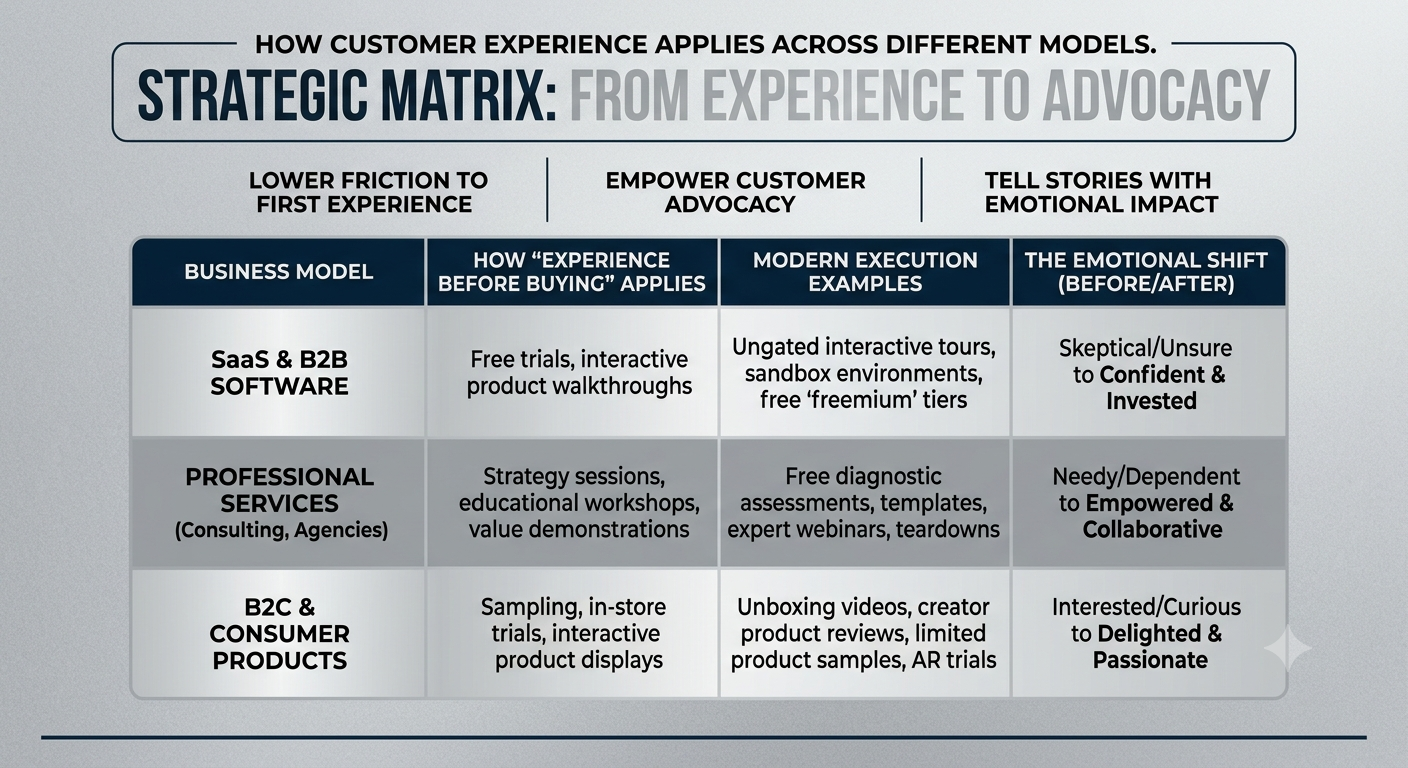
The “Coffee Principle” of customer experience isn’t limited to a specific market; it’s a universal psychological driver of affinity. To cultivate deep customer connection and bypass loyalty-eroding shortcuts, organizations across the B2B and B2C spectrum must adapt their strategies for “experience before buying” to match the nuances of their customer journeys. The matrix below contrasts how the core principle of low-friction experiential education can be modernized across traditional and digital sectors to turn cold prospects into advocates.
Before You Pitch the Solution, Reframe the Problem
Most customers don’t actively seek out new solutions because they have adapted to their current pain points. They accept inefficient processes, subpar quality, or lingering friction simply because they do not know a better reality exists.
Trying to pitch a product to a customer who doesn’t realize they have a problem—or who misdiagnoses the cause—is like trying to describe a fine espresso roast to someone who thinks all coffee is supposed to taste burnt.
Before you can convince prospects that your solution is superior, you must first educate them on why their current baseline is broken.
1. Uncover the Hidden Friction
Growth-stage marketing isn’t about shouting product features; it is about diagnosing hidden inefficiencies. Shift your content away from what your product does and toward exposing the cost of the status quo.
- The Traditional Approach: “Our platform automates workflow management in three clicks.”
- The Thought Leadership Approach: “Teams spend 40% of their productive energy managing work rather than doing it. Here is why task coordination is draining your velocity.”
2. Introduce a New Mental Model
To teach customers a new way to see the problem, you need to provide a new framework or vocabulary. When you give market problems a clear name, structure, and cause, you establish your brand as the definitive authority.
- Shift from Symptoms to Root Causes: Help your audience understand why the issue occurs rather than just acknowledging that it feels uncomfortable.
- Provide an Analytical Lens: Use industry benchmarks, diagnostic tools, or visual frameworks to show prospects where they fall on the maturity curve. Once a customer views their challenge through your framework, your solution becomes the logical, inevitable next step.
3. Lead with Category Education, Not Product Promotion
When you focus on educating the market, you transition from a vendor selling a tool to a trusted advisor guiding a transformation.
- Unguided Education: Publish actionable teardowns, industry insights, and educational guides without demanding immediate purchasing decisions.
- Value Before Friction: Give away your best strategic frameworks for free. When prospects learn how to evaluate their problem from your content, they will naturally trust your product to solve it.
By reframing the problem first, you create a market that actively seeks your perspective. Customer love isn’t built on a sales pitch—it’s built on the clarity you provide before a transaction ever takes place.
Audit your customer journey today: Where are you asking prospects to commit before they truly understand what you do?
Fix that single friction point, and watch customer affinity follow.