Best practices to make personas an effective tool to guide marketing activities by increasing customer understanding and empathy
Updated October 2026 with ICP and AI context. I wrote the original version of this post in 2015 (it first appeared on the OpenView Labs blog).
Personas are one of the most useful tools a marketer has. Done well, they guide almost every marketing activity by increasing customer understanding and empathy. But like any tool, they only deliver value when you get the fundamentals right.
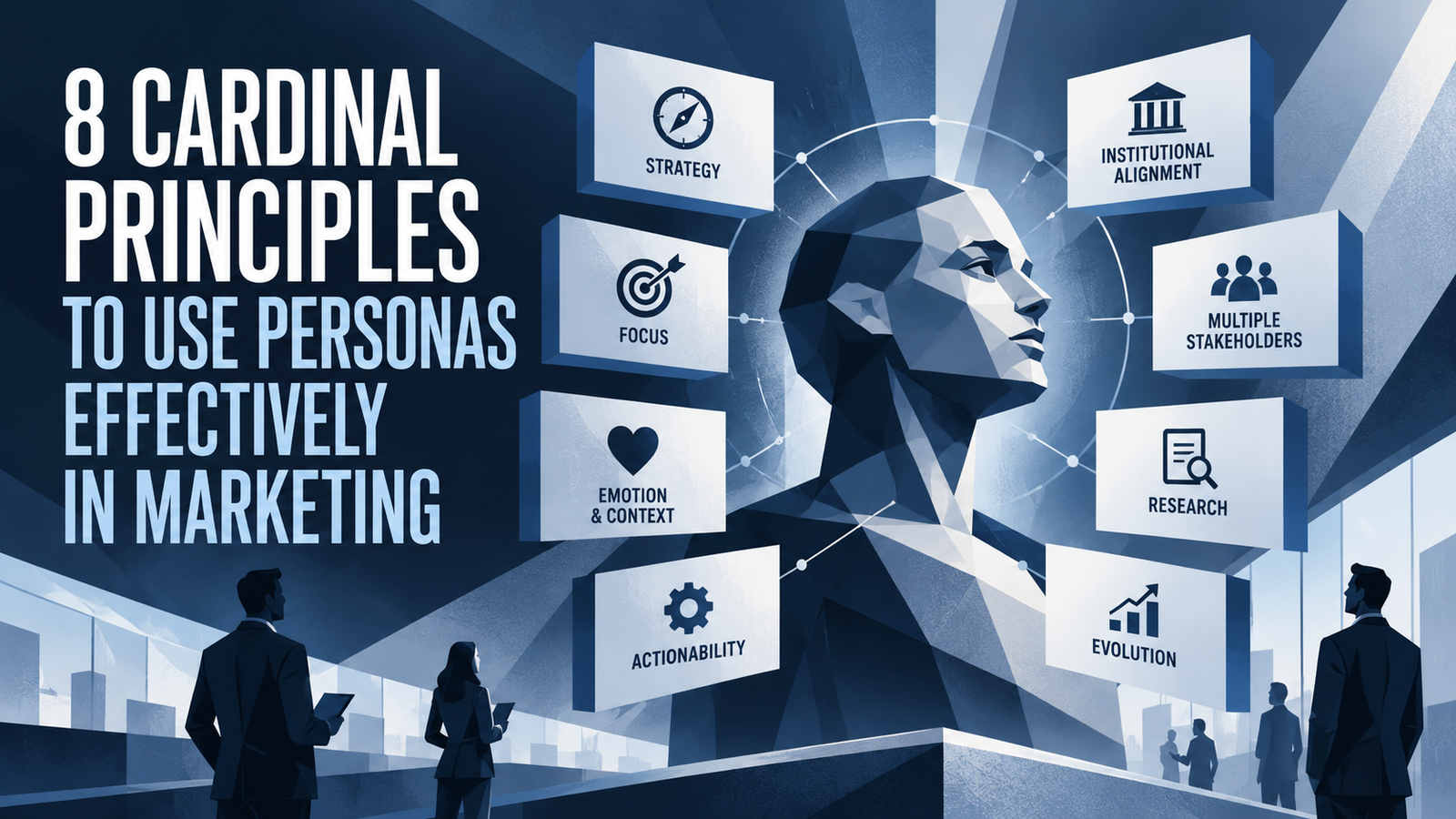
Many marketing teams have personas but very few of them use them well. For some marketers, the concept is somewhat ambiguous or is confused with segmentation or with an ICP. I have seen many persona documents created by product marketing that nobody reads. Here are eight principles that make personas a tool that improves everything marketing does. effectiveness and empathy of sales and customer-facing teams and product management
The concept of personas is not new. It was developed in 1998 by Alan Cooper, who also invented Visual Basic, as a tool to help with software interaction design. In 2002, Tony Zambito developed the concept of buyer personas to focus on buyer behavior and to guide customer strategies.
The concept of sales going up with a higher price is counter intuitive. It goes against the basic concept of price and demand taught in school. It defies the ‘law’ of demand. But it is real. Here are a few examples:
I wrote about British Airways doubling the price of the Concorde transatlantic tickets with no decrease in sales and a dramatic increase in profits in A Pricing Lesson from the Concorde it’s one of my most popular posts.
One developer doubled the price of his software from $9.99 to $19.99, hoping to at least hold onto revenue — instead, daily sales jumped tenfold with no change in traffic or marketing. Here is the story.
A founder selling vertical-market software was originally selling it at $3K. On a consultant´s advice he doubled the price with no impact to sales volume, effectively doubling revenue overnight.
Jacques Mattheij, an entrepreneur quadrupled subscription prices with no impact on unit sales, effectively finding a 4x sales increase with the same demand.
But the question we need to ask us is Why? Increasing price is fantastic for any business because the additional revenue goes straight to the bottom line. If you have been reading this blog, you know I am a fan of leading with value rather than discounts. Not that I ever advocate abusive pricing, which is simply a form of bad profits.
Back to the question – Why is it that customers are willing to buy more products at a higher price? The answer is straightforward: price communicates value. Maybe we can be bolder: price establishes value in the mind of customers.
Imagine I told you I just found a wonderful whiskey that sells for $5 a bottle. It is not credible. Your first thought may be that I don’t even know what is good whiskey (and you’d be right, but that’s another story). Conversely, when you are at a restaurant and you see a bottle of wine priced at $150. you immediately assume it is of very high quality.
You can charge more money for a product and see higher sales when your price and the value you deliver to customers is not aligned. In other words, when you are leaving money on the table.
How do you know if you are in this situation? The first and most common clue is when the price for your products or services is determined using a cost plus model. You have a target profit margin that gets added to your total costs and that becomes the price. This happens often when finance is in charge of pricing. The alternative is value-based pricing.
Building a value-based pricing model requires understanding your customers, what aspects of your product or service they value, and how they quantify that value. Often times, the value customers put in a product or service is determined by pricing anchors. Pricing anchors are prices in the mind of the customer that provide a range of costs for a product, a service or to solve a problem.
Pricing anchors are the reference points customers use to judge the relative price of your products. One effective way to set these anchors deliberately is Goldilocks Pricing, which consists in offering three pricing tiers: low, medium, high or good, better, best. I am sure you have seen this. With this tactic, customers judge each option relative to the others rather than in isolation.
The lowest tier makes the middle one feel affordable, the highest tier makes the middle one feel like a smart value rather than a splurge, and most buyers gravitate to the middle, which is often the exact option you wanted to sell all along. It’s the same anchoring effect at work in the Olay example below, just engineered on purpose rather than discovered by accident.
For now, imagine you need to replace the furnace in your home. You may think a furnace is going to cost you somewhere between $700 and $1200 (these are made up numbers) Whether those figures reflect the range of prices in the market is irrelevant. When you call the repairmen, you will judge the price based on the range established by these anchors.
As in the post about the pricing lesson of the Concorde, when your price and the expected price are misaligned, you can make a correction without an impact to demand. You can also do this with products that don’t have a strong price elasticity.
Understanding your customer segments, their anchors, their values and their price expectations is fundamental for value-based pricing.
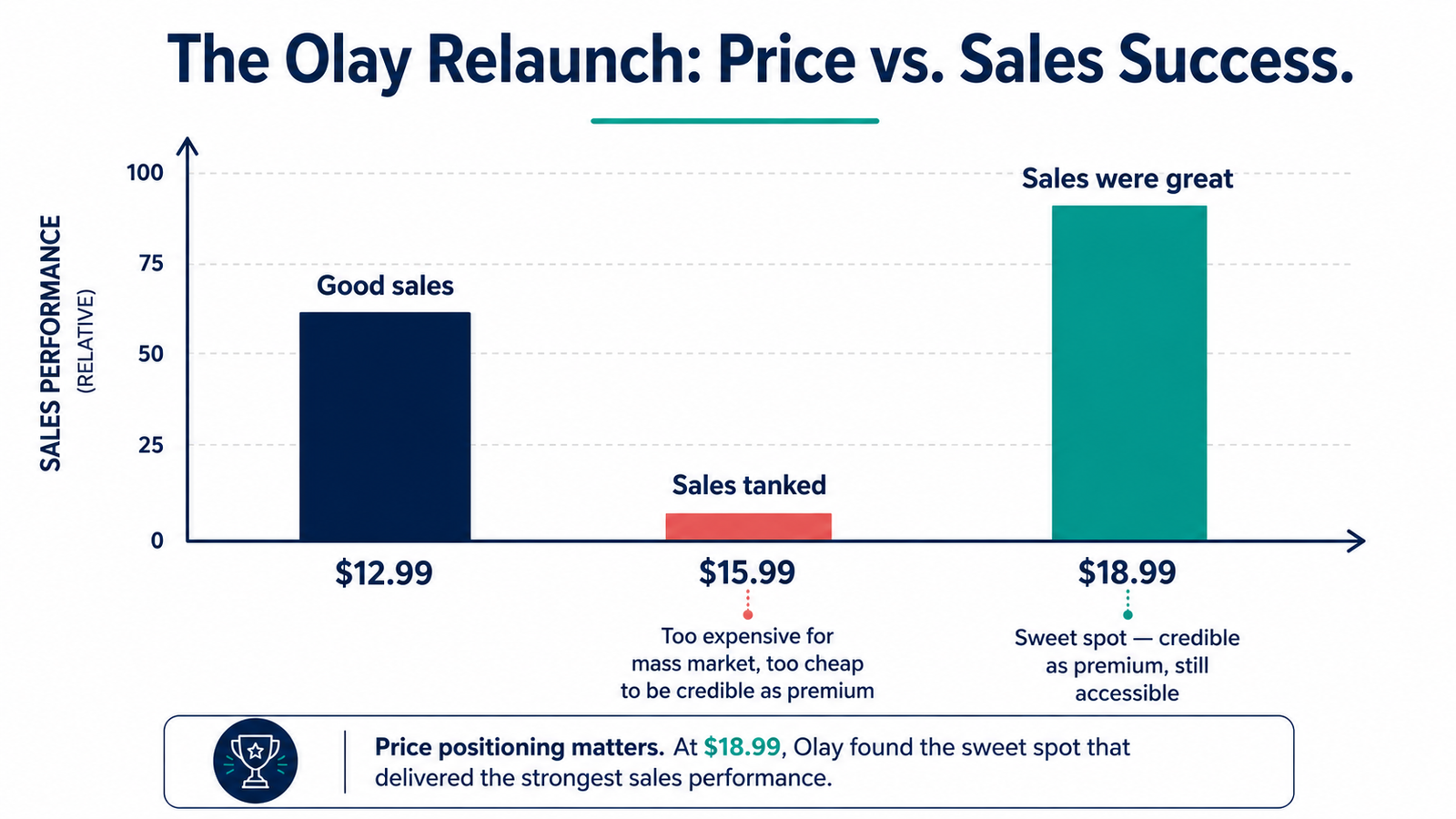
Let’s look at another example: As told in the book Playing to Win , when P&G was re-launching the Olay brand they did test on three prices:
At $12.99 the sales were good. It was affordable to the mass market.
At $15.99 sales tanked. Not expensive enough to be considered a premium cosmetic for the mass market, and to cheap to be a credible quality product for the prestige shopper
At $18.99 sales were great. A good value but not too cheap for premium shoppers, yet credible as premium and still affordable for Mass market
Launching at $18.99, Olay became a $2.4 billion dollar business for P&G with double digit growth and fantastic margins.
Pricing can make or break a business. I want to suggest another resolution for the new year (the first one is at the end of this post): understand the value model for your products and services, and use it to review your pricing strategy.
A Quick Glossary
Cost-plus pricing — Setting price by starting with your total cost to produce or deliver a product, then adding a target profit margin % on top. It’s simple to calculate, but it ignores what the product is actually worth to the customer, often resulting in leaving money on the table or an overpriced product that does not sell.
Value-based pricing — Setting price based on what customers believe your product or service is worth to them (the outcome), rather than what it costs you to make. It requires understanding your customer buyer segments deeply: what they value, how they quantify that value, and what they’d be willing to pay to get it.
Pricing anchors — The reference points customers carry in their minds for what something should cost. Anchors come from past experience, competitor prices, or often guesses. They shape how expensive or reasonable your price feels, regardless of your actual costs.
Goldilocks pricing — A tactic for setting anchors deliberately: offering three tiers (low, medium, high) so customers judge each option against the others instead of in isolation. The role of the lower price is to make the middle one feel affordable and to avoid discounting, providing an option for value-based buyers. The high price makes the middle one feel like smart value.
What drives business success? What is the one thing any business can do to increase its chances of surviving, thriving and growing?
We are always looking for a single thing that can give us success, the ephemeral silver bullet. It’s called the delusion of the single explanation (read more about this one and 8 other delusions here). In business, like in most cases, it is always a combination of factors that results in success. Strategy is probably at the top of the list. Other factors include execution, passion, culture, and some may even say luck (timing is usually a better description).
While I believe Strategy is the #1 factor, I was looking for a formula to create a strategy that could be applied broadly, to almost every business, of any size and industry, to increase its chances of success. I think I found it.
The Formula for Business Success
Long time ago, probably in the early 90s I saw a magazine ad for Lotus (I believe) which had a central message designed to make small business owners feel empowered. The headline read:
Give Customers What they Want, Make Money, Repeat
Since, it stuck in my mind because of its simplicity and power. I am sure most people read it and thought “d’uh! – of course!’. Some of the most powerful concepts in business and in life are hidden behind simple phrases like this one. Often we fail at the basics. Often we get distracted by complex stuff and ignore the basics. My college professor used to say “Marketing is common sense, which is the least common of all senses. Never underestimate the Power of Simplicity.
Why is this simple customer so powerful? Let’s break it apart:
Give Customers what They want – offers four insights:
Giving customers what they want is very different than giving customers what you sell. This means you must change your marketing and your entire organization around customer needs, not around your products.
Third, it means you need to decide who is your customer. It is very hard for a business to try to satisfy every kind of imaginable customer. You need to understand market segment,s buying behaviors and the type of customer you are better suited to serve. You can start with simple terms – do you want to serve a quality oriented customer, a price conscious customer or one that values full service?
Fourth, the ‘Give’ talks about the delivery model. I think about it as understanding how your customer wants to consume your product. What format, what pricing model, what packaging, what place, etc.
Make Money – This is about having a fundamental understanding of your business metric. Understanding your cost to acquire a customer, your fixed and variable costs, cash flow, profitability, margin, cost of capital – start with the basics. If you talk to owners of small businesses, you may be surprised how many have no clue about many of these metrics. The same can be said of product managers, marketers, and even large companies. Remember the dot com bust? The focus on making money also means your business must be market driven, not technology or buzzword driven. Another no-brainer that is often the cause of business failure.
Repeat – This is a key part. It talks about building the culture, the processes and the company around these basic principles. Listening to customers once is not good. Looking at your balance sheet every now and then is not good management. These need to be habits. Even more than that, they need to be made core of the way you think about your business – as an entrepreneur, as a CEO or as a product marketer in a large company.
I hope this formula can help you and your business, or at least re-think your overall strategy.
Are you pricing your products right or are you leaving money on the table?
The Concorde was one of the most innovative machines ever built. The first and only supersonic commercial aircraft capable of flying at twice the speed of sound is also one of the most beautiful machines ever built. The Concorde story provides an interesting lesson on pricing.
During the first 6 years of operation, the fantastic Concorde lost money for British Airways. Losses were so bad, in 1982 BA’s boss Sir John King gave the responsibilities of the newly created Concorde division to Captain Brian Walpole and gave him two years to turn Concorde losses into profits. If he failed, BA would terminate operations, shutting down Concorde for good.
The Concorde team decided to do some market research. They asked businessmen how much they thought a Concorde ticket cost. The answer, “Most of them didn’t know. It was their secretaries or travel companies doing the bookings. When they were asked to guess, because they were senior, very important people, they all guessed that the fare was higher,” explained Captain Jock Lowe, Concorde resource & Planning Manager.
This insight led to a new pricing strategy. Captain Lowe described “So very simply, we said, we’ll charge them what they think they are paying. And so, we put the fares up”. There was a discrepancy between what the company was charging, and the value customers saw in the product. Have you asked your customers how valuable your product or service is for them?
Concorde ticket prices were doubled to over $7,000, one way, in today’s prices. As a result, Concorde was repositioned to provide a super-elite class for bankers, the rich, and the famous. Concorde became the place to be seen.
Despite the high price, sales were very strong. For one particular day, half the tickets for its first fare-paying London-New York flight were sold out in the first two hours of booking, (source).
Concorde started making money. Lots of it. Estimates point to £50 million in profit per year. “We made about £500 million in net, clear profit.”. This is the estimated cumulative profit over 20 years of operation. Despite having only about five aircraft actively operating. That’s significant, even for a company the size of BA.
Many companies build their pricing strategies based on cost + margin. Often, there is a predetermined margin based on an overall pricing strategy or on a corporate profitability target. The story of Concorde shows us the power of market-based pricing and the importance of understanding the true value of the products and services your company offers.
The lesson is not simply that British Airways could charge more for Concorde. It is that price is part of positioning. Customers already perceived Concorde as an extraordinary product—a faster, more exclusive and fundamentally different way to travel. The original price simply failed to reflect that perceived value. By raising the price, British Airways brought the economics of the product in line with the position it already occupied in the customer’s mind.
The result was a powerful virtuous cycle: higher perceived value supported a higher price; the higher price reinforced Concorde’s premium positioning; and that positioning helped produce sustained profitability.
Sometimes the biggest pricing mistake is not charging too much. It is charging less than your customers already believe your product is worth.
Price elasticity measures how much demand changes when price changes. For many products, you expect raising the price would push enough customers away so that total revenue suffers. Concorde was different. Its customers were relatively price insensitive, and the reason comes down to what they were actually buying.
They were not purchasing transportation from London to New York; they were buying time, convenience, exclusivity, and status — an experience that could not easily be replicated elsewhere. For a business executive whose time was extremely valuable, saving several hours could be worth far more than the incremental cost of the ticket. The price didn’t need to make sense against a coach fare, because a coach fare wasn’t buying the same thing.
That is also why Concorde is such a good example of value-based pricing. Cost-based pricing starts with what a product costs to provide and adds a margin. Competitor-based pricing asks what alternatives charge. Value-based pricing starts somewhere else entirely: what does this actually buy the customer, and what is that worth to them? Comparing Concorde’s price to a first-class airline ticket understated its value, because Concorde wasn’t competing on the same axis. First class buys comfort. Concorde bought time, arriving before you left, and the ability to say you’d flown it. Once BA understood what customers were really buying, the old cost-plus-margin math became irrelevant.
British Airways eventually priced to match that value, and in doing so demonstrated an important principle: the right price is not necessarily the price that maximizes the number of customers. It is the price that captures a fair share of the value you create. When customers perceive your offering as meaningfully differentiated, and alternatives are poor substitutes for what they’re actually buying, demand can be far less price-sensitive than conventional pricing logic would suggest.
Influencer strategy seems to be one of the pillars of social media marketing. There are many questions about how to identify, reward and empower influencers. So let’s say you have identified the top 1000 influencers in your space. And then what? It reminds me of the U2 song that goes “We thought we had the answers….it was the questions we had wrong”.
What is an influencer? Often an influencer is measured in terms of the number of friends of twitter followers. Fans and followers are a measure of reach or popularity, not influence, but it is related.
A definition of Influencer Marketing
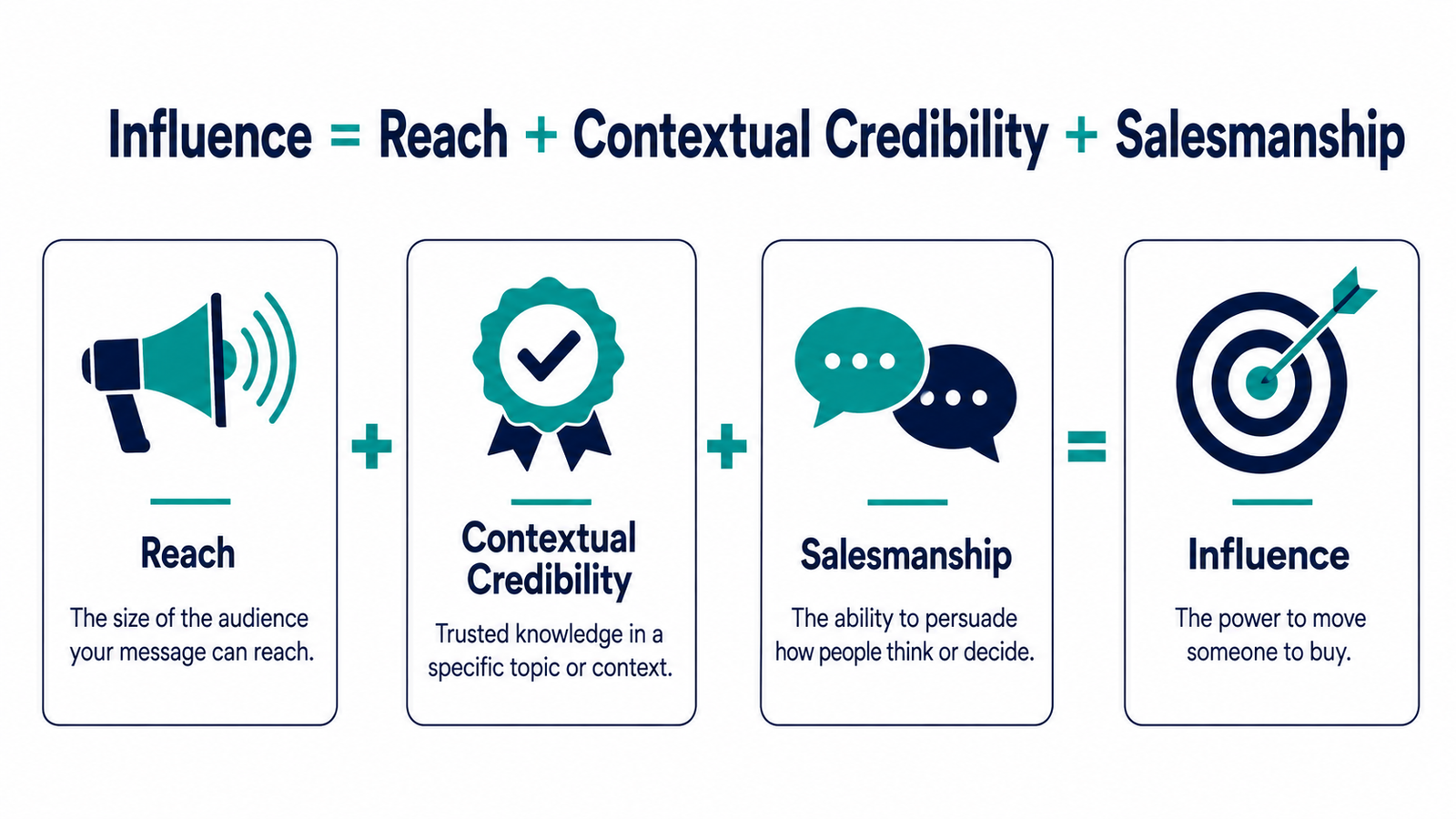
Influencer marketing is the discipline of identifying and building relationships with the people who have a disproportionate ability to shape how others think and buy — not because they’re popular, but because they combine three key factors: reach, contextual credibility, and salesmanship.
Unlike traditional advertising, which tries to persuade the masses impersonally, influencer marketing works through personal relationships with a smaller group of people whose opinions others already trust. For a deeper look at influencer marketing and how to identify real influencers, see PR in the Digital Age: Welcome to Influencer Marketing.
Getting Influencers Wrong
“influencer” is not a label for people in general. It’s not a species. There is no influencer gene that I know of. People have different levels of influence in different topics, it is contextual. For example, I am an influencer when it comes to photography, but a normal guy when it comes to sports and very much not an influencer in terms of cosmetics.
How do I know I am an influencer in the context of photography? Because many of my friends and colleagues have purchased digital cameras based on my recommendations. Many people I don’t even know have done the same – people I have never met, never exchanged emails with, people that don’t follow me. How? I have influenced them because they have read my opinions online and relied on my knowledge to make a buying decision. They trust me because I am a regular consumer, like them, and I have lots of passion and experience about photography.
All consumers, myself included, avoid or ignore advertising. When exposed to advertising most people don’t believe what it says. Grab a photography magazine and look at the ads: all of them say their cameras are awesome. People don’t trust marketers. But they trust people like them. They will be influenced by other customers who have experience with the products they are considering. People who like talking about their experiences, share their knowledge and opinions are advocates.
The most common influencer strategy is to find the top influencers and reward them for their advocacy. Depending on the nature of your business, this could be a good strategy – or not. Often these customers, identified as influencers, are already predisposed to buy. Surely they deserve some recognition and special treatment, and you must empower them to be advocates. However, you cannot influence the influencers easily. They are experts; they know their stuff and probably know more about your products than most people in your company.
Here is an interesting idea: instead of finding influencers why don’t you create influencers. Or better said, you can turn a customer who is very satisfied into an advocate by empowering him or her to influence others.
Imagine you are in the banking business. Now imagine you have a customer that is really happy with your checking account, the service from your credit card and your credit services. This customer is willing to tell other people about how great your bank is.
Imagine how powerful it would be to put this customer in a center of a room full of customers who are interested in checking accounts. Imagine if he had the ability to share his experience with your bank, in his own words, to all these potential customers. That would be really powerful, right? This room full of prospects is your website, they are visiting the “checking accounts” page, or the “credit cards” page. They are interested in your services, why else would they be there?
That’s the power of empowering customers to share opinions and experiences (what we at Bazaarvoice call reviews and stories). They allow customers to become influencers, enabling “normal” people to become advocates for your brand, in a very authentic and very convincing way. By enabling this conversation on your site, on your product or service pages, you are creating an influencer strategy that results in more sales. It’s a proven system.
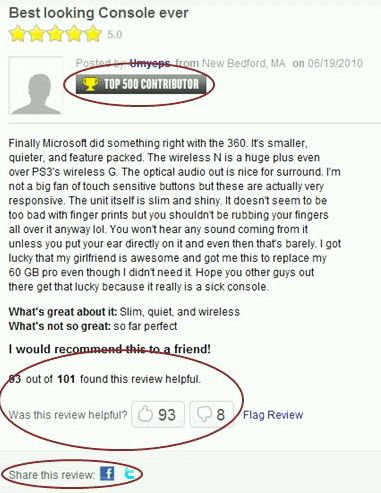
A great thing about a customer influencer strategy is that you don’t even have to find these influencers. You don’t have to identify them or know their name or pamper them with special treatment. However, you can still recognize them. You can give the more influential customers a badge that recognizes their contributions or their expertise.
And this recognition can be helpful for customers. It helps them find among dozens of other customer opinions and give content to these opinions. In fact, customers can vote on the helpfulness of other customers contribution and sort them based on their helpfulness. The helpfulness votes help identify the most influential customers, those that write reviews that help customers make decisions, which earn them badges in turn.
All these pieces work together to promote advocacy, identify and recognize influencers in a way that helps customers buy. This system of advocacy and influence is customer centric, customer-driven and helps customers. Except for the sales, which benefit you and your business.
How to turn customers into influencers:
Give reach to people who don’t have their own audience. Most satisfied customers have no blog, no following, and no platform. You can provide the traffic and exposure to their influence. Give them a voice. Empower them to become advocates.
Let contextual credibility surface on its own. Don’t assign expertise, instead let it emerge. A customer who writes detailed, specific articles or reviews about a particular use case is demonstrating contextual credibility. Find these authors and turn them into influencers.
Verify the source to protect credibility. Tag reviews as “verified buyer” or “verified customer”. Your credibility will collapse if readers suspect the opinion isn’t authentic or paid for. Be transparent.
Recognize salesmanship without paying for it. Some customers are simply more persuasive writers than others. Use badges or reputation levels to reward the contributions that demonstrably help other customers decide, not the ones that are just longest or most frequent. Microsoft created the Microsoft created the MVP Program to recognize independent technology experts who share deep technical knowledge with local and online communities. Influencers are often driven by status: recognition is more important than rewards
Let readers vote credibility and salesmanship into rank. Helpfulness votes let your community of users itself decide whose contributions they find most useful. This approach is more reliable than any internal guess at who your top influencers are.
Track sales impact, not follower count. The only real measure of influence is whether a review or contribution is associated with a buying decision. That’s the ultimate KPI to focus on, not likes or shares.
Don´t confuse correlation and causation. Your most influential customers are already predisposed to buy from you
Conclusion
The lesson here isn’t that influencers don’t matter. It’s that you don’t need to chase them, bribe them, or artificially create them. Every business with a good product already has customers who are satisfied enough to become advocates; the job of an influencer strategy is to give them the platform, the recognition, and the reason to speak up.
This is a key question every large company has two answer, especially when different groups want to contact customers with messages about training, events, new products, promotions, surveys, etc.
When I was responsible for the Developer audience at Microsoft, I tried to create communication channels that would carry all these messages: the MSDN site, MSDN Flash newsletter, sub-audience specific sites, blogs, etc. But there is always a need for more formal communications that would go via email. The audience owners had to approve any communications going out or any new channels to avoid spamming customers and having a massive number of newsletters. At some point many companies have a discussion about how often they should be sending emails to their customers.
I have seen companies who have a rule about not sending broad emails to the customer base more than once a week. Some companies think it should be every two weeks or every month. Some companies have no rules and every one is free to spam everyone who has ever opted-in. Defining a fixed cadence to contact customers misses the point altogether.
The key for customer communications, either via email, RSS, twitter, fax, etc., is relevance.
Yetserday at the Omniture Summit, Forrester Analyst Emily Riley was sharing how after two years she still enjoys the weekly email newsletter sent by BabyCenter and read it thoroughly because it is relevant – it has information that is useful for her becaus eit has been targeted based on her baby’s age.
But when I get emails from a similar site (to remain unnamed) those emails are spam. My two daughters are 7 and 9, I don’t care about pretty much baby anything, the communcation is not relevant. Now, if the company had a Pre-Teen Parent newsletter, I might be interested. After all, they have my information, my permission (I haven’t opted out, my bad) and the exact age of my two daughters. Whay wouldn’t these companies continue to provide relevant information to parents as they grow? from diapers to cell phones and college.
If I am a developer heads down on a project or trying to understand a technology, I will dig every piece of relevant, useful information you send my way. If the information is useful, I will be grateful for that information even if I get an email every single day, scoring points for your brand. But if you send me information that is not targeted, relevant and useful, then every email is spam even if I only get one every leap year.
Content is King, Relevance is the Crown that makes Content the King.