
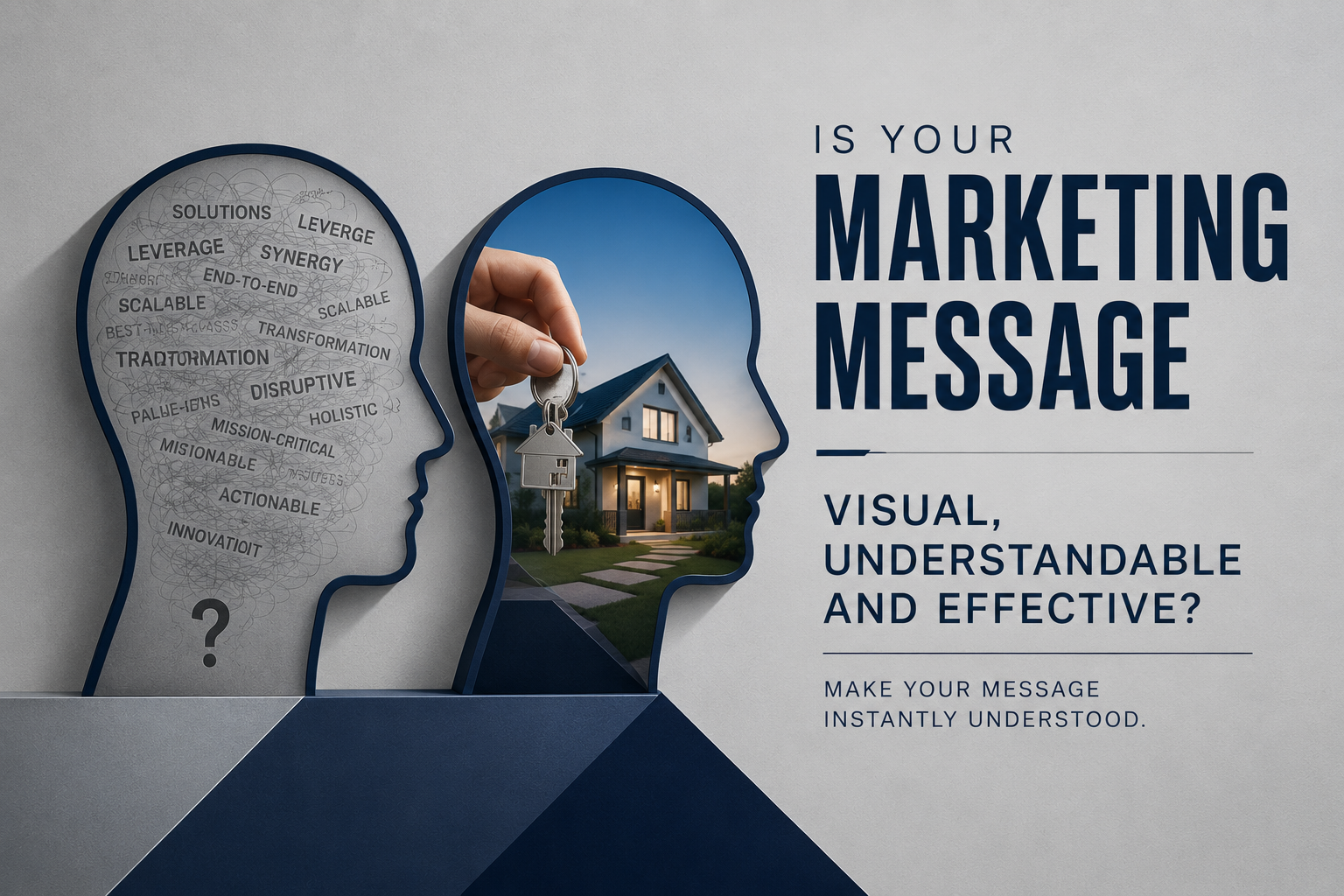
Patton Oswalt, the famous comedian, has a skit where he made fun of movie titles he thought were lame like “Something’s Gotta Give” or “Audacity” because they don’t tell you what the movie is about.
He then talked about the move Texas Chainsaw Massacre, and he explained how as you hear each word, an image is forming in your mind. “Texas….Chainsaw…Massacre…. sounds like a great movie! I want to go! You can see the movie in your head, for free! “
How does that compare to the messages that we marketers sometimes create? let’s look at some examples:
Take a look at this copy from a Toyota print ad ¨A quantum leap in interior refinement, and the uncompromising new shape of things to come from Toyota¨. A lot of words, very little meaning. I can’t see a movie, or even a picture in my head.
Or this email I recently received from Dell – the headlined read “Get end-to-end solutions that go beyond making ends meet“. Can you guess what they are talking about? The message showed a banner that read: ¨Enjoy free shipping and easy returns on Dell.com¨. Then a headline promised “Turn big ideas into cash big flow”. Now I was seriously confused. What are they talking about? it went on: ¨One Place. Countless ways to better manage your business’ finances“. Do you have a clue what is Dell trying to tell me in this email?
The rest of the email showed a laptop next to tax and accounting software. It was not even a bundle. Maybe I am not as intelligent as Dell’s target market, so I read everything again, very carefully – and yet could not figure it out. Wouldn’t it be better to have a subject that said, ‘Dell can help your business with business laptops and financial software” or even more specific “Here is a good deal on a Dell laptop, tax and accounting software”
Of course, I am trying to pick at Dell or Toyota. I know for a fact there are very competent marketers at Dell and Toyota, these are simply good real-world examples. Most of us marketers fall under the trap of writing ‘solution-oriented copy’ full of buzzwords and platitudes. In fact, let me share an example of the content we had on our website at Rackspace:
“…provides fanatical support during the IT strategic planning process and creates true end-to-end IT transformation solutions for Rackspace customers.….to complete their strategic IT vision and make game changing, innovative decisions regarding their cloud computing strategy.”
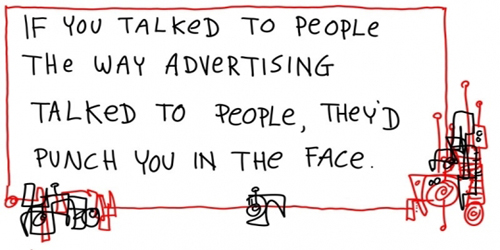
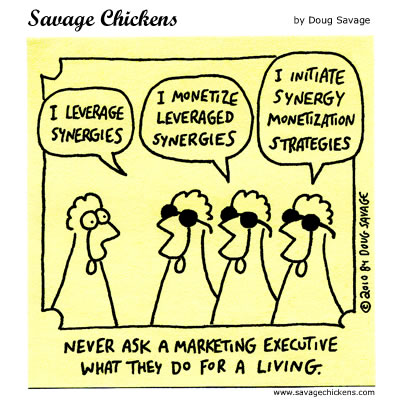
I am not the first to complain about how buzzwords let customers down. Many cartoons make fun of Marketers. Maybe it is this kind of jargon that has resulted in marketers being considered just above used car salesmen. We rightfully deserve this reputation.
But it does not have to be this way. Here are some rules to write copy that is clear, visual, and understandable:
- Speak in conversational English, nor corporate-speak. Imagine two your customers talking among themselves about this topic. Would they use the same words, the same language?
- Avoid a 2-dollar-word when a 10-cent word will do. Overly dense, formal, or internal-focused language distances the reader.
- Lead with the bottom line. Don´t bure the lede. Don´t write a lengthy intro or use click-bait headlines. Start with the main message and make it easy for a reader to quickly find out what you are talking about.
- Assume the reader is looking for a reason to stop reading. Our audience today are skimmers by default: they scan for immediate relevance and will discard a message the second it feels tedious or self-serving.
- Use verbs that describe visual mechanics, movement, or direction. Replace “The new strategy is effective for our growth. ¨wth : “The new strategy accelerates our growth.”
- Avoid wordy abstract nouns. Replace ¨We have the necessity to make a decision to provide assistance to bring about an improvement¨ with ¨We need to decide to help improve¨
- Replace abstract concepts with physical things, numbers, concrete concepts. Be specific. ¨saved a lot of money. ¨ vs ¨Saved $3,000¨. From ¨We sell apparel and footwear” to “we sell running shoes, and hoodies”. From “We secure your personal assets” to “We lock down your checking account and stock portfolio”.
To help us write more clearly, let me recommend of my favorite books: Your Attention Please. Andy Craig, who facilitates workshops based on Made to Stick, a must-read for every marketer, has built a business out of helping marketers communicate clearly. I recommend you read this interview on Inc. Magazine.
Next time you are writing a headline, marketing copy or even an email, remember Patton Oswalt and start by thinking about what movie do you want your customers to see in their head when they get your message, then write a good ‘movie title’ that will effectively tell that message.
Patton Oswalt didn’t need a tagline to sell you on Texas Chainsaw Massacre — three words did the work, because each one built a picture. That’s the whole job of marketing copy, and it’s a job most of us quietly avoid because concrete language feels risky; vague language feels safe. But safe language is invisible, and invisible messages don’t sell anything. So, before you publish, run the Movie Test. Give your customers a movie, not a memo.
when the consumer mentality attaches high price to high value or prestige,a higher price can result in more sales.