Hint: it is probably not because of the quality of the coffee.
This post was inspired by a question on Quora that asked if Starbucks coffee was really superior and how the company made it addictive. What I found very interesting is that the quality of the coffee is not really that important. There are other psychological and emotional reasons why Starbucks is so successful worldwide.
After all, contrary to what most people believe, we all make purchase decisions emotionally and then (sometimes) justify them rationally. This is true in B2B and B2C, it is true for $1 or for $1 Billion purchases. And it is critical for all marketers to understand.
The concept of sales going up with a higher price is counter intuitive. It goes against the basic concept of price and demand taught in school. It defies the ‘law’ of demand. But it is real. Here are a few examples:
I wrote about British Airways doubling the price of the Concorde transatlantic tickets with no decrease in sales and a dramatic increase in profits in A Pricing Lesson from the Concorde it’s one of my most popular posts.
One developer doubled the price of his software from $9.99 to $19.99, hoping to at least hold onto revenue — instead, daily sales jumped tenfold with no change in traffic or marketing. Here is the story.
A founder selling vertical-market software was originally selling it at $3K. On a consultant´s advice he doubled the price with no impact to sales volume, effectively doubling revenue overnight.
Jacques Mattheij, an entrepreneur quadrupled subscription prices with no impact on unit sales, effectively finding a 4x sales increase with the same demand.
But the question we need to ask us is Why? Increasing price is fantastic for any business because the additional revenue goes straight to the bottom line. If you have been reading this blog, you know I am a fan of leading with value rather than discounts. Not that I ever advocate abusive pricing, which is simply a form of bad profits.
Back to the question – Why is it that customers are willing to buy more products at a higher price? The answer is straightforward: price communicates value. Maybe we can be bolder: price establishes value in the mind of customers.
Imagine I told you I just found a wonderful whiskey that sells for $5 a bottle. It is not credible. Your first thought may be that I don’t even know what is good whiskey (and you’d be right, but that’s another story). Conversely, when you are at a restaurant and you see a bottle of wine priced at $150. you immediately assume it is of very high quality.
You can charge more money for a product and see higher sales when your price and the value you deliver to customers is not aligned. In other words, when you are leaving money on the table.
How do you know if you are in this situation? The first and most common clue is when the price for your products or services is determined using a cost plus model. You have a target profit margin that gets added to your total costs and that becomes the price. This happens often when finance is in charge of pricing. The alternative is value-based pricing.
Building a value-based pricing model requires understanding your customers, what aspects of your product or service they value, and how they quantify that value. Often times, the value customers put in a product or service is determined by pricing anchors. Pricing anchors are prices in the mind of the customer that provide a range of costs for a product, a service or to solve a problem.
Pricing anchors are the reference points customers use to judge the relative price of your products. One effective way to set these anchors deliberately is Goldilocks Pricing, which consists in offering three pricing tiers: low, medium, high or good, better, best. I am sure you have seen this. With this tactic, customers judge each option relative to the others rather than in isolation.
The lowest tier makes the middle one feel affordable, the highest tier makes the middle one feel like a smart value rather than a splurge, and most buyers gravitate to the middle, which is often the exact option you wanted to sell all along. It’s the same anchoring effect at work in the Olay example below, just engineered on purpose rather than discovered by accident.
For now, imagine you need to replace the furnace in your home. You may think a furnace is going to cost you somewhere between $700 and $1200 (these are made up numbers) Whether those figures reflect the range of prices in the market is irrelevant. When you call the repairmen, you will judge the price based on the range established by these anchors.
As in the post about the pricing lesson of the Concorde, when your price and the expected price are misaligned, you can make a correction without an impact to demand. You can also do this with products that don’t have a strong price elasticity.
Understanding your customer segments, their anchors, their values and their price expectations is fundamental for value-based pricing.
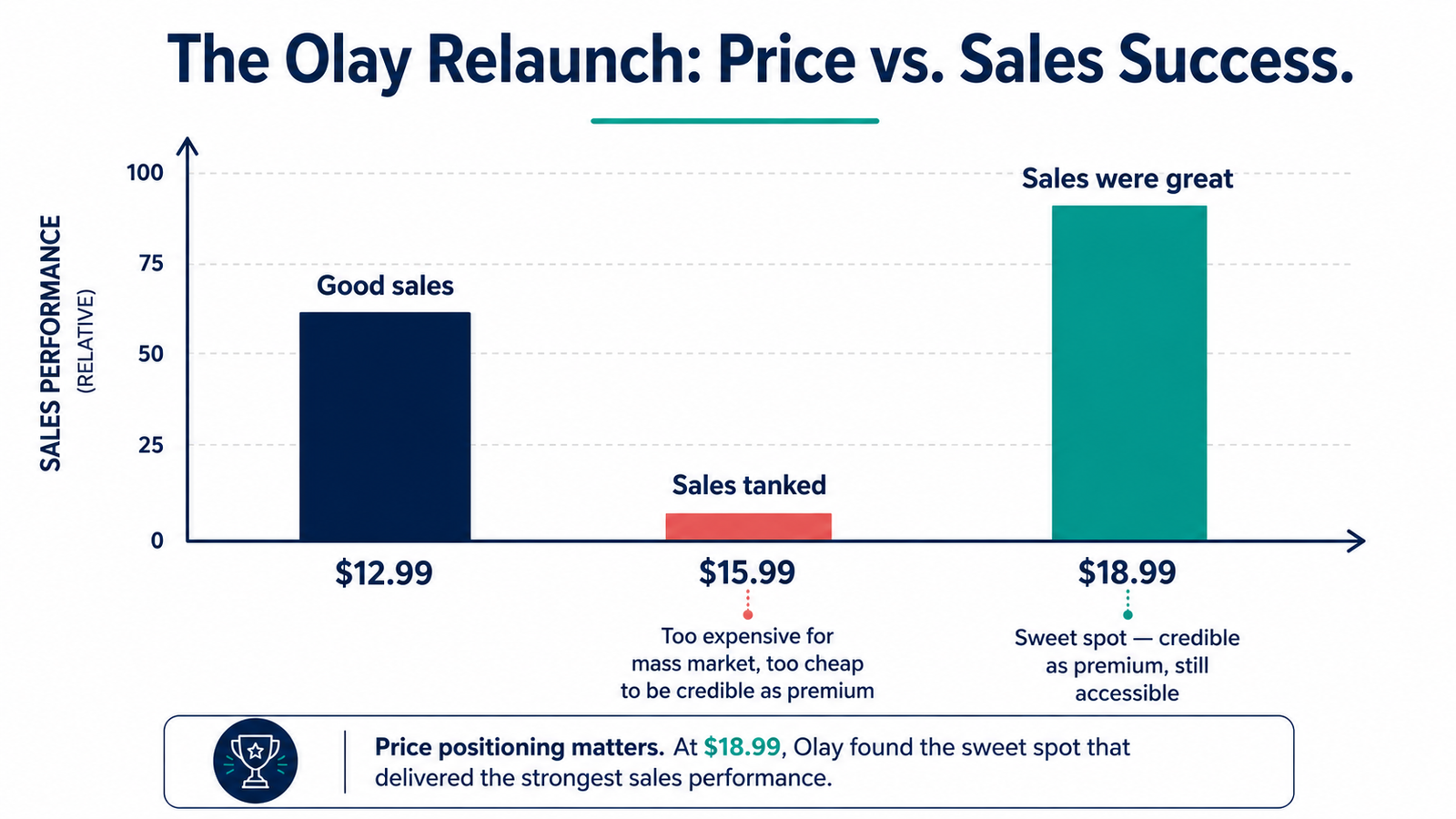
Let’s look at another example: As told in the book Playing to Win , when P&G was re-launching the Olay brand they did test on three prices:
At $12.99 the sales were good. It was affordable to the mass market.
At $15.99 sales tanked. Not expensive enough to be considered a premium cosmetic for the mass market, and to cheap to be a credible quality product for the prestige shopper
At $18.99 sales were great. A good value but not too cheap for premium shoppers, yet credible as premium and still affordable for Mass market
Launching at $18.99, Olay became a $2.4 billion dollar business for P&G with double digit growth and fantastic margins.
Pricing can make or break a business. I want to suggest another resolution for the new year (the first one is at the end of this post): understand the value model for your products and services, and use it to review your pricing strategy.
A Quick Glossary
Cost-plus pricing — Setting price by starting with your total cost to produce or deliver a product, then adding a target profit margin % on top. It’s simple to calculate, but it ignores what the product is actually worth to the customer, often resulting in leaving money on the table or an overpriced product that does not sell.
Value-based pricing — Setting price based on what customers believe your product or service is worth to them (the outcome), rather than what it costs you to make. It requires understanding your customer buyer segments deeply: what they value, how they quantify that value, and what they’d be willing to pay to get it.
Pricing anchors — The reference points customers carry in their minds for what something should cost. Anchors come from past experience, competitor prices, or often guesses. They shape how expensive or reasonable your price feels, regardless of your actual costs.
Goldilocks pricing — A tactic for setting anchors deliberately: offering three tiers (low, medium, high) so customers judge each option against the others instead of in isolation. The role of the lower price is to make the middle one feel affordable and to avoid discounting, providing an option for value-based buyers. The high price makes the middle one feel like smart value.
What drives business success? What is the one thing any business can do to increase its chances of surviving, thriving and growing?
We are always looking for a single thing that can give us success, the ephemeral silver bullet. It’s called the delusion of the single explanation (read more about this one and 8 other delusions here). In business, like in most cases, it is always a combination of factors that results in success. Strategy is probably at the top of the list. Other factors include execution, passion, culture, and some may even say luck (timing is usually a better description).
While I believe Strategy is the #1 factor, I was looking for a formula to create a strategy that could be applied broadly, to almost every business, of any size and industry, to increase its chances of success. I think I found it.
The Formula for Business Success
Long time ago, probably in the early 90s I saw a magazine ad for Lotus (I believe) which had a central message designed to make small business owners feel empowered. The headline read:
Give Customers What they Want, Make Money, Repeat
Since, it stuck in my mind because of its simplicity and power. I am sure most people read it and thought “d’uh! – of course!’. Some of the most powerful concepts in business and in life are hidden behind simple phrases like this one. Often we fail at the basics. Often we get distracted by complex stuff and ignore the basics. My college professor used to say “Marketing is common sense, which is the least common of all senses. Never underestimate the Power of Simplicity.
Why is this simple customer so powerful? Let’s break it apart:
Give Customers what They want – offers four insights:
Giving customers what they want is very different than giving customers what you sell. This means you must change your marketing and your entire organization around customer needs, not around your products.
Third, it means you need to decide who is your customer. It is very hard for a business to try to satisfy every kind of imaginable customer. You need to understand market segment,s buying behaviors and the type of customer you are better suited to serve. You can start with simple terms – do you want to serve a quality oriented customer, a price conscious customer or one that values full service?
Fourth, the ‘Give’ talks about the delivery model. I think about it as understanding how your customer wants to consume your product. What format, what pricing model, what packaging, what place, etc.
Make Money – This is about having a fundamental understanding of your business metric. Understanding your cost to acquire a customer, your fixed and variable costs, cash flow, profitability, margin, cost of capital – start with the basics. If you talk to owners of small businesses, you may be surprised how many have no clue about many of these metrics. The same can be said of product managers, marketers, and even large companies. Remember the dot com bust? The focus on making money also means your business must be market driven, not technology or buzzword driven. Another no-brainer that is often the cause of business failure.
Repeat – This is a key part. It talks about building the culture, the processes and the company around these basic principles. Listening to customers once is not good. Looking at your balance sheet every now and then is not good management. These need to be habits. Even more than that, they need to be made core of the way you think about your business – as an entrepreneur, as a CEO or as a product marketer in a large company.
I hope this formula can help you and your business, or at least re-think your overall strategy.
From the teenager girl buying her next cell phone at a mall to the CIO making a multi-million decision that will impact his company’s information platform, people make emotional decisions and justify them rationally.
Why have people grabbed over 50 million Motorola’s RAZR phones? style. Not because of its performance as a phone, ability to get multimedia content, or ease of use. It is cooland it’s the gadget to have. Even Samsung this week launched a copy cat.
When we talk about mobile platforms for enterprises, people talk about “security” as a key factor in making purchase decisions. However, most of these people do not have a thorough understanding of what should be their security requirements and how each platform meets those requirements. Surely there are many people who do, my point is that many decisions are made based on perceptions and pre-conceived notions.
Most people who like technology feel very passionate and personal about the technology decisions they make. When I was in high school I was part of the Commodore 64 clan, and we tried many times to convince the people on the dark side (Apple II users) about the superiority of the Commodore machines.
In retrospect, I remember feeling a bit envious of some of the Apple’sfeatures, but my choice went far beyond a simple purchase. I still have a strong emotional attachment to Commodore that influenced my decisions and the recommendations I made. Quite frankly, I cannot say all the advice I gave to friends and customers (I used to own a computer reseller company) was completely unbiased and facts-based. but I am not the exception.
A CIO who is anti-Microsoft, for example, would be naturally predisposed to support Linux and see that platform as more secure and more cost effective. His feelings will be reassured every time he would read an article about a Microsoft patch, subconsciously ignoring the article on the other side of the page talking about Linux’s vulnerabilities. The same happens for a CIO who has been using Microsoft’s (or Sun’s or Oracle’s) platform successfully. It’s just human nature.
So how are you as a marketer optimizing your customer engagements for emotional impact?