
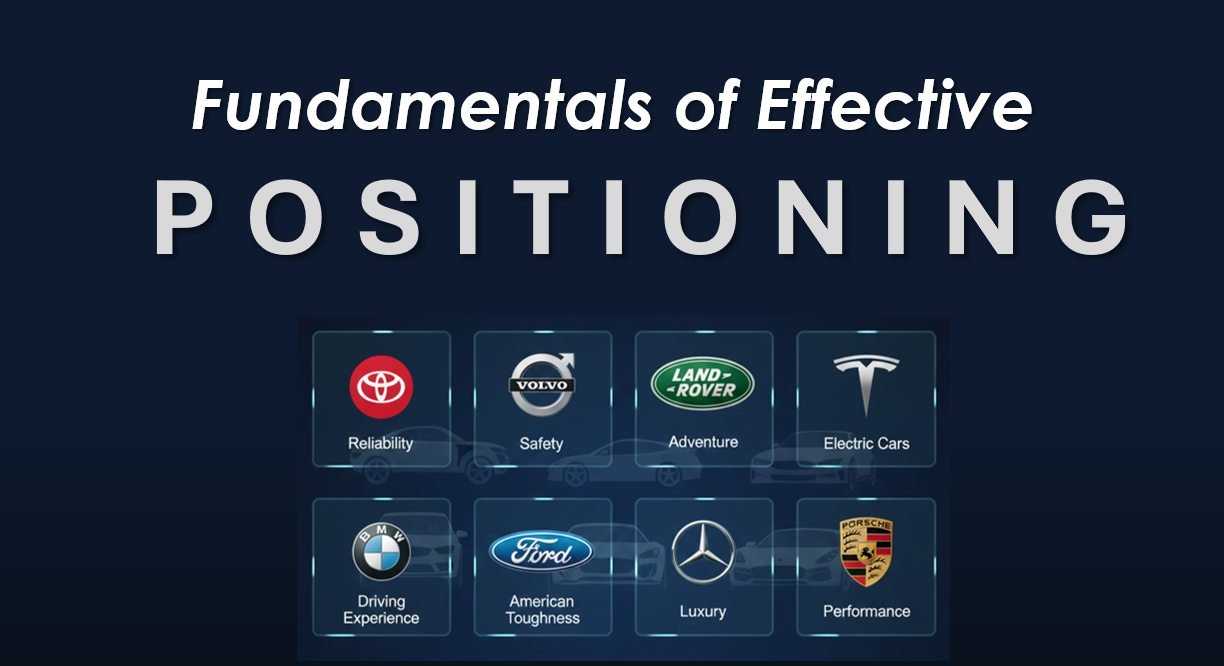
Positioning is one of the most powerful — and most misused — tools in marketing. It’s not a tagline, a clever campaign, or the latest buzzword tossed around in a boardroom. Positioning is the strategic lens through which customers understand who you are, what you stand for, and why you matter.
When done well, it becomes the foundation of every message, product decision, and go-to-market motion. When done poorly, it creates confusion, weak differentiation, and a brand that feels interchangeable. Despite its importance, positioning is often treated as a quick creative exercise rather than a rigorous strategic discipline — which is why so many companies get it wrong.
In this post, I break down the eight rules that define effective positioning — the principles that separate brands that own a place in the customer’s mind from those that simply blend into the noise. Whether you’re refining an established brand or shaping a new one, these rules will give you a practical framework to sharpen your strategy and communicate with clarity and conviction.
How I Discovered Positioning (And Why It Still Matters Today)
My father constantly exposed us to new ideas and experiences. He would show up with a new book, or with a musical instrument, or would show us how to make drawings using Chinese ink.
I was in middle school back in the early 80s when he brought a book: Positioning – the battle for your mind by Al Ries and Jack Trout. It´s a classic. I found the book fascinating. The concept of positioning mixed strategy, psychology, and marketing. I was hooked. More importantly, I found my calling. I would become a marketer.
Fast forward to 2025, when Laura Ries, Al´s daughter, continues her legacy with her book The Strategic Enemy. A good book that reinforces some of the key aspects of positioning with some new stories that illustrate the key points. The book sparked the idea of writing a blog post about my perspective on positioning.
What Positioning Actually Is — And Why Most People Misunderstand It
Marketers often confuse positioning with messaging or branding, but it is something deeper. Positioning is not something you do right before a product launch or when writing a press release. It´s way more strategic than that.
Positioning is the act of establishing a single, clear idea in the customer’s mind relative to alternatives.
This definition includes three very important elements:
1. A single idea — Great positioning demands discipline: you must choose one idea to stand for, even if it means letting go of other strengths or messages you’d love to highlight. The sharper and more singular the idea, the easier it is for customers to remember and repeat — and the harder it is for competitors to copy.
2. In the customer’s mind —Positioning isn’t what you say you are; it’s what customers actually come to believe over time. You earn that place in their mind through consistent proof, repeated experience, and a message that resonates with their priorities—not your internal desires or aspirations.
3. Relative to competition —Customers don’t evaluate your brand in a vacuum; they compare you to alternatives, whether direct competitors or substitutes. Effective positioning makes that comparison obvious and favorable by carving out a space where you are meaningfully different, not just descriptively unique.
Because positioning is always relative to competition, you must define the category you play in — the frame that determines which competitors you’re being compared against and what “winning” in that space actually means.
Laura Ries´ book offers an excellent example: Everready owned the category of batteries for flashlights. When the Mallory battery company launched a new set of alkaline batteries driven by the need from Kodak´s to power its energy hungry Instamatic camera with built-in flash. In 1965 the Duracell brand name is introduced and is a home run.
EverReady tried to compete with Duracell in the alkaline battery but their brand meant regular batteries in the mind of consumers. In 1980 they changed the name of its alkaline battery line from “Eveready Alkaline Power Cell” to “Energizer”. It was easier to launch a new brand in a new category than to change the current brand positioning in the customer´s minds.
Levi´s has a similar story. The company was launching a line of khakis. They knew Levi´s was positioned as the original denim jeans brand, so Levi´s Khakis would not work. Their new brand, Dockers, owned the category for a long time.
8 Rules for Effective Positioning
These principles hold up across industries, decades, and categories.
1. Focus on a Narrow Target – Effective positioning starts by focusing on a well-defined, minimum-viable market. You can’t win by trying to appeal to everyone; you win by resonating deeply with someone.
2. Anchor in Emotion – People make buying decisions based on emotions and justify with logic. The best positioning taps into a core emotional driver—security, pride, belonging, confidence, ease—not just functional benefits.
3. Make It Visually Ownable – A strong position becomes instantly recognizable through iconic visuals (a visual hammer, as Laura Ries calls it) —colors, visuals, symbols, or design cues that reinforce your idea without needing words.
4. Make It Instantly memorable – If customers can’t quickly recall what you stand for, your positioning isn’t working. Clarity, simplicity, repetition, and distinctiveness are what lodge ideas into memory. Good positioning is memorable.
5. Commit for the Long Term –Positioning only becomes powerful through consistency over years—or decades. Frequent changes dilute credibility and prevent your idea from taking root. BMW has been the ultimate driving machine since 1974.
6. Keep It Brutally Simple – The best positions are brutally simple. If you need a paragraph to explain your idea, you don’t have one. Simplicity makes it easier for customers (and employees) to repeat and act on it.
7. Stand Out Clearly – Positioning must be unique.If your statement could be swapped with a competitor’s name without losing meaning, it’s not real differentiation. A position must make you unmistakably distinct.
8. Focus on Valuable Differentiation – Differentiation is not enough. Your differentiation must matter to the customer—not just to your team. Effective positioning highlights a unique advantage that improves the customer’s life or business in a real, compelling way.
One of the best examples of positioning is from Lexus. When Toyota was launching the new brand in 1989 they launched it with an ad for the LS 400 which featured 15 champagne glasses stacked on the hood, which remained undisturbed as the car reached 145 mph on a dyno. The ad was striking, a memorable and visual proof of the car’s refined engineering and smooth ride. By 1991 Lexus was the number one import car in the US.
Why Every Strong Position Needs a Strategic Enemy
A strategic enemy gives your positioning contrast — and contrast creates clarity.
A strategic enemy is the market force, competitor, or entrenched idea you deliberately position yourself against to clarify who you are and why you matter. By defining what you are not, you make it easier for customers to understand what you are.
“Choose your enemies carefully ´cause they will define you” -U2
This contrast sharpens your differentiation, creates tension that attracts attention, and gives your brand a clear narrative to rally around. In a crowded market, choosing the right enemy is often the fastest way to carve out mental space and build a position that sticks.
Some examples of clear strategic enemies (from the book)
- Siebel CRM vs Salesforce – ¨No Software¨ positioned Salesforce as the leader in SaaS, even though Salesforce was neither the first nor the leader in SaaS, and technically it is still software.
- Kibble vs Farmer’s Dog – Farmer´s dog positioned against kibble promoting longer life for your pets.
- Uber vs Taxi – Uber positions taxis as old, expensive, unsafe, and inconvenient
Some of the most effective uses of strategic-enemy positioning don’t pit one product against another—they pit one idea against its opposite. Strong positioning defines not only what you stand for, but also what you stand against, creating a sharp contrast that makes your message easier to understand.
“Pro-Life” is a powerful example. The label frames supporters as defenders of life, which implicitly positions the opposing side as “anti-life,” even though the actual debate is about who gets to make the decision (the government or the parents). By choosing a morally charged idea as their banner, the movement reframed the entire conversation and defined its enemy on its own terms.
The term “Designated Driver” works the same way. It doesn’t just describe the sober person—it also forces everyone else into the opposite role: the “designated drinker.” The contrast makes the choice impossibly clear and socially reinforced: you’re either the driver or you’re not. If you drink, you can´t drive.
How Strategy, Positioning, and Brand Actually Fit Together
The three terms are interrelated and often confused. They work together to drive results. It all starts with strategy and positioning. Strategy is the system of choices (where to play/how to win/capabilities/resources) that delivers your position and makes it profitable. Strategy answers what choices let us consistently deliver and defend that advantage? (segments, offerings, pricing, channels, ops, partnerships, capabilities, cost structure).
We already defined Positioning as the competitive place you choose to occupy in the customer’s mind vs. alternatives. It provides the north star for brand expression.
Brand is the total set of meanings and memories people have about you (promise, personality, experiences, symbols). Brand assets make the position salient, credible, and sticky. A tagline is a short, memorable phrase that captures the essence of a brand’s promise or personality. The tagline expresses that idea, the brand position, in a concise, emotionally resonant way.
Southwest Airlines built a strategy around a low-cost, no-frills airline. Their positioning was to be as affordable and enjoyable for the everyday traveler as driving. They weren’t competing with legacy carriers on luxury or global reach—they were competing with cars and buses by offering fast, friendly, low-fare transportation.
They operationalized the strategy with a hub-and-spoke model, a single type of aircraft to simplify operations, no meals, and an employee culture that supported the strategy. Every operational choice reinforced the positioning, creating a tightly aligned system where strategy, positioning, culture, and execution supported one another and made Southwest’s low-cost, high-efficiency model nearly impossible for competitors to copy.
Positioning Is Not a Marketing Task — It’s a Strategic One
Two important points to make here to close this blog post. First, positioning is not just a message or a tag line; it´s part of a business system.
Second, and more critically, positioning is not an exercise that the communications or the marketing team can own. It´s inherently tied to corporate strategy. Positioning is a strategic process that impacts the entire company.
If your position doesn’t shape your product, pricing, culture, and operations, it isn’t a position — it’s just a slogan.