
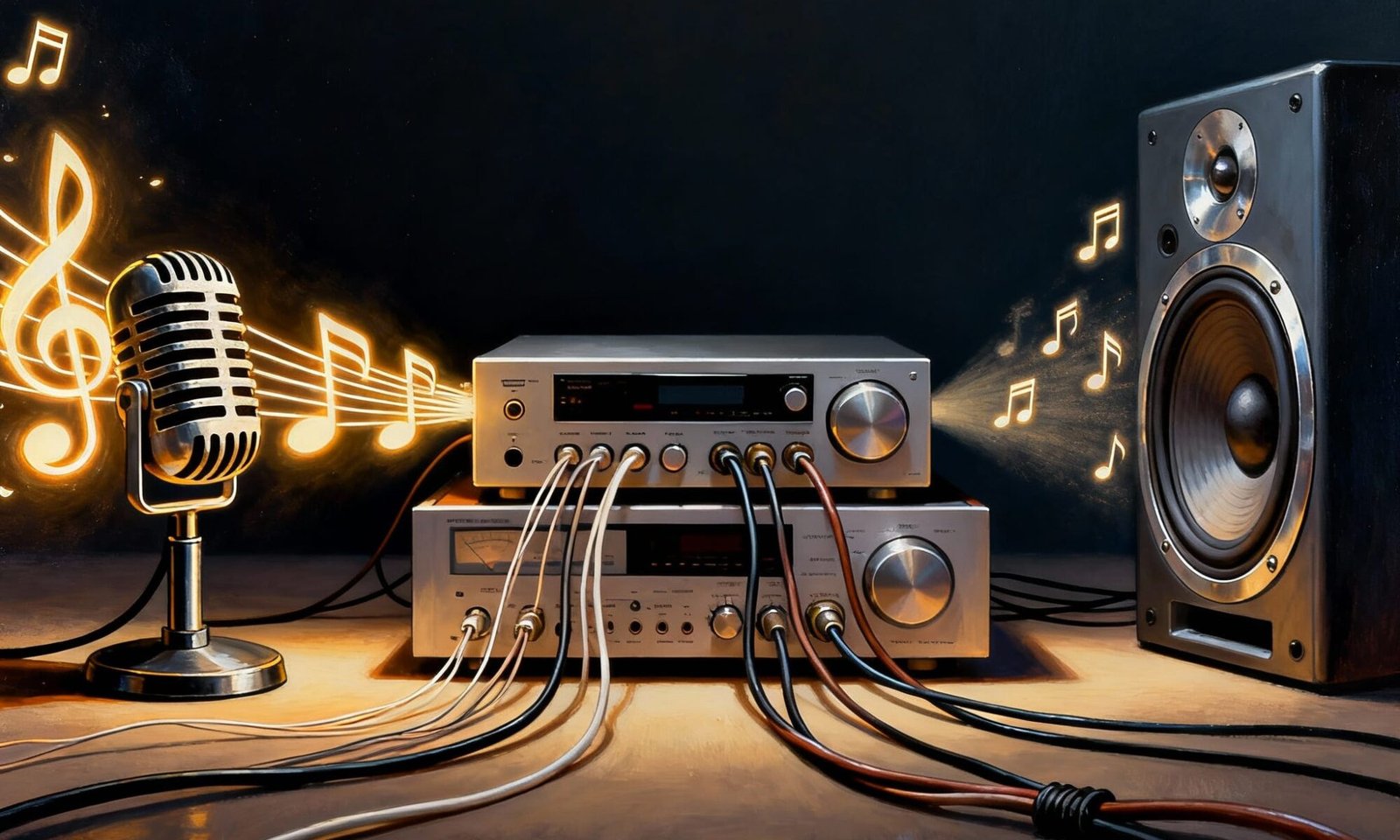
Some people don’t just listen to music – they listen for it. They notice the space between instruments, the texture of a voice, the way a cymbal fades into silence.
Audiophiles are people who perceive music not as background, but as a craft, a performance, and an experience worth obsessing over. Audiophiles actively pursue the most faithful and emotionally engaging reproduction of recorded music. Are you one of them?
The problem? CD quality is not high quality
I remember when CDs first came out: they were supposed to be the epitome of music quality. Reproduction without noise, no magnetic degradation as you had with tapes, no vinyl erosion and playback issues as with LPs.
It’s not.
Then we evolved to MP3 music through Napster and iTunes. More recently, we started streaming our music from services like Spotify – and mostly assumed the quality would be there.
As music is converted to digital formats, it is limited by the resolution of the converted file and how much detail is preserved in the digital version.
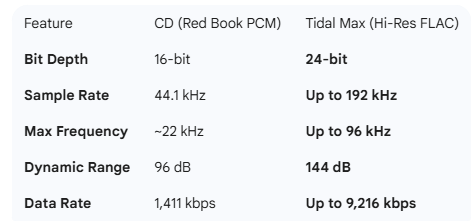
CD audio uses PCM encoding defined by the Red Book standard which has a 16-bit depth and a 44.1kHz sampling rate. Worse, if you listen to MP3 over standard Bluetooth your audio quality goes down to a fraction of that.
Quality Factor #1 – Bit Depth
When an analog wave is converted to digital, the system has to “round” the volume of the sound to the nearest available level. That rounding creates a tiny bit of hiss, known as the noise floor.
Standard CD Quality has a depth of 16-bits, which means it can record 65,536 possible volume levels. This results in a dynamic range (the distance between the loudest possible sound and the noise floor) of about 96 dB.
HD Audio has a depth of 24-bits, which means it can record over 16 million possible volume levels. This massive increase in precision pushes the theoretical dynamic range to 144 dB. The “noise floor” is so low it is virtually non-existent.
Why does this matter?
– Micro-Details: Because there is no “hiss” masking the quietest parts of the music, you can hear the faint decay of a cymbal, the breath of a singer, or the room’s natural reverb.
– Increased Headroom: Engineers have more “room” to record without worrying about the signal getting lost in the noise or clipping at the top.
– Signal-to-Noise Ratio (SNR): In HD audio, the signal (the music) is so much “taller” than the noise floor that the clarity becomes staggering, especially during quiet passages.
Quality Factor #2 – Sample Rate
The sample rate determines the highest frequency that can be recorded.
Standard CD Quality: Uses a 44.1kHz sample rate captures up to 22Khz. However, to prevent “aliasing” (digital distortion), engineers must use a “brick-wall filter” to cut off everything above $20\text{ kHz}$ very sharply. These filters can sometimes cause “phase shift” or “pre-ringing” artifacts in the audible range.
HD Audio Quality:With a 96kHz or 192kHz sample rate, the “brick-wall” is moved far beyond human hearing which allows for much gentler filters that don’t interfere with the music we actually hear, resulting in a cleaner, more natural “top end” (often described by audiophiles as “air”).
Why does this matter?
This extra data allows the system to capture ultra-high frequency overtones and the precise “timing” of sounds—like the instantaneous strike of a drumstick or the shimmer of a cymbal—more accurately. Because these high rates move the digital filters far beyond the range of human hearing, the result is a smoother, more “analog” sound that feels less fatiguing and more spatially realistic than standard digital formats.
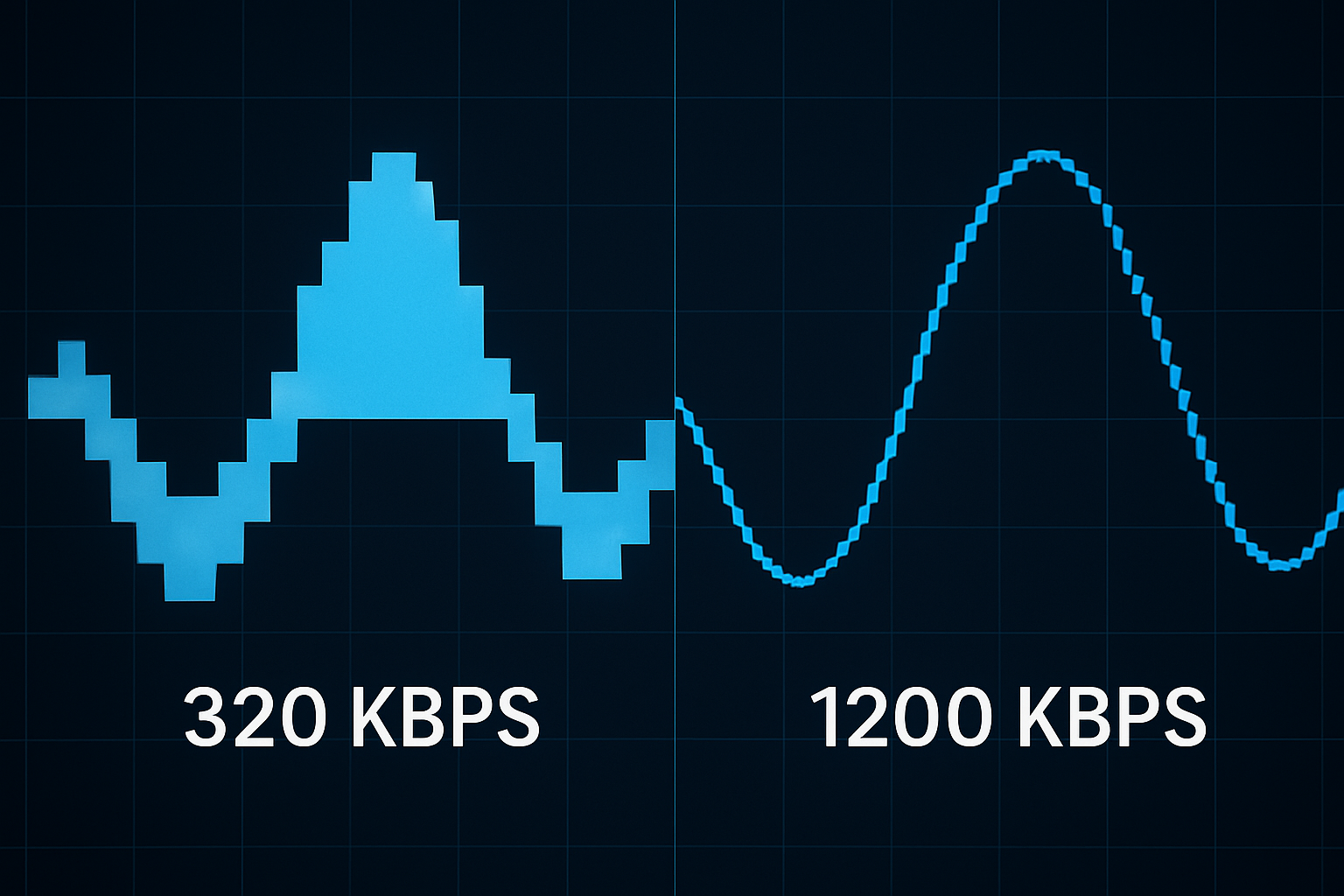
Quality Factor #3 – Bit Rate
If we summarize bit depth as the vertical resolution of audio, and sample rate as the horizontal resolution of digital music, bitrate is the combination of both. Think of Bitrate as the volume of the pipe required to carry your audio
Bit rate is “data speed” of your music. It represents the total amount of information being processed every second, usually measured in kilobits per second (kbps) or megabits per second (Mbps).
In other words, bit rate is a simple way to estimate the maximum quality audio a component can handle.
Is HD Audio Really Better? Can We Hear the Difference?
The short answer is yes – to a point. Just like with our eyes, there is a biological limit of the quality we can perceive. We saw a big upgrade from standard TV to HD (720p) and then we got another bump to 1080, but we can’t really say a 4K or even an 8K screen is any better.
Same with audio: some systems advertise going as high as 40,000 Hz frequencies, but our ears can only hear to 20,000 Hz – and that’s for healthy, younger people. Our ability to hear higher frequencies diminishes over the years.
However, in many cases, the difference is clear. If you are an audiophile, the difference can be astonishing.
My brother installed a new mid-range audio system at home with an Onkyo receiver and a 5.1 configuration using Monitor Audio speakers. He was very happy with it.
When I visited, I introduced him to HD Audio. We listened to Toto’s Africa on Spotify and then on Tidal. The difference was evident. We can clearly listen to instruments and sounds that were lost in the standard definition version. It was like getting prescription glasses. The world sounds different in HD.
I love listening to cello music in HD – you can feel the grip of the bow hair against the texture of the strings, the resonance of the wood, and the complex tapestry of overtones that usually get lost in the digital shadows
Listening to Diana Krall in HD audio feels like the “digital veil” has been lifted, allowing you to hear the subtle textures of her voice and the resonance of the piano strings as if she were performing just a few feet away in a quiet room.
Listening to ‘Tin Pan Alley in HD audio you experience how the snap of his Stratocaster hangs in a three-dimensional space, and the deep bass beautifully complements the guitar. The track moves from pin-drop silence to explosive guitar stabs. In HD, those transitions feel physical, not just loud.
Audiophile Audio requires an HD System
If you are still reading you are likely at least curious about how to experience HD Audio. The answer starts with a very important maxim:
The quality of your audio system is only as good as its weakest component.
Each element plays a role in the maximum quality your audio system will produce. To enjoy audiophile quality audio, you must ensure all these components are delivering the quality you expect. Let´s go over each component.
Recording quality
High-definition audio is only as good as its foundation: if the original recording captures every nuance and the mastering process preserves the natural dynamics without excessive compression, HD audio serves as a transparent window into that studio session.
However, if the source is poorly recorded or “brick-walled” (loudness-boosted), a higher bitrate will simply provide a more accurate reproduction of a bad sound.
Tips on finding quality albums:
1. Look for Specialty Labels: Labels like Mobile Fidelity Sound Lab (MoFi), Analogue Productions, Chesky Records, and Blue Note specialize in audiophile pressings and high-resolution masters that prioritize instrumental separation and soundstage.
2. Search for Native Hi-Res: Some HD tracks are just “upsampled” (taking a CD file and making it a bigger file without adding detail). Look for albums recorded natively in 24-bit or 192kHz, or those remastered from the original analog master tapes.
3. Use the audiophile Forums: Sites like the Steve Hoffman Music Forums or the r/audiophile subreddit have endless threads debating which specific version of a classic album (e.g., Rumours or Dark Side of the Moon) has the “best” mastering.
Audio file format
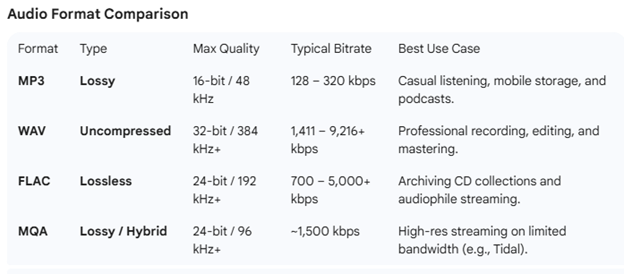
Common audio formats like MP3 are optimized for file size. A smaller file is easier to store, faster to transmit or download, and faster to process. They achieve this by reducing the quality of the file, using compression algorithms, or both. MP3 files achieve the small size by throwing away 80% of the data, using algorithms to try to drop details that most people may not hear.
In contrast, lossless and high-resolution formats like FLAC preserve every bit of data from the original studio master. MQA is a new audiophile format, a specialized hybrid, that packs high-resolution data into a streamable file size, though it requires MQA compatible hardware to fully “unfold” and reach its peak potential.
– Think of FLAC like a ZIP file; it shrinks the size for storage but “unpacks” into a perfect, bit-for-bit copy of the original when played.
– WAV is the raw, unedited photo of the audio world. It is perfect in quality but occupies massive amounts of “digital real estate.”
– MQA claims “Master Quality,” although many purists prefer FLAC because MQA is proprietary and technically involves some data manipulation that may result in some detail loss (maybe imperceptible?).
Streaming source
You may choose to convert your CD collection to FLAC format and store them in a PC at home. More likely, people use a streaming service like Spotify or YouTube Music.
Just like with file formats, these services limit the quality of their music to save storage space, streaming costs, and to ensure a good listening experience even in situations with limited bandwidth.
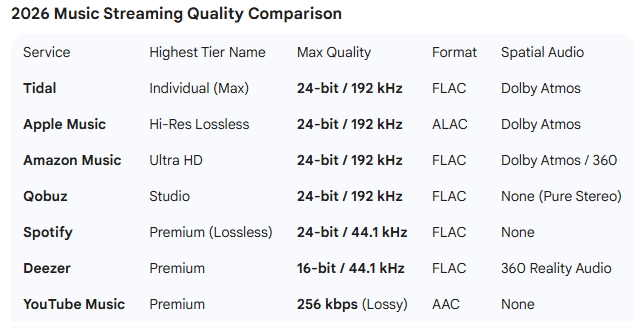
– The “Hi-Res” Leaders: Tidal, and Qobuz remain the gold standard. They offer the highest possible resolution at 192 kHz
– After years of anticipation, Spotify finally launched its lossless tier in late 2025. While it provides CD quality at 44 kHz, it is still far below 192 kHz quality
– Qobuz is unique because it avoids “Spatial Audio” (like Dolby Atmos) entirely, focusing strictly on the most accurate two-channel stereo reproduction possible. It is often cited by audiophiles as having the “cleanest” signal path.
Transport – Getting Quality Music to your Amplifier
Here you have multiple options
You may choose to use your PC as the system that sends music from your hard drive or a streaming service to your audio system. Another option is to use a streamer device, which connects via your WiFi directly to the streaming service to then send it to your amplifier.
You may use an HD-capable cable to send music directly from your PC to your audio system, typically optical (SPDIF), HDMI, or HDMI eARC. While all three are digital, they have very different speed limits. For HDMI eARC you need a cable labeled “Ultra High Speed” (HDMI 2.1 or higher) and to ensure both the transmitter and receiver support it.
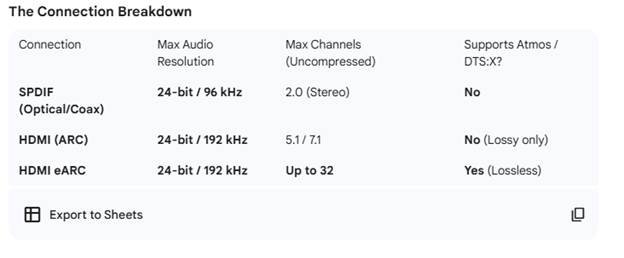
Like most people, you may prefer to stream wirelessly to your amplifier or audio system. It is convenient to control your Tidal or Qobuz listening experience from your cell phone and to use it to download music and stream it. However, you need to be aware of the limitations of the different Bluetooth codecs and their quality limitations.
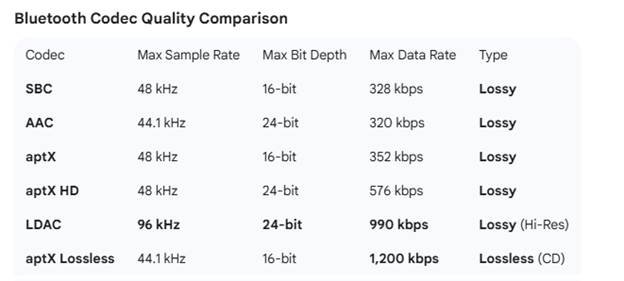
SBC (The Baseline): The “lowest common denominator.” Every Bluetooth device supports this. It is functional but often sounds “flat” or “muffled” compared to others.
AAC (The Apple Choice): Not HD quality but sounds noticeable better than SBC.
aptX HD (The Android Workhorse): Available in most Android phones as it is standard in the modern Qualcomm Snapdragon processors. Provides a noticeable jump in clarity over standard Bluetooth. Very stable.
LDAC (The Audiophile Favorite): Sony’s codec is the “spec king.” At its highest setting, it is virtually indistinguishable from a wired connection to most ears. However, if you move too far from your phone, it will automatically drop its quality to maintain the connection.
aptX Lossless (The New Frontier): It is the first codec that actually delivers a “bit-for-bit” identical copy of a CD by using a clever 1.2mbps transmission. However, few devices support it.
DAC – Converting Music to Analog
Once digital music makes it to your amplifier, it must be converted back to analog to be amplified and sent to your speakers. The conversion is usually done with a dedicated chip. Your phone has a DAC to convert all sounds and music to the analog format required to power its speaker. Similarly, an HD Audio system requires a DAC.
There are different price and quality levels in DACs. For example, a low-cost amplifier may use the Cirrus Logic CS4344 DAC, which supports 24-bit/192kHz resolution audio. Texas Instruments PCM5242 is one of the most common and widely used DACs in mid-range integrated amplifiers and DAC/headphone amps. The ESS Sabre line of DACs (especially the ES9038PRO) is considered the reference standard DAC chip in premium audiophile equipment.
Amplifier and Speaker Quality
Your amplifier and speakers bring your HD music to life. To truly experience HD audio, your amplifier must have a high signal-to-noise ratio and enough power to handle the rapid peaks in music without distortion. Simultaneously, your speakers be able to deliver the clarity, balance, and dynamic range you enjoy.
You can spend a fortune on an audio system, but you don´t have to. There are some excellent systems that will deliver a highly enjoyable audio experience without spending a fortune.
Is Vinyl better?
It comes down to personal preference but technically speaking the answer is no, Vinyl is not a superior medium. Vinyl has a feel that is different. Just because it is an analogous medium does not mean it has infinite resolution.
Vinyl maybe has artificial texture that is pleasing to many people. The appeal of vinyl lies not only in its resolution but also in the tactile experience and nostalgia it brings to music listening.
Technically speaking, vinyl has more limited dynamic range, with inherent limitations in high and low-frequency response, and more noise and distortion. Technically speaking, yes, HD digital audio is superior than vinyl.
Getting started HD Audio systems
Maybe you are convinced about Audio HD or maybe you are just curious. How do you get started?
First, you probably want to get a Tidal or Qobuz. I think both offer a free trial. Then you need to find a couple tracks that you love that are high quality and are good to test or to experience Audio HD. I built this Tidal playlist for this purpose: Best Hi-Fi Audiophile Tracks .
Here are a few HD Audio systems you can set up at home without breaking the bank:
If you have a Smart TV and a good soundbar or a stereo system. I have a Sony Bravia TV and a good Sony soundbar. I loaded the Tidal application on my TV and used an eARC cable to connect to my soundbar. Instant HD Audio. Unfortunately, there is no easy way to confirm the quality of the music being received by the sound system in this case.
If you have an Android phone and a good stereo system – Unfortunately, iPhone does not support HD Audio, but most Android phones, especially those with modern Qualcomm Snapdragon chips do. You can get a HD receiver like this 1Mii B06 Ultra, which is under $50 and supports aptXHD and LDAC to stream HD audio from Tidal to your system. This is the simplest, least expensive option. When you go to your Bluetooth connections, you can see if the connection is LDAC or aptX to verify you are getting HD Audio. You could also go up a notch to the Auris Blueme Pro, which includes the ESS Sabre DAC and a screen for about $150.
If you are an iPhone / Mac person – and you are looking for the lowest-cost option, you could connect your Mac to your amplifier or receiver using an HDMI cable (especially if both support eARC). Chances are, you already have an HDMI cable somewhere. Unfortunately, this requires having your laptop near your receiver which may not be ideal.
Awesome low-cost HD Audio System. For my home office, I decided to get a new system. I got a pair of Polk XT20 bookshelf speakers, which cost around $250, connected via a $15 set of banana plug audio cables to an incredible D-class amplifier powered by the new TI TPA3255 chip: the Ayima A08 PRO. This little guy looks awesome, supports aptX HD ad aptx LL as well as LDAC, and sounds awesome, plus it is under $100. In total, for about $350 you get an amazing little system that sounds beautiful.
You have a stereo system and don´t want to use your phone – or you have an iPhone. You can then buy a streamer like the wonderful Wiim Ultra streamer which connects to music services like Tidal, Qobuz, and Amazon Music via Wi-Fi 6 ; it includes an ESS ES9038 DAC, a nice 3.5” touchscreen, and multiple ways to connect to your amplifier or TV system. The mobile app offers room correction and independent EQ settings so you can adjust music to your liking. For about $300 you can get HD Audio music straight into your existing audio system.
You are ready to invest in a quality system. If you want to go one step up, you can get a good quality amp and speakers. This is what I wrote on my list to Santa: A NAD C700 V2 Streaming amplifier which is a modern, audiophile amplifier that connects directly to Tidal and other services, supports MQA decoding, includes an ESS Sabre ES9028 DAC, and multiple digital and analog inputs and outputs, plus a HybridDigital UcD 80 watt amplifier with ultra-low distortion. After much research and hours in listening rooms, I want to pair this system with the Danish Dynaudio Emit 50 speakers. Yes, we are talking about investing around $4500 in this setup, but it may be a good investment for someone who really enjoys music.
In closing
Audiophiles see music not as a data stream to be optimized but art to be experienced. When the lights are low, the phone is face down, and a song gives you chills, no one asks about bit depth or codecs. What matters is that, for a few minutes, the music feels real – and you’re fully there to hear it.