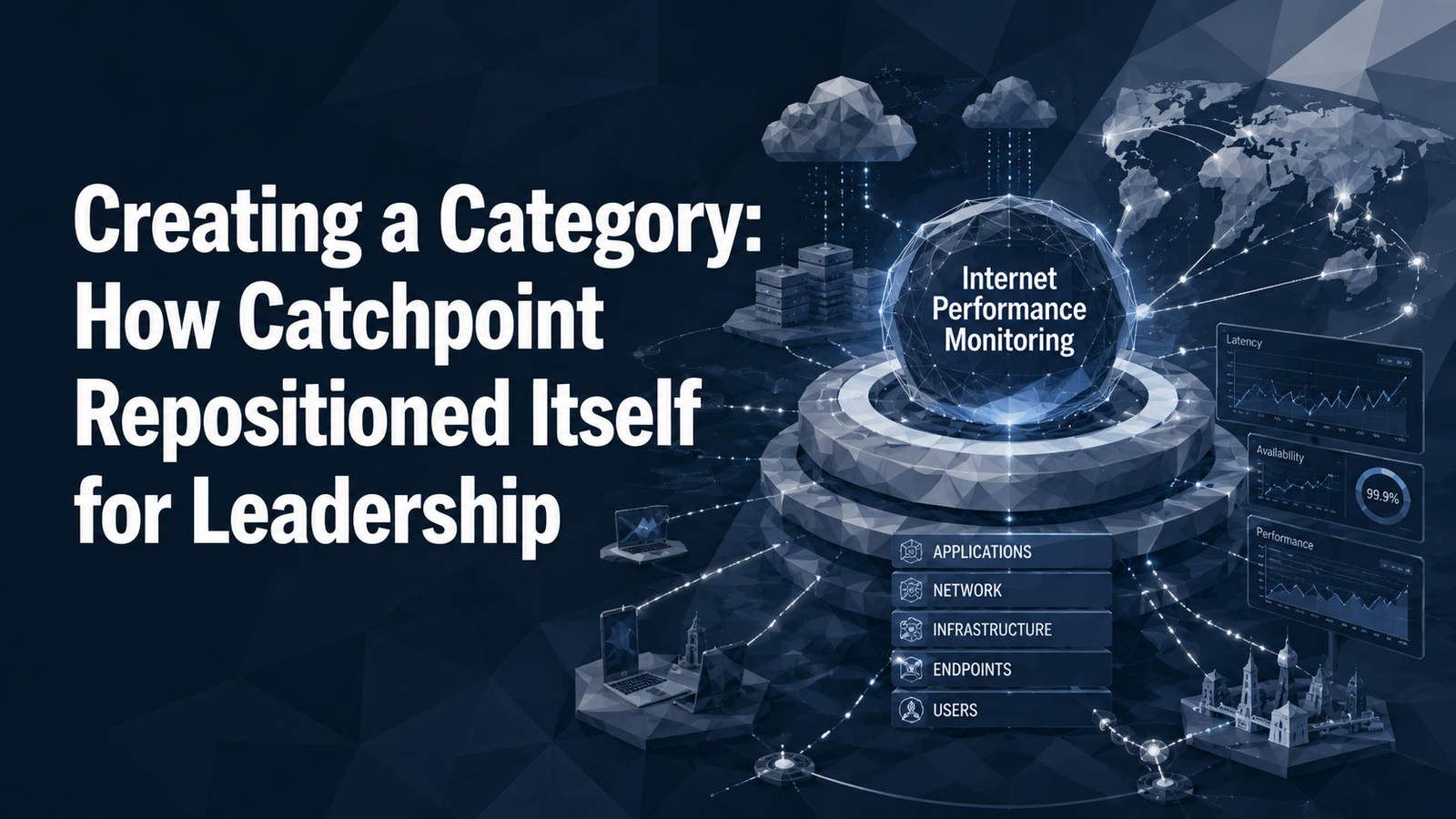
Creating a Category: How Catchpoint Repositioned Itself for Leadership

A little over 3 years ago I joined Catchpoint, a software company who met my criteria for my ideal job: I wanted a medium-sized company (I am not good with big company politics), that had a great product and bad marketing.

My last requirement, which was not negotiable, was that the company had to have a great leader and a good culture. I found Catchpoint to be a company with heart: a passion for customers, for what they do, and for the team that worked together to build a great company.

My Most Important Priority as a CMO

The first job was not to upscale the team, optimize demand programs, or rebuild the website, no. My most important task was to build a strategy that would help the company stand out, build awareness, and earn the business of the biggest companies in the World.

This is how, Catchpoint embarked on one of the most remarkable repositioning journeys in enterprise technology.

Over the last three years, the company evolved from being perceived as one of many “monitoring” vendors to becoming the authority on Internet Performance Monitoring (IPM) — defining a category, reshaping an industry narrative, and reasserting the company’s leadership through clear differentiation and thought leadership.

This is not just a story about branding; it’s a case study in how positioning, strategy, and execution can work together as a system to transform awareness, create new value, and drive growth.

1. The Challenge: Standing Out in a Sea of Similarity

By 2021, Catchpoint found itself in a crowded ecosystem of “observability” vendors — DataDog, New Relic, Dynatrace, Kentik, and others — each claiming a variation of digital experience monitoring or performance analytics. To illustrate the point, I captured the taglines from the companies in this space.

What became evident is that most of these companies were trying to participate in the same categories and ride the same technological waves. It reminded me of my time at Rackspace when it seems every tech company wanted to be a Hybrid Cloud company – or today when everything is AI-powered.

It seems to me companies don’t want to miss out on these massive shifts. They don’t want to be the only company who does not have an AI powered thing or the company who missed the hybrid cloud shift. And yet, in their positioning they became one more sheep in a very large herd.

A few weeks after joining the company, I put these tag lines on a slide, and I challenged employees and executives to point which tagline corresponded to each tag line – an exercise everyone failed. Then I asked them to point which one was Catchpoint’s tagline. -an effort the majority failed at.

The question for Catchpoint’s leadership and marketing team wasn’t simply “How do we compete?” It was more fundamental:

How do we make what we do indispensable — and distinct — in a market drowning in sameness?

The terms ‘observability” and “digital experience” were as ubiquitous as they were ambiguous. In other words, they were useless to describe what made the company unique.

I this case, they were also useless to describe what the company did. The terms did not reflect what the company focused on. They were related, but they did not capture the essence.

I knew the company had a unique set of capabilities. My job was to identify them and describe them in a way that everyone would understand them quickly.

2. The Insight: The Internet Is the New Stack

The pursuit of this differentiation is the foundation for marketing effectively. To re-position the company I had to find what was the unique, differentiated, valuable thing that made catchpoint a unique company.

Over time, it became clear: While most of the observability companies were focused inward — monitoring applications, infrastructure, and code — Catchpoint recognized that modern digital performance no longer lives solely within an application. It lives across the Internet itself.

The company had a unique set of capabilities: monitoring an increasingly complex ecosystem of networks, cloud services, protocols, and providers that are now essential for most applications. Especially after the pandemic moved a good chunk of the workforce to work remotely and hybrid cloud technology resulted in modern applications being distributed, complex, and interdependent. Yet, no existing monitoring category directly addressed this layer of digital dependency.

We needed a way to define these new technologies and protocols that companies need to pay attention to. Technology teams have worked with multiple technology ‘stacks’ – many systems were described as a set of layers, tiers, or a stack of technologies. I thought we could borrow this concept to define what we called the Internet Stack.

The Internet Stack

This was logical for most technical people I spoke with. It was evident the set of technologies and protocols were important for any IT organization. The concept was valid independently of what Catchpoint did, so it was a valuable concept for the industry anyway.

This was the first positioning element. It was a foundational concept on top of which I could build the position for the company.

3. Creating a new category

Building a category is the dream for many marketers. Everyone wants to be the Kleenex of their industry, a company so dominant that it becomes synonymous with the category itself. I knew category creation nis really hard. Few companies are successful in this effort.

However, I also understood what the company did was different enough we did not want to be grouped together with the other companies in network monitoring, digital experience, or observability. We needed a new category to explain how the company solved a new set of problems most IT organizations were facing.

This is essential: a category cannot be defined by a company or by a set of features, or in any other selfish way. A category must be defined as a set of real, unmet customer needs. In other words, the category already exists in the market as a set of needs and problems, you take advantage of this by defining it and claiming ownership.

It is important to note that while there were some similarities and a n overlap in capabilities, Catchpoint did not have many of the expected capabilities that existing categories had and did not solve the problems that existing categories solved. It was truly a different category.

If the other categories in this somewhat ambiguous universe called observability were Application Performance Monitoring (APM) and Network Performance Monitoring (NPM), the most logical name for the new category became evident to me: Internet Performance Monitoring (IPM) — a parallel to APM to NPM, but focused on the internet layer that connects everything users and businesses rely on.

We explained the new category in very simple terms that any technologist in our target market could understand “IPM is like APM, but not for your app stack — for your Internet stack (DNS, SSL, APIs, SASE, CDNs, EDGE, etc.).” When we explained it this way for customers, you could see them nod. A lightbulb went off. They got it quickly and clearly.

By naming this gap, Catchpoint did more than differentiate — it redefined the frame of reference. IPM gave structure to a pain customers already felt but couldn’t articulate.

4. Re-Examining Value Proposition: From Monitoring to Internet Resilience

Beyond defining the category and the foundational concept of The Internet Stack, which defined what we do, we needed a tagline that defined the value we bring to customers.

This was shortly after the pandemic had ended. If you remember those times, companies,  investors, and people were more interested in survival than in growth. This was becoming a new priority for every IT organization as well.

Gartner research stated that resilience had become a primary investment driver for over 63% of infrastructure and operations leaders, our target market, validating Catchpoint’s focus on the outcome, not the feature.

Armed with this insight, Catchpoint repositioned itself under a bold new identity:

“The Internet Resilience Company.”

This wasn’t just a tagline — it was a north star. The message spoke to what every CIO and infrastructure leader cares about: ensuring in the new world where applications are complex, distributed and cloud centric, and where users are distributed and need access to critical systems to do their jobs, resilience enabled them to trust the systems that drive customer experience and business continuity.

5. The Execution: Making the Category Real

Positioning alone isn’t enough; it must be operationalized. Catchpoint executed across multiple fronts:

The re-brand initiative introduced a modernized logo, color palette, and typography — emphasizing clarity, confidence, and modernity (pages 4–10). The new visual system reflected a brand that was both authoritative and approachable — embodying trust, innovation, and expertise.

The logo evolution took it back to the original logo, where dots symbolized internet endpoints around the world, but under a more modern design. Rather than investing six figures with a brand agency, the team worked with a graphic designer to arrive at the new identity.

The evolution of the Catchpoint logo

Catchpoint aligned all messaging — from sales decks to product pages — around a clear hierarchy that was used consistently across all channels:

Education Through Thought Leadership

Catchpoint competes directly with industry giant Cisco and indirectly with companies like DataDog and New Relic who had 10x to 30x more resources. To make a dent in a competitive market, Catchpoint focused on educational content. The rule was simple: useful, interesting, technical content that would be appreciated by technical audiences.

All content was ungated. That meant letting content be consumed and shared freely. While this meant the company did not generate leads from content downloads, it understood that most people who download a paper are not really leads and that considering them so usually results in wasted effort from a BDR team.

Catchpoint’s blog, webinars, and analyst engagements became a masterclass in category education. Instead of selling products or talking about features, the company focused on teaching the market about the Internet Stack — how it works, where it breaks, and why resilience matters. The company had a well defined of industry-centric points of view that the company amplified across blog posts, industry presentations, contributed articles, webinars, etc.

This educational posture led to validation from industry analysts. Gartner and Forrester began referencing Internet Performance Monitoring as an emerging discipline, citing Catchpoint as a key innovator. Even competitors copied or borrowed concepts from the messaging and the though leadership angles.

6. The System That Made It Work

The success of Catchpoint’s repositioning wasn’t due to a single decision — it was the integration of strategy, brand, and execution into one system. Together, these components created a flywheel of credibility and awareness: as analysts and customers adopted the language, Catchpoint’s differentiation solidified; as the company delivered on the promise, its authority grew.

A key learning is that positioning is not a marketing activity. Yes, it is often led by marketing because it is the team that should understand the market better than anyone else (competitors, opportunities, customer needs, etc.). When positioning is only driven by marketing, it ends up making empty promises to customers and execution suffers.

On the other hand, when the entire company buys into the strategy and the position, magic can happen. At Catchpoint, the product team was inspired by the new strategy resulting in an Internet Stack Map – which was not only an extremely valuable product innovation but also a visual representation of the company’s unique value to customers.

A partnership with sales is critical. We worked together as one team. T was important for me to be in front of customers, understand their perspectives, see how they reacted to our messaging, what problems they wanted to solve with our technology, and how we fit into the solutions they were considering.

Our marketing goals were not leads, or impressions, but revenue. This ensured we were aligned with the sales team 100%. We were partners working towards the same objective and avoided the typical friction between marketing and sales.

7. The Results: From Confusion to Clarity

The repositioning delivered multiple business outcomes:

  • Clarity: In a crowded market with dozens of players, Catchpoint was able to carve out its unique slice of the market and effectively communicate the problems it solves for customers. The market understood Catchpoint’s differentiated value.
  • Analyst Recognition: Analysts, who prefer to define the market themselves, adopted Catchpoint’s point of view and category definition. Forrester Research, GigaOM, EMA, Gartner Research, Constellation, Futurum, and other leading firms and industry experts become advocates for the category.
  • Customer Advocacy: The world’s leading cloud providers, software companies, ISPs, CDNs, and retailers began referencing Catchpoint as the tool to “understand the internet better than anyone else” and talking about Internet Performance Monitoring.
  • Customer Engagement: Three years after the new position and thought leadership strategy was launched, website traffic had grown by over 650%.
  • Brand Differentiation: the idea of Internet Performance Monitoring and the Internet Stack became synonymous with Catchpoint’s mission and message — echoed across campaigns, customer case studies, and even T-shirt slogans (“You can’t fix what you can’t see,” “Every. Millisecond. Counts.”).

Most importantly, Catchpoint succeeded in turning an undifferentiated market into one where it defined the rules.

8. Lessons for CMOs and Product Marketers

Catchpoint’s transformation offers several key lessons for marketing leaders seeking to reposition or create a category:

  1. Name the Problem Before You Sell the Solution.
    The term Internet Stack gave shape to an unarticulated pain point, making the problem real — and giving Catchpoint ownership of the solution.
  2. Anchor on Outcomes, Not Features.
    “Resilience” spoke to business impact, not technical jargon, aligning with executive priorities.
  3. Educate Relentlessly.
    Thought leadership, analyst engagement, and visual storytelling turned a new term (IPM) into an accepted discipline.
  4. Align Brand and Category.
    The rebrand wasn’t aesthetic; it was strategic. Every design element reinforced the new identity.
  5. Make It a System.
    Great positioning isn’t a message — it’s an operating model. Catchpoint’s success came from the orchestration of brand, product, and communication around one unified narrative.

The Takeaway

Catchpoint’s journey from a “monitoring vendor” to the Internet Resilience Company demonstrates that true differentiation isn’t about shouting louder — it’s about thinking differently.

By defining the Internet Stack, creating the IPM category, and embodying a mission centered on resilience, Catchpoint didn’t just evolve its brand — it redefined an industry conversation. For CMOs and product marketers, it’s a powerful reminder: You can’t lead a market until you first define it.

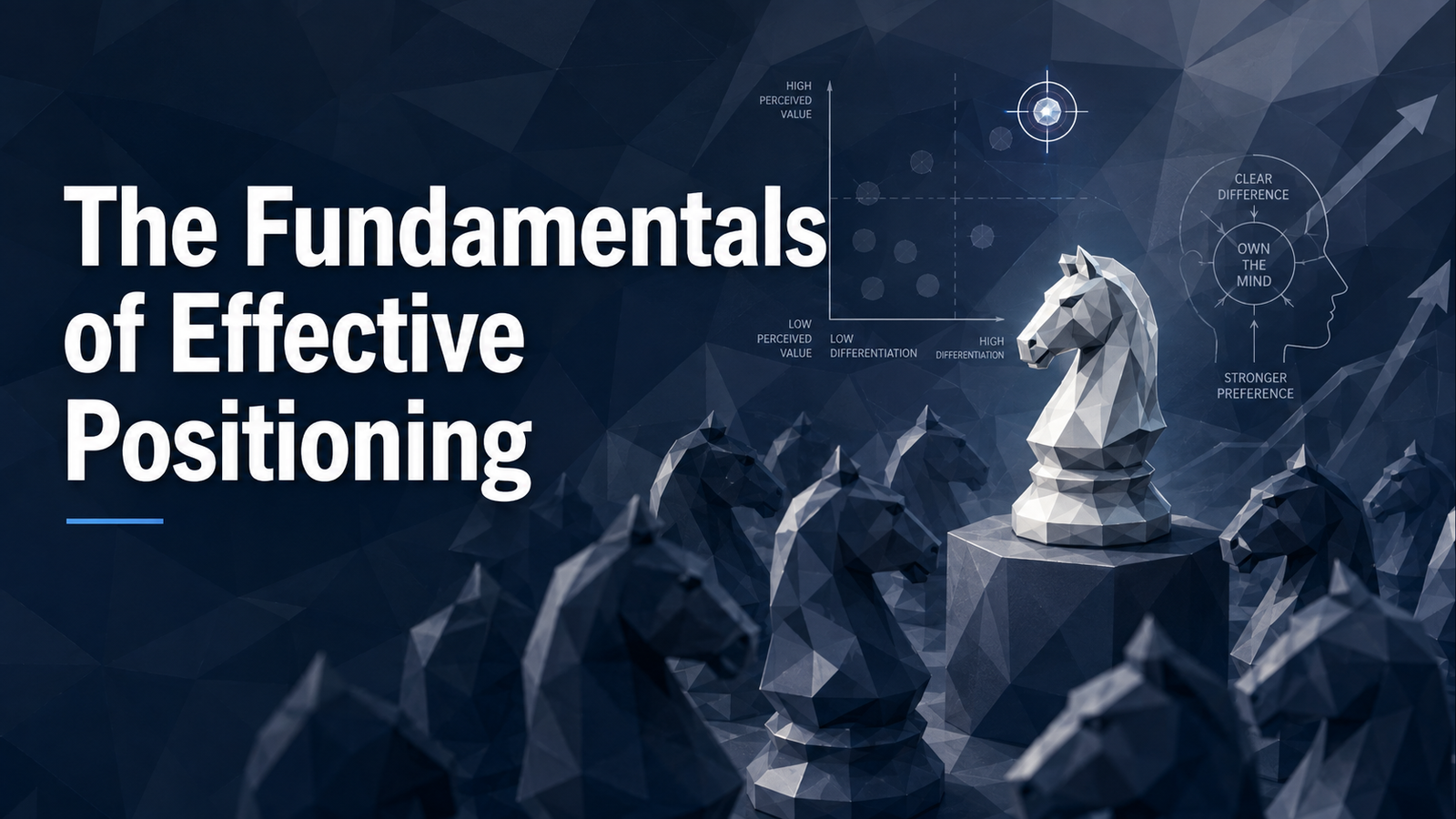
The Fundamentals of Effective Positioning

Fundamentals of Effective Positioning

Positioning is one of the most powerful — and most misused — tools in marketing. It’s not a tagline, a clever campaign, or the latest buzzword tossed around in a boardroom. Positioning is the strategic lens through which customers understand who you are, what you stand for, and why you matter.

When done well, it becomes the foundation of every message, product decision, and go-to-market motion. When done poorly, it creates confusion, weak differentiation, and a brand that feels interchangeable. Despite its importance, positioning is often treated as a quick creative exercise rather than a rigorous strategic discipline — which is why so many companies get it wrong.

In this post, I break down the eight rules that define effective positioning — the principles that separate brands that own a place in the customer’s mind from those that simply blend into the noise. Whether you’re refining an established brand or shaping a new one, these rules will give you a practical framework to sharpen your strategy and communicate with clarity and conviction.

How I Discovered Positioning (And Why It Still Matters Today)

My father constantly exposed us to new ideas and experiences. He would show up with a new book, or with a musical instrument, or would show us how to make drawings using Chinese ink.

I was in middle school back in the early 80s when he brought a book: Positioning – the battle for your mind by Al Ries and Jack Trout. It´s a classic. I found the book fascinating. The concept of positioning mixed strategy, psychology, and marketing. I was hooked. More importantly, I found my calling. I would become a marketer.

Fast forward to 2025, when Laura Ries, Al´s daughter, continues her legacy with her book The Strategic Enemy. A good book that reinforces some of the key aspects of positioning with some new stories that illustrate the key points. The book sparked the idea of writing a blog post about my perspective on positioning.

What Positioning Actually Is — And Why Most People Misunderstand It

Marketers often confuse positioning with messaging or branding, but it is something deeper. Positioning is not something you do right before a product launch or when writing a press release. It´s way more strategic than that.

Positioning is the act of establishing a single, clear idea in the customer’s mind relative to alternatives.

This definition includes three very important elements:

1. A single idea — Great positioning demands discipline: you must choose one idea to stand for, even if it means letting go of other strengths or messages you’d love to highlight. The sharper and more singular the idea, the easier it is for customers to remember and repeat — and the harder it is for competitors to copy.

2. In the customer’s mind —Positioning isn’t what you say you are; it’s what customers actually come to believe over time. You earn that place in their mind through consistent proof, repeated experience, and a message that resonates with their priorities—not your internal desires or aspirations.

3. Relative to competition —Customers don’t evaluate your brand in a vacuum; they compare you to alternatives, whether direct competitors or substitutes. Effective positioning makes that comparison obvious and favorable by carving out a space where you are meaningfully different, not just descriptively unique.

Because positioning is always relative to competition, you must define the category you play in — the frame that determines which competitors you’re being compared against and what “winning” in that space actually means.

Laura Ries´ book offers an excellent example: Everready owned the category of batteries for flashlights. When the Mallory battery company launched a new set of alkaline batteries driven by the need from Kodak´s to power its energy hungry Instamatic camera with built-in flash. In 1965 the Duracell brand name is introduced and is a home run.

EverReady tried to compete with Duracell in the alkaline battery but their brand meant regular batteries in the mind of consumers. In 1980 they changed the name of its alkaline battery line from “Eveready Alkaline Power Cell” to “Energizer”. It was easier to launch a new brand in a new category than to change the current brand positioning in the customer´s minds.

Levi´s has a similar story. The company was launching a line of khakis. They knew Levi´s was positioned as the original denim jeans brand, so Levi´s Khakis would not work. Their new brand, Dockers, owned the category for a long time.

8 Rules for Effective Positioning

These principles hold up across industries, decades, and categories.

1. Focus on a Narrow Target  – Effective positioning starts by focusing on a well-defined, minimum-viable market. You can’t win by trying to appeal to everyone; you win by resonating deeply with someone.

2. Anchor in Emotion – People make buying decisions based on emotions and justify with logic. The best positioning taps into a core emotional driver—security, pride, belonging, confidence, ease—not just functional benefits.

3. Make It Visually Ownable – A strong position becomes instantly recognizable through iconic visuals (a visual hammer, as Laura Ries calls it) —colors, visuals, symbols, or design cues that reinforce your idea without needing words.

4. Make It Instantly memorable – If customers can’t quickly recall what you stand for, your positioning isn’t working. Clarity, simplicity, repetition, and distinctiveness are what lodge ideas into memory. Good positioning is memorable.

5. Commit for the Long Term –Positioning only becomes powerful through consistency over years—or decades. Frequent changes dilute credibility and prevent your idea from taking root. BMW has been the ultimate driving machine since 1974.

6. Keep It Brutally Simple – The best positions are brutally simple. If you need a paragraph to explain your idea, you don’t have one. Simplicity makes it easier for customers (and employees) to repeat and act on it.

7. Stand Out Clearly – Positioning must be unique.If your statement could be swapped with a competitor’s name without losing meaning, it’s not real differentiation. A position must make you unmistakably distinct.

8. Focus on Valuable Differentiation – Differentiation is not enough. Your differentiation must matter to the customer—not just to your team. Effective positioning highlights a unique advantage that improves the customer’s life or business in a real, compelling way.

One of the best examples of positioning is from Lexus. When Toyota was launching the new brand in 1989 they launched it with an ad for the LS 400 which featured 15 champagne glasses stacked on the hood, which remained undisturbed as the car reached 145 mph on a dyno. The ad was striking, a memorable and visual proof of the car’s refined engineering and smooth ride. By 1991 Lexus was the number one import car in the US.

Why Every Strong Position Needs a Strategic Enemy

A strategic enemy gives your positioning contrast — and contrast creates clarity.

A strategic enemy is the market force, competitor, or entrenched idea you deliberately position yourself against to clarify who you are and why you matter. By defining what you are not, you make it easier for customers to understand what you are.

Choose your enemies carefully ´cause they will define you” -U2

This contrast sharpens your differentiation, creates tension that attracts attention, and gives your brand a clear narrative to rally around. In a crowded market, choosing the right enemy is often the fastest way to carve out mental space and build a position that sticks.

Some examples of clear strategic enemies (from the book)

  • Siebel CRM vs Salesforce – ¨No Software¨ positioned Salesforce as the leader in SaaS, even though Salesforce was neither the first nor the leader in SaaS, and technically it is still software.
  • Kibble vs Farmer’s Dog – Farmer´s dog positioned against kibble promoting longer life for your pets.
  • Uber vs Taxi – Uber positions taxis as old, expensive, unsafe, and inconvenient

Some of the most effective uses of strategic-enemy positioning don’t pit one product against another—they pit one idea against its opposite. Strong positioning defines not only what you stand for, but also what you stand against, creating a sharp contrast that makes your message easier to understand.

“Pro-Life” is a powerful example. The label frames supporters as defenders of life, which implicitly positions the opposing side as “anti-life,” even though the actual debate is about who gets to make the decision (the government or the parents). By choosing a morally charged idea as their banner, the movement reframed the entire conversation and defined its enemy on its own terms.

The term “Designated Driver” works the same way. It doesn’t just describe the sober person—it also forces everyone else into the opposite role: the “designated drinker.” The contrast makes the choice impossibly clear and socially reinforced: you’re either the driver or you’re not. If you drink, you can´t drive.

How Strategy, Positioning, and Brand Actually Fit Together

The three terms are interrelated and often confused. They work together to drive results. It all starts with strategy and positioning. Strategy is the system of choices (where to play/how to win/capabilities/resources) that delivers your position and makes it profitable. Strategy answers what choices let us consistently deliver and defend that advantage? (segments, offerings, pricing, channels, ops, partnerships, capabilities, cost structure).

We already defined Positioning as the competitive place you choose to occupy in the customer’s mind vs. alternatives. It provides the north star for brand expression.

Brand is the total set of meanings and memories people have about you (promise, personality, experiences, symbols). Brand assets make the position salient, credible, and sticky. A tagline is a short, memorable phrase that captures the essence of a brand’s promise or personality. The tagline expresses that idea, the brand position, in a concise, emotionally resonant way.

Southwest Airlines built a strategy around a low-cost, no-frills airline. Their positioning was to be as affordable and enjoyable for the everyday traveler as driving. They weren’t competing with legacy carriers on luxury or global reach—they were competing with cars and buses by offering fast, friendly, low-fare transportation.

They operationalized the strategy with a hub-and-spoke model, a single type of aircraft to simplify operations, no meals, and an employee culture that supported the strategy. Every operational choice reinforced the positioning, creating a tightly aligned system where strategy, positioning, culture, and execution supported one another and made Southwest’s low-cost, high-efficiency model nearly impossible for competitors to copy.

Positioning Is Not a Marketing Task — It’s a Strategic One

Two important points to make here to close this blog post. First, positioning is not just a message or a tag line; it´s part of a business system.

Second, and more critically, positioning is not an exercise that the communications or the marketing team can own. It´s inherently tied to corporate strategy. Positioning is a strategic process that impacts the entire company.

If your position doesn’t shape your product, pricing, culture, and operations, it isn’t a position — it’s just a slogan.

Establishing a Premium Position in the Market

Premium Products

Today (February 2012) I had the opportunity to present at the American Marketing Association Austin luncheon lunch on the topic of how to establish a premium position in the marketplace.

The key points form the presentation:

  1. Building a premium product is about differentiating by focusing on a segment of customers who are willing to pay more for a product that serves them better. Premium products are created by value.
  2. People buy emotionally – then justify their decisions rationally
  3. People buy experiences
  4. Price communicates value
  5. Packaging communicates value
  6. Happy, empowered employees create value

Here are my slides: