
It’s not a people problem, and a happy hour won’t fix it. Here’s what will.
Every B2B company I have worked with says marketing and sales alignment is getting better, but in reality almost none of them are. The sign of misalignment is not open conflict, which is rare and, honestly, healthy, when done respectfully.
The misalignment is evident when marketing celebrates a quarter that sales calls a miss.
Often, salespeople create their own decks because the corporate ones are not helpful in a real conversation with customers. Leads get passed over the wall, ignored, and then argued about in a QBR three months later. Nobody is being difficult. Everyone is doing exactly what they were asked to do.
That is the point. The marketing–sales divide is almost never a people problem. It is a design problem. And most companies try to fix a design problem with a happy hour.
Sales & Marketing Alignment Challenges
Before you fix anything, it helps to understand why two teams who genuinely want the same outcome behave as if they do not.
- They are measured on different things. Marketing is measured on leads, MQLs, traffic, pipeline created. Sales is measured on closed revenue. Those are not the same metric with a lag. These are different metrics that can move in opposite directions. A marketing team can have its best quarter ever while sales has its worst, and both scoreboards will be accurate.
- They operate on different clocks. Sales lives in the quarter while some of marketing’s most valuable work like positioning, buyer engagement, and content pays off over years, especially in B2B. When the quarter is at risk, the long-horizon work looks like a luxury. It gets cut first, and the company pays for it eighteen months later, when nobody remembers the decision.
- They have different views of the customer. Sales talks to buyers who are already in a buying process. Marketing talks to a market, most of which is not buying anything today. Both views are true and neither is complete. Sales concludes marketing does not understand real customers and does not help them close deals. Marketing concludes sales is not following up on the leads they produce. Both are partly right.
- They have different definitions of a good lead. This can be the trickiest one. Marketing defines quality by a scoring model based on activity. Sales defines it by whether the person picks up the phone and has budget. Nobody wrote down a shared definition, so each team optimizes its own, which results in friction.
None of these are character flaws. They are consequences of how traditional sales and marketing organizations have been built and measured for decades. The good news is they can be redesigned to avoid these problems.
The Reframe: Customer Acquisition is One Engine, Not a Relay Race
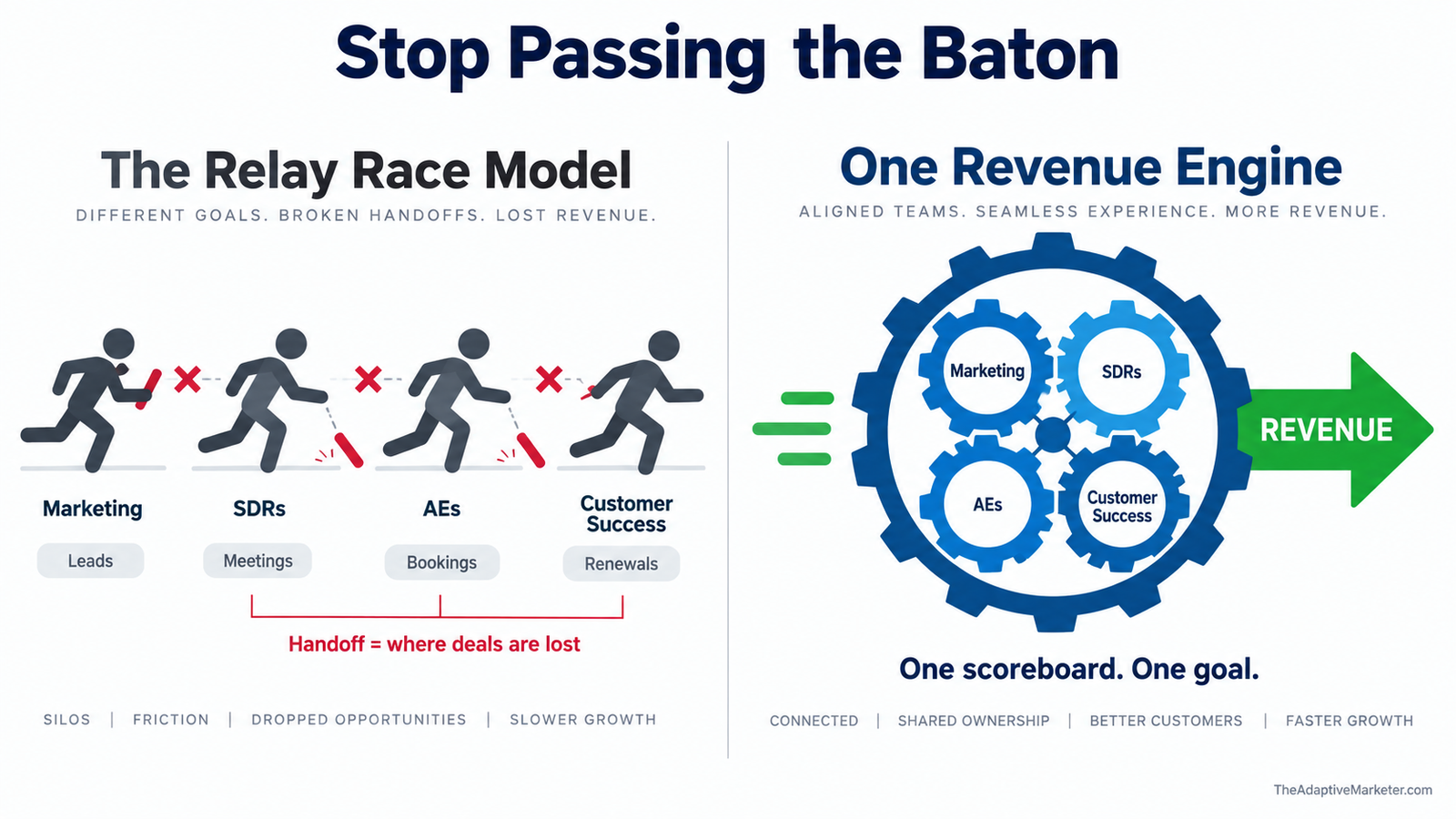
The mental model most companies inherited is a relay race. Marketing runs the first leg, hands the baton to SDRs, who hand it to AEs, who hand it to customer success. Each function owns its leg and optimizes it in isolation.
The problem with a relay is that the handoff is where you lose the race. By day one as a user, the customer has had four separate conversations with people who have different objectives. Each one is more focused on qualifying the customer (making sure they deserve their time and attention) than in learning about their problems or adding value.
Buyers do not care about your org chart. Their buying process is not a four step linear process described in a slide deck. They go through multiple experiences to form an opinion: a search result, an LLM query, a peer’s opinion in a Slack community, an analyst note, a demo, a pricing page, reading reviews online, a security review, a conversation with a rep, a conversation with three colleagues you will never meet.
We have heard many times the customer has gone through 70% of the buying process before they speak to a rep. If we know that is the reality, “marketing generates demand and hands it to sales” is a fictional story that does not match the real world.
Many leaders now call this integrated system “go-to-market,” or GTM. The label is useful because it points at the right idea: buyers experience one company, not a set of departments. But renaming the org chart doesn’t fix it. GTM alignment only exists when marketing and sales share one number, one ICP, one story, and one set of incentives.
What Actually Fixes Sales and Marketing Alignment
Here is what I have seen work, starting with the biggest bang for the buck.
1. Give marketing a revenue number
The better model is one engine with one output as key metric and goal: revenue. Everything else (leads, meetings, opportunities, pipeline) is an intermediate variable, a leading indicator.
At Catchpoint, our marketing goals were not leads, MQLs, marketing-attributed pipeline, or share of voice. We measured all of those, of course. The only goal that counted was revenue. That one decision eliminated most of the friction before it started, because there was no longer a scenario where marketing won and sales lost. We were partners working toward the same objective, and every debate about lead quality resolved itself: a lead that does not become revenue is not a lead, it is a sunk cost.
The objection is always the same: marketing does not control the close. True. Marketing also does not control the product, pricing, or the competitive landscape, and we hold marketing accountable for growth anyway. Shared accountability for an outcome you jointly influence is not unfair, it is the whole idea.
I am not suggesting to change the compensation model for marketers (yet) but their quarterly targets, the way success is measured, should be in revenue growth.
Some teams might feel a good compromise is pipeline sourced and pipeline influenced, measured the same way both teams measure it, reviewed in the same meeting. Even though this a positive step, the logic is flawed as we don´t really know what was the true influence of a prospect, or more accurately, what is the combination of factors that influenced a person to become an active buyer.
Yes, we should still try to measure impact and influence of every activity, but we should not be misguided to think the buying process is linear, visible, and easily measured.
2. Agree on the ICP — and on who you will not sell to
Many alignment problems are ICP problems in disguise. When there is no shared, specific, written definition of the ideal customer, marketing fills the funnel with whoever raises a hand and sales chases whoever answers the phone. Volume goes up, pipeline looks good, but also conversion goes down, and both teams blame each other with equal sincerity.
A real ICP is not a persona deck. It is a set of firmographic, technographic, and situational criteria specific enough that both teams can look at an account and agree, in ten seconds, whether it belongs. It is very clear about what is disqualified and what deals you will walk away from.
At Catchpoint we made a deliberate choice to pursue high-intent demand rather than maximize lead volume. Fewer leads, but far better ones. Sales stopped filtering and started selling. That was not a marketing tactic, it was a joint commercial decision that only holds if both leaders (CMO and CRO) sign it.
We had a list of names of companies in our ICP, and a smaller list of high-value targets. Any prospect not in the list would get different treatment, or would be disqualified based on very clear criteria. There was no ambiguity for a marketing manager or for an SDR. Every marketing activity was measured based on the influence to ICP and high-value ICP customers.
3. Make positioning the shared artifact
Positioning is where alignment either becomes real or stays as a good intention that never materialized. If marketing and sales are telling different stories, no amount of process will fix it, because the buying committee is comparing notes. The website says one thing, the deck says another, the rep says a third, and the buyer concludes — correctly — that you do not know what you are.
Positioning is also the thing marketing owes sales that sales cannot build for itself. Reps can improvise messaging. They cannot come up with a defensible market position between calls.
The fix is a single message hierarchy that everyone uses. At Catchpoint, everything from sales decks to product pages ran on the same structure: monitor what matters, monitor from where it matters, get to the answer faster. Three ideas. Used everywhere. Consistently.
The test is simple: pick five reps at random and ask them what the company does and why it wins. If you get five different answers, you do not have a positioning problem in the marketing department. You have a revenue problem in the making.
4. Build for the buyer’s frame, not the product’s
Most sales conversations are product pitches dressed in the language of value. The words sound right, but execution is not. This is a joint failure. Sales is asked to sell on value, but marketing hands them a feature comparison chart and a competitive battlecard.
What sales actually needs is to understand the buyer’s frame: what problem this person is accountable for, what it costs them today (negative implications), what are the viable alternatives (including doing nothing), and how the decision will be justified internally to their manager and to a CFO who will never see a demo.
Marketing’s real product is not content. It is the argument. If marketing produces the argument (a clear statement of differentiated value, the business case, the proof, the customer evidence, the objection handling, etc.) then sales can carry it into the room. If marketing produces assets and leaves the argument to be improvised deal by deal, you get inconsistency, discounting, and long sales cycles.
5. Fix the operating cadence, not the org chart
Reorganizing Marketing under a CRO does not create alignment. It creates a common boss. Sometimes that helps. Often it just moves the argument up one level and results in a marketing team that reports to someone who may not understand marketing and how it should work.
What creates true alignment is a shared operating rhythm:
- One pipeline review, both teams in the room. Not a marketing readout followed by a sales readout. One conversation about one pipeline. One presentation to the board.
- Joint account planning on target accounts. Marketing should know which twenty accounts matter most this quarter and be building programs to target them specifically. Marketing and sales coordinate the 1-2 punch to go after accounts.
- Marketing in the field. Every marketer should sit in on real sales calls on a regular schedule. Nothing recalibrates a messaging debate faster than hearing a prospect say “I don’t understand what you do.”, “Your competition claims the same”, or “I don’t see how that would help me”.
- Closed-loop feedback that goes both ways. Sales tells marketing which content moved deals and which objections keep surfacing. Marketing tells sales what the market is signaling before it shows up in the pipeline.
- A shared, written definition of every stage. If marketing’s “qualified” and sales’ “qualified” differ by even a little, your entire funnel math is fiction.
6. Align the incentives, or nothing else sticks
If sales is paid on bookings and marketing is bonused on MQLs, the system will produce exactly what it pays for, regardless of what the strategy deck says. Incentives are the strategy, in the sense that they are what actually happens.
This does not require identical compensation. A new sales hire and a new marketing hire have very different compensation expectations. But at least a part of their compensation should be aligned. For example, an important component of marketing and SDRs bonus targets are achieving revenue targets. It is uncomfortable, but it may be worth it.
What Marketing and Sales Alignment Is Not
A few things that get proposed as fixes and are not:
It is not an SLA nobody enforces. A document specifying that sales will follow up on MQLs within twenty-four hours, signed by two VPs and read by nobody, changes nothing. If the leads are bad, the SLA just formalizes the argument.
It is not more dashboards. Visibility is not agreement or alignment. Two teams can stare at the same dashboard and draw opposite conclusions if they are graded on different lines of it.
It is not a relationship problem to be solved socially. Get your leaders in a room together, break bread, build relationships, absolutely. But if the incentives are misaligned, the friction returns on Monday. Culture does not override compensation.
It is not “sales enablement.” Enablement is a function, and a valuable one, but naming a team does not resolve a structural conflict between two scoreboards.
How to Know Alignment Is Working
Alignment is hard to measure directly. Alignment is a condition, an outcome. So look for the second-order signals:
- Both leaders quote the same pipeline number without checking notes.
- Reps use the corporate deck because it is better than what they would build, not because they were told to.
- Marketing’s biggest complaint is account velocity, not lead volume.
- Sales asks marketing for help on specific named accounts rather than for “more leads.”
- Marketing planning (prioritizing activities) is done jointly with sales leadership.
- When a quarter goes badly, the first conversation is about what the market told you, not about whose fault it was.
- Win rates move. Alignment shows up in conversion, not in activity.
That last one matters most. If everything feels more collaborative and win rates are flat, you have improved the mood, not the engine.
The Bottom Line
Marketing and sales are not two functions that need to get along. They are one revenue engine that has been artificially split, for good reasons. In football (and fútbol) defense and offense play differently, train differently, act differently. But there is one scoreboard for the entire team.
A business buyer does not separate marketing and sales. They see one company, telling one story, either compelling or not.
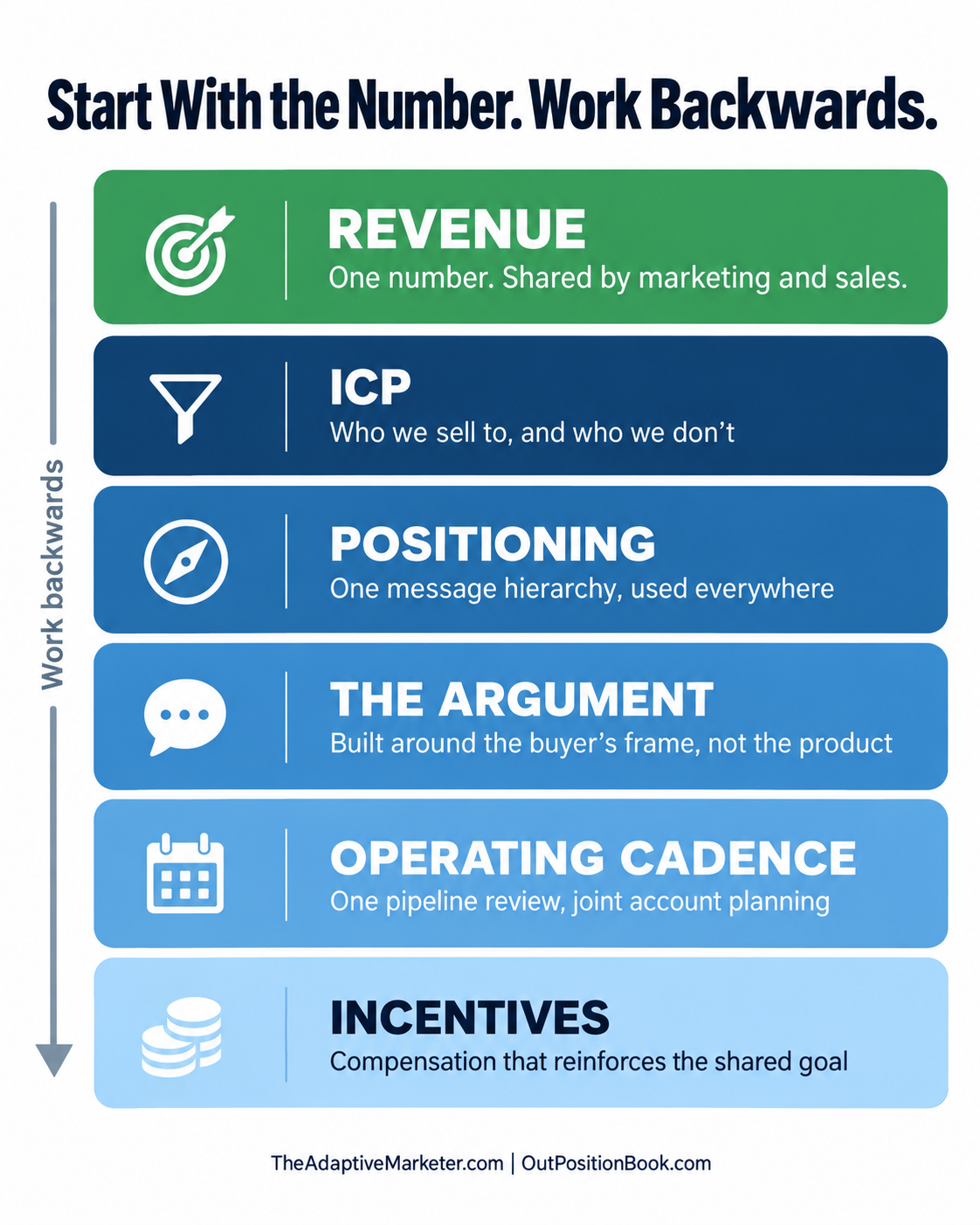
Start with the number. Share it. Then work backwards through ICP, positioning, the argument, the cadence, and the comp plan. It is not fast, and it is not a workshop. But it is the difference between two teams working hard and one company compounding.
If your reps gave five different answers to “what does the company do and why does it win,” the fix starts with positioning. That’s the problem I wrote OutPosition to help solve: how to build a position that’s defensible in the market and simple enough for every rep, marketer, and website page to carry. You can read more at OutPositionBook.com.
This post is based on the conversation in this podcast: One Revenue Engine: Fixing the Marketing-Sales Divide with Gerardo Dada
FAQ – Frequently Asked Questions
Why are marketing and sales misaligned?
Marketing and sales are usually misaligned because of how the organization is designed, not because of the people. The two teams are measured on different metrics, work on different time horizons, see different parts of the customer, and often lack a shared definition of a good lead. Each team optimizes its own scoreboard, so the friction is a predictable result of the system.
How do you align marketing and sales teams?
Start with one shared goal: revenue. Then work backwards through a shared ideal customer profile (ICP), a single positioning and message hierarchy, an argument built around the buyer’s frame, a joint operating cadence, and incentives that reinforce the same outcome. Reorganizing the org chart or adding an SLA rarely fixes the problem on its own.
What is GTM alignment?
GTM (go-to-market) alignment means marketing, sales, and the rest of the commercial team operate from a shared revenue goal, ICP, positioning, and operating rhythm instead of optimizing separate functions in isolation. The term is often used as shorthand for marketing and sales alignment, though strictly it can also include pricing, packaging, and customer success.
Should marketing be measured on revenue?
Yes, revenue should be the shared goal and the ultimate scorecard for marketing, with leads, meetings, and pipeline treated as leading indicators. That doesn’t mean tying marketing bonuses only to quarterly revenue, since marketing also has to invest in long-term work like positioning and brand. The point is that marketing and sales win or lose together.
What is an ideal customer profile (ICP), and why does it matter for alignment?
An ICP is a specific set of firmographic, technographic, and situational criteria that lets both teams look at an account and agree in seconds whether it belongs. It also defines who you will not sell to. Without one, marketing fills the funnel with whoever raises a hand, sales chases whoever answers the phone, and conversion falls while each team blames the other.
Does putting marketing under the CRO fix alignment?
Not really. Reorganizing creates a common boss but doesn’t change how the two teams operate day to day. Alignment comes from a shared operating rhythm: one pipeline review, joint planning on target accounts, marketers listening to real sales calls, and written definitions of every stage.
How do you know if marketing and sales are actually aligned?
Look for second-order signals. Both leaders quote the same pipeline number, reps use the corporate deck because it’s better than what they’d build, and sales asks for help on named accounts instead of “more leads.” The strongest signal is that win rates improve, because alignment shows up in conversion, not in activity.
Why doesn’t a marketing–sales SLA work?
An SLA formalizes an argument without resolving it. If the leads are poor, a 24-hour follow-up commitment doesn’t make them better, and if the incentives conflict, nobody has a reason to honor it. SLAs work only when the underlying goals, definitions, and incentives are already shared.