
Blue Ocean strategy tells you where to sail. Category design is what gets customers to follow
Every industry eventually becomes highly competitive. Competitors converge on the same customers, chase the same features, and compete on the same handful of variables until the water turns bloody with discounting and diminishing differentiation.
This is why category creation seems to be a big topic now in marketing circles. Category Creation is the effort to reframe the problems customers face, and therefore define the solution set (language and buying criteria) to dominate the new space.
Renée Mauborgne and W. Chan Kim in 2005 wrote Blue Ocean Strategy, offering the idea that instead of competing in a highly competitive space (a red ocean), companies should find or create a new one, a blue ocean, an uncontested market space where there are no competitors.
Both Blue Ocean and Category Creation are concepts that guide us towards new categories or spaces to avoid competition. Category creation approaches the problem a more from a positioning perspective, while the blue ocean approach has focused more on innovation strategy. However, as I make the case in my book OutPosition, Strategy, competitive differentiation and Positioning only work effectively when they work together as a system, with each of these three elements reinforcing each other.
In other words, chasing a new space is a strategic effort, that must be grounded in competitive differentiators, and then established in customers’ minds via positioning. You won’t be effective in owning a category if your product does not have the competitive advantages to offer distinct value to customers, solving new problems, and if it is not grounded in a company-wide strategy.
The category graveyard
With Iridium Motorola had created a real blue ocean: a satellite phones with global coverage and no cell towers needed – very similar to StarLink today. The company positioned against mobile phones on price and convenience instead of being framed as a different category centered around connectivity where nothing else works. Motorola lost billions, sold the technology to a company who created the right category around remote, maritime and military use cases and became very successful with it.
Segway, Google Glass, Juicero, Web Van and Quibi are examples of companies that had an innovative product, but the company either
- tried to position against an existing category instead of defining a new one,
- tried to be several things to several audiences at once, or
- assumed the innovation would explain itself without a clear “here’s what this is and here’s why it’s different” frame.
Blue ocean strategy gets you the white space. Positioning is what makes the market actually see it as a category rather than a curiosity. But the opposite problem also exists. Companies who try to create a category, when it is not based on real innovation that solves a specific customer problem.
BMW launched the X6 as a Sports Activity Coupe, coining the acronym SAC to define a category of coupe-styled SUVs. The category naming was simple, people quickly understood what it was trying to be, but the product was not a good SUV with bad cargo and visibility and it did not deliver on the handling of a coupe. Interesting concept, but the innovation was not solving a customer problem. Today there is no category of Sports Activity Coupes.
Crystal Pepsi and Zima were two attempts at defining a “clear beverage” category in the early 90s, banking on the idea that the beverage clarity would be perceived as pure, healthy, and different. The products were a novelty, the category was well defined, but they were another case of differentiation that was not valuable, not grounded in a customer problem.
Category naming and positioning are easy to generate internally, but actual differentiation that serves an unmet customer need is not.
The seduction of Blue Ocean thinking is that it promises to make competition irrelevant. But an uncontested market is not the same thing as a guaranteed one. Chasing a Blue Ocean carries risks. Examples include arriving too early, attracting powerful competitors and other sharks, among others.
None of this makes Blue Ocean Strategy wrong. It makes it incomplete. Choosing to sail into open water is a strategic decision, a choice about where to play. But a strategic choice, on its own, is invisible to the market. Once Blue Ocean strategy tells a company where the opportunity lives, it needs to re-orient the company to build competitive differentiation to exploit it and the positioning of the new category to ensure customers find it, understand it, believe in it, and act on it.
Open water isn’t enough
Customers don’t evaluate companies in the abstract. They evaluate them against a category, which provides the context, a mental shelf that brings with expectations, comparisons, and a reference price (a price anchor, as defined here). A blue ocean or a new category, by definition, has no shelf yet. That absence is the opportunity, but it is also the risk. An uncontested market with no category attached to it isn’t open water to most customers; it’s just confusing.
The concentrated laundry detergents P&G launched in the 1990s failed for exactly this reason. The market space was real. The customer had no framework for believing a few drops could replace a capful, and no one had done the work of building one.
Category design is the discipline that closes that gap. It means giving the new space a name, not just occupying it. Red Bull didn’t just enter the beverage aisle, it created “energy drinks” and became the name people reach for when they mean the category itself.
Five ways to compete on category
A company doesn’t create a category merely by naming one. A category exists when enough of the market adopts a new way of classifying the problem and its solutions. The category provides context, defines competition set, solution criteria, and language. Creating a new one is not easy, and it is not an answer for every company.
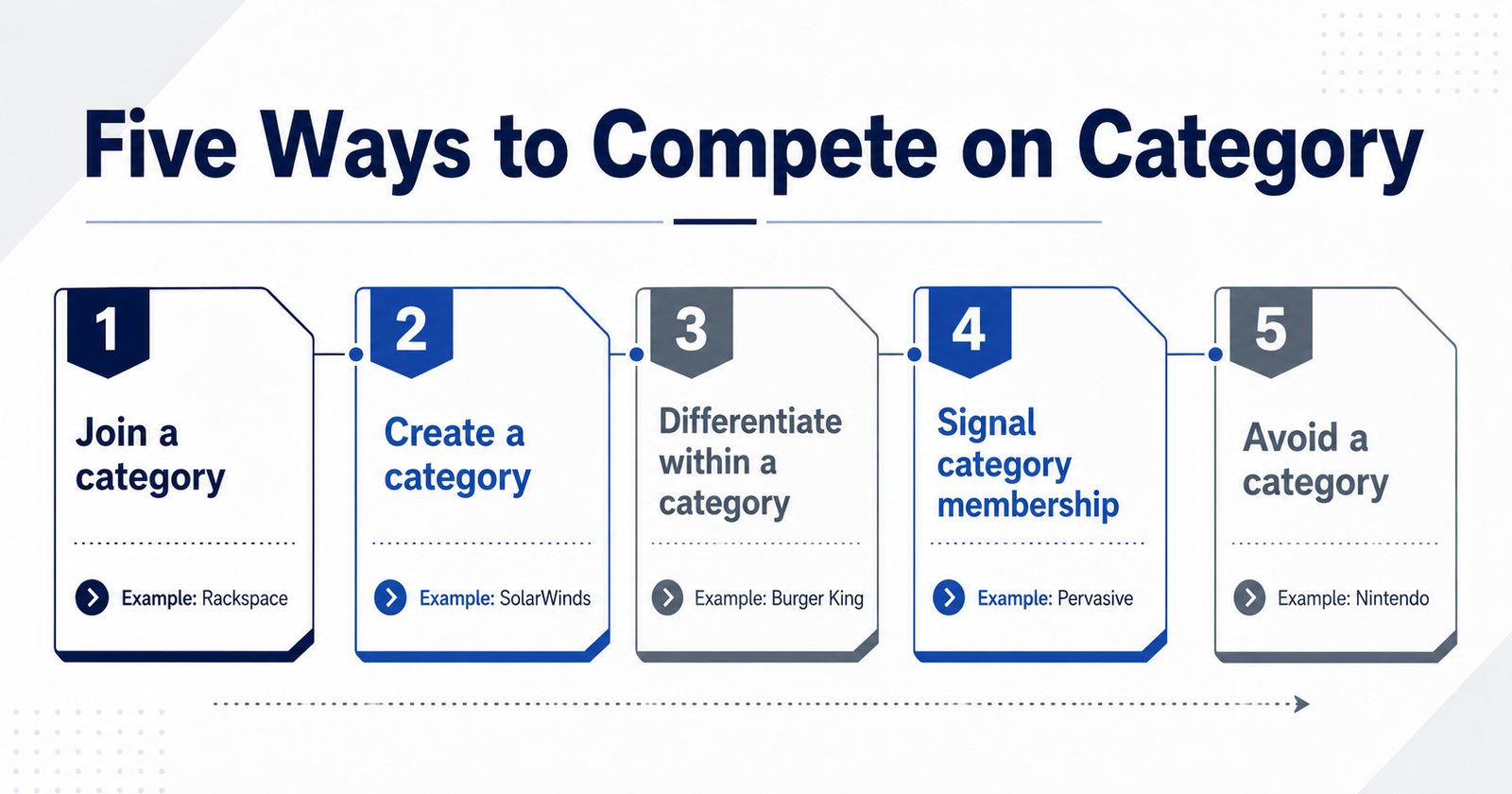
Sometimes you want to join a category that already exists. I joined Rackspace in the early days of cloud computing. Our focus was in educating customers and growing the market. We created Cloud University, helped establish the category, and created the perception that it was a two-horse race in that category between Amazon AWS and Rackspace, which resulted in tremendous growth for the company.
In other cases, you need to create a completely new category. When I joined SolarWinds, the company had just acquired a company that helped improve database performance. After some research I learned this product was uniquely capable for optimizing the performance of a database while the rest of the products in the market were really focusing on health and resource optimization.
Changing the name to Database Performance Analyzer was not enough. We needed to educate the market on the two categories of products as they solved two very different problems. Our marketing education focused on the need for database administrators to look at health and resources with a database monitoring product but also at performance, and the benefits of using a wait-time analysis as the right solution for performance optimization.
We worked with industry experts, partnered with 3rd party sites, and invested in thought leadership to establish this new category in the market, which resulted in triple digit growth for the product. At Catchpoint we had a similar situation where the product was already solving a different problem, and we had to create and educate the market about the category.
In many situations, the answer is not to create a category but to add an attribute to your product to differentiate within your category. Burger King is not in a different category as McDonald’s. Their flame broiled burgers solve the same problem, with a slightly different product. Similarly, Island tried to create a new category of secure browsers, but security was simply an attribute of a browser, not a new market problem, and the existing browser vendors added similar security capabilities, neutralizing the efforts to create a new category.
Sometimes you want to signal membership in a category. At Pervasive, we were in the middle of the internet boom. Our database product was very capable, but we needed to signal the market that the product worked with the new internet technologies. We launched SQL 2000i, with the I indicating it’s focus on supporting internet technologies. We were signaling the market our membership in a category with our language.
Nintendo is an interesting case of a company who wanted to avoid an existing category. In 1983 the video game industry crashed wiping out consumer and retailer trust in the category. Nintendo was launching the NES in 1985. Rather than positioning it as a video game console, Nintendo launched it as a Family Entertainment System with a front-loading cartridge design that resembled a VCR rather than the toy-like consoles of the Atari era, and bundled it with a light gun to reinforce the framing of a novelty toy.
Seven moves that build a category
None of the paths above are simple to execute. Creating a category is the most difficult of the five. It requires a deliberate sequence of activities to give it the biggest chance to succeed.
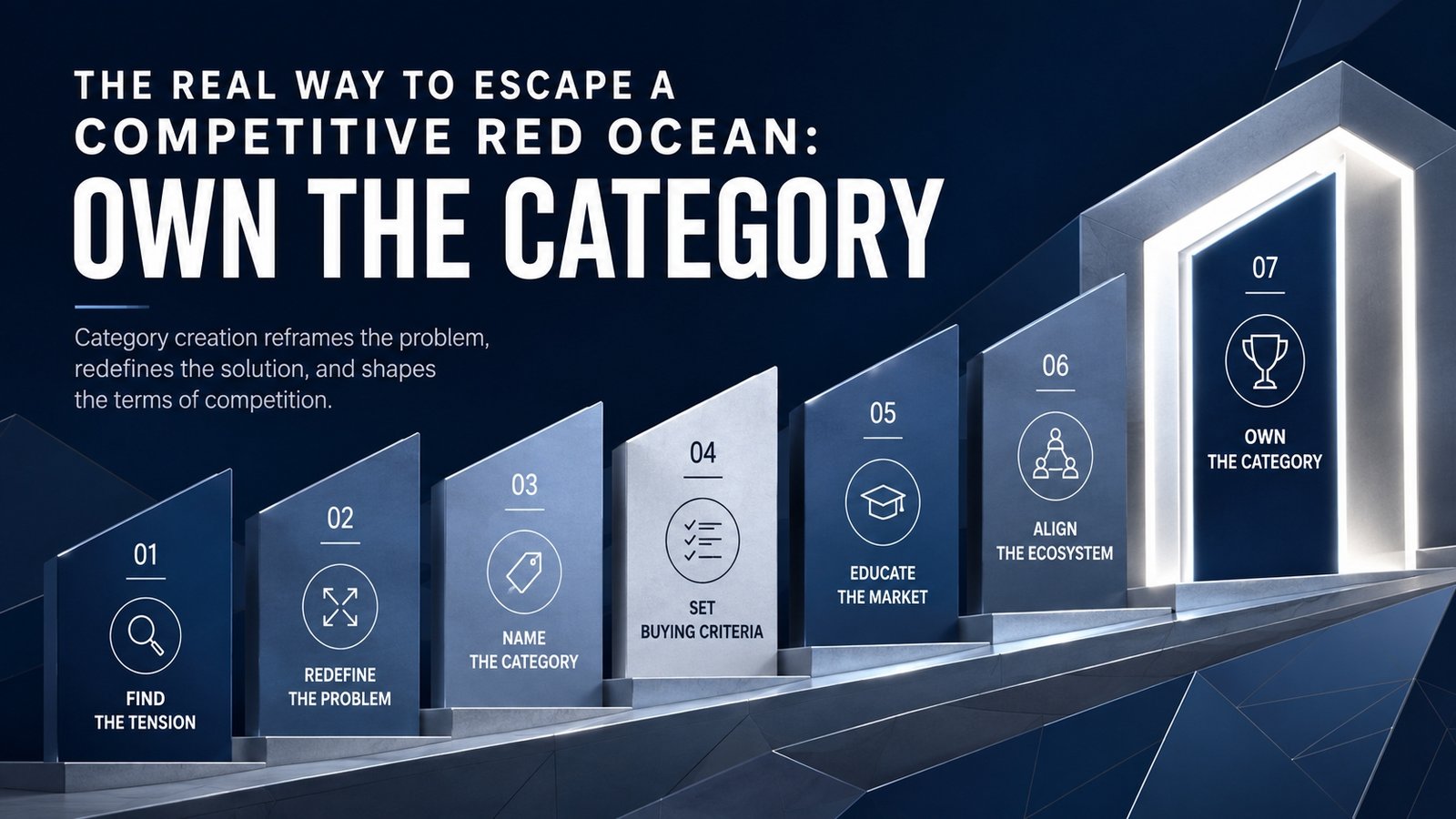
- Find the tension in the market. A category cannot be defined by a company or by a set of features. Categories are created when there is an unmet need, a problem that is ignored by current market leaders, or a new market that does not have a solution that satisfies customers.
- Redefine the problem. Pick an enemy: either a bad practice, a consequence of the problem, a solution that is not ideal, or a competitor that is the antagonist to the new brand. Salesforce picked no Software.
- Establish the vocabulary. Give your problem an intuitive, descriptive name and name the solution. The language you define is intended to give customers a mental model for the problem before asking them to accept a new category. Consistency and repetition are important. Use analogies and borrow terminology from similar concepts that make the problem easier to understand.
- Define the solution criteria. Explain the new priorities and requirements to solve the problem. Categories become important when they connect to outcomes. When there are strong proof points.
- Educate the market. The best form of marketing is education. Don’t sell the product. Promote the problem, explain why it is important, and how it needs to be solved, introducing the new solution and the category. Then your product is a natural fit.
- Promote alignment. You do not create a category when you say it. You start to build it when the market, press, industry analysts, influencers customers, partners, and even competitors repeat your language.
- Align execution and reinforce your advantage. Category creation is a company operating model, not a marketing project. Category creation and positioning are not merely marketing activities. They work when they are connected with the company strategy as a system. They are effective when marketing, product, sales, analysts, content, brand, and revenue goals are aligned around the same narrative.
These seven lessons sound easier than they are to execute. When applying them against a real market, with real stakes and a real competitor set they may not sound as intuitive.
A good example to illustrate them is tequila: a category so saturated that a new entrant’s odds of standing out through price, packaging, or advertising alone are close to zero. Here’s what it looked like when someone found the tension in that market and built a category around it instead.
How one bottle beat 3,000 brands – the cristalino play
Tequila is a popular drink, a saturated market (a red ocean) with 200 distilleries and 3,000 brands. Even if a tequila brand comes up with aggressive pricing, creative advertising, and flawless execution, for consumers it will likely look like yet another brand.
In 2008, Juan Domingo Beckmann, from Maestro Dobel, launched Maestro Dobel Diamante, the first “cristalino” tequila. Beckmann was looking for a product that maintained the complex flavor of an añejo tequila with the clarity and freshness of a white one. He achieved it by taking an aged tequila through the right filtration process to remove the color and harshness while conserving the complex flavors that result from aging in a barrel, resulting in a good flavor with extreme smoothness.
The new category made tequila more drinkable for a segment of the market that previously found the liquor too harsh on their throat, created a differentiated offering, and promoted the practice of sipping premium tequilas.
Today, cristalino tequilas represent about 40% of the premium tequilas sold in the World. The category is growing at 15% annually globally. In the third quarter of 2024, the company reported a 300% growth in profits resulting from the “Dobel effect”: selling a lower volume of inexpensive products but a higher volume of premium, high-margin tequilas.

Category Creation Is the Advantage Competitors Can’t Copy
Category creation isn’t a naming exercise, and it isn’t a substitute for strategy. It’s what happens when a real competitive advantage gets translated into language the market can adopt — a new shelf, not just a new label. Blue Ocean tells you where to sail. Category design is what makes sure the market actually finds you once you’re there.
Most companies won’t need to create a category. Some will find more leverage joining one, or differentiating sharply within one they already compete in. But when the opportunity is real — when you’re solving a problem no existing category name captures — category creation is one of the few strategies that turns a product advantage into a market position competitors can’t simply copy their way into.
If you want to learn more about this topic you may want to listen to the FrontLines podcast on Category creation, or consider reading OutPosition, the practitioners guide to strategy, competitive advantage, and positioning.