
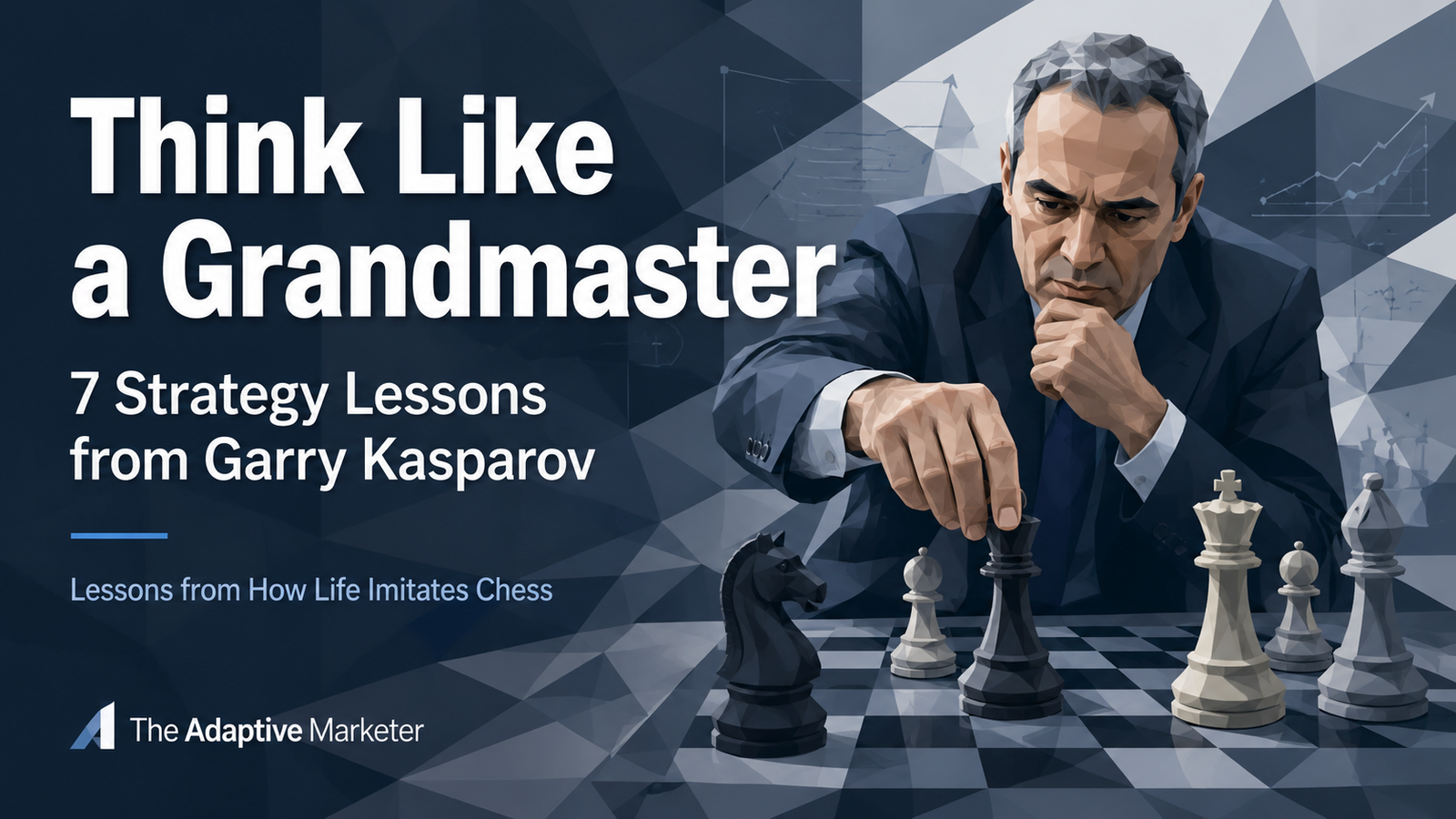
What a Chess Champion Can Teach You About Strategy (You Don’t Need to Know Chess)
Garry Kasparov was the best chess player in the world for twenty straight years. He became World Champion at twenty-two and held a version of the title until 2000. Then he wrote How Life Imitates Chess, looking back at how he made decisions under pressure, and tried to write it down.
It’s no surprise that people draw parallels between chess and strategy. Both are competitive intellectual exercises built on a sequence of decisions and the responses they provoke. Both demand careful observation, analysis, and creative thinking. And both require understanding the strengths, weaknesses, and potential contribution of each piece at any given moment.
But you don´t need to know chess (or even like it) to appreciate the insights from Kasparov on strategy. The board was just his laboratory. What he is really studying is decision-making under uncertainty, with imperfect information, against an opponent who is also trying to win. Below are the principles that translate most directly from his board to your business — and how to actually use them.
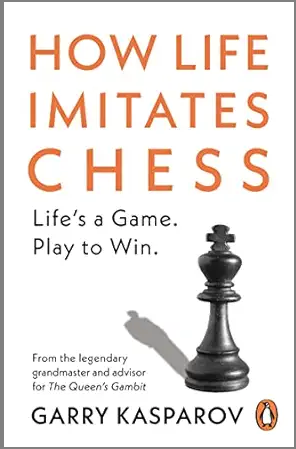
1. Strategy is the “why.” Tactics are the “how.” Most people confuse the two.
Kasparov draws a sharp line between strategy and tactics, and it is the line most businesses blur. Tactics are what you do when there is something to do — the immediate calculation, the move in front of you. Strategy is the long-term plan that tells you which moves are even worth calculating.
His warning is the one I wish every team I have worked with had tattooed somewhere visible: if you play without a strategy, your decisions become purely reactive, and you end up playing your opponent’s game instead of your own. You get pulled from one urgent thing to the next, always responding, never directing.
This is the single most common failure mode I see in marketing. A competitor launches something, so you scramble to respond. A new channel gets hot, so you chase it. A board member reads an article, so you pivot. None of these are decisions. They are reactions. And a year of reactions does not add up to a strategy — it adds up to exhaustion and a brand nobody can describe in a sentence.
The fix is not complicated, but it is hard: decide on a strategy before you decide what to do next. When you have a real strategy, half the “urgent” decisions answer themselves, because they are obviously off-plan.
2. Evaluate every move with one question: why this, and why now?
Kasparov’s most practical advice is embarrassingly simple. Before making any move, you must ask: What am I trying to achieve, and exactly how does this action get me closer to that goal?
Imagine running that exact test against last quarter’s marketing calendar. The rebrand, the event sponsorship, the aggressive new campaign—for each one, why this, and why now? How does it advance the core strategic objective?
In my experience, most executive teams cannot cleanly answer this for their top projects. More often than not, initiatives exist simply because they existed last year, because a competitor did it, or because a senior leader championed a pet project. That isn’t strategy. That is momentum wearing a strategy costume.
“The discipline of justifying each move against the goal is what separates a deliberate operator from a busy one.”
Every move carries an immediate opportunity cost. In chess, as in business, time is a finite resource. You only get one move before the market responds. Every dollar, hour, and ounce of focus spent on a low-conviction project prevents you from deploying those resources where they could actually move the needle.
Busy is easy—anyone can fill a calendar with activities. Deliberate is rare. It requires the discipline to stop the clock and ensure that every single play is an intentional step toward winning the game.
3. Know your own style — and play positions that suit it.
One of Kasparov’s sharpest insights is that great players don’t copy each other; they dictate the nature of the contest. Master players develop a distinct personal style and deliberately steer the game toward positions where that style becomes an unfair advantage. Kasparov watched grandmasters stumble not from a lack of skill, but because they allowed themselves to be dragged into a style of play that favored their opponent.
For business strategy, the lesson is clear: never fight a competitor on their terms. If you are positioned around trust and partnership, don’t let the procurement process reduce you to a checklist. If you are outpositioning the market with a brand new category, refuse to be dragged into a feature-war slugfest.
We executed this exact playbook at Catchpoint. Most monitoring vendors were fighting for the same ground: observability inside the data center. Instead of trying to out-feature them on their own turf, we changed the board entirely. We argued that the internet had become the new corporate network, and no one was watching it. By reframing the category, we forced the competition onto terrain that favored our unique strengths, rather than fighting to be marginally better at a game they had already defined.
4. Sometimes the strongest move is to improve your position, not to attack.
Kasparov admired strategists who understood that having nothing forcing to do does not mean doing nothing. When there is no winning attack available, the best players quietly improve their position — strengthening a weak point, freeing up a constrained piece — so that when the moment to strike arrives, they are ready and their opponent is not.
Translate that to business and it becomes patience with a purpose. Not every quarter has a big swing in it. In the quiet stretches, the temptation is to manufacture activity to look busy, or to force a launch before it is ready. Even worse, many use this time to diversify, grow their portfolio, and to expand to new markets instead of reinforcing their strategy and solidifying their position in the market they are winning.
The disciplined move is to use that time to strengthen your foundation: sharpen the positioning, fix the leaky funnel, build the content engine, develop the team, deepen customer relationships, invest in long-term projects. None of it is flashy. All of it compounds. When the opportunity comes — and it always does — you strike from strength.
5. Intuition is earned. It is not a shortcut around the work.
Garry Kasparov defines intuition as the bridge between conscious preparation and unconscious execution. He calls it the “bedrock of our decision-making,” but he is careful to demystify it. Intuition is not a magical alternative to analysis; it is the compressed product of it.
A grandmaster who “just sees” the right move can do so only because they have internalized thousands of hours of patterns, failures, and study. Chess masters relentlessly study other top players, their styles, their strategies, and even specific moves. Their gut is educated through careful analysis.
In business, the same rule applies: a marketer who has built, run, and dissected a hundred campaigns has an intuition worth trusting. Someone who hasn’t done the reps just has a guess wearing intuition’s clothes.
Kasparov notes that we train this subconscious performance by being deeply, painfully conscious of our choices during post-game analysis. By studying every style and dissecting every failure, you build a mental library.
The ultimate payoff of this educated intuition is the ability to know exactly when to break the rules. In chess, that looks like a positional sacrifice—giving up material because your instinct tells you that you are gaining long-term control. In market strategy, it means looking at immediate, linear data that tells you to play it safe, and choosing instead to make a bold strategic bet because you recognize a deeper macro-pattern your competitors can’t see.
6. Preparation wins, but over-preparation paralyzes.
Kasparov was famous for the depth of his preparation. He would study opponents and positions exhaustively. But he was equally clear about the trap on the other side: thorough preparation is essential, yet over-preparation leads to analysis paralysis, where the sheer volume of information and possible outcomes freezes you from deciding at all.
Every leader has felt both sides of this. Under-prepared, you walk into the big decision exposed. Over-prepared, you commission the fourth study, demand more data, and let the window close while you “make sure.” Both are failures. The skill is knowing when you have enough to act — and acting.
Prepare hard enough to understand the position deeply, then accept that no amount of analysis removes all the uncertainty. At some point judgment has to take over from calculation. The people who win are not the ones with perfect information. They are the ones who make a strong decision with good-enough information while their competitors are still analyzing.
7. Know yourself, including your biases.
Kasparov wrote extensively about self-awareness. He argues we should be as vigilant about our own preferences and blind spots as we are about our opponent’s. We naturally drift toward what is comfortable and conventional, and we mistake that comfort for sound judgment.
This is the hardest one, because it is about you, not the market. Do you avoid the bold repositioning because the data says no — or because it scares you? Do you keep funding the channel because it works — or because you built it and your ego is attached? Do you reject the contrarian strategy because it is wrong — or because it is unfamiliar?
The best strategists I know have an almost uncomfortable honesty about their own tendencies. They know what they are inclined to over-rate and under-rate, and they build that correction into how they decide. Strategy is hard enough when your only opponent is the competition. It is impossible when you are also fooling yourself.
Kasparov noticed most players would compete in the category of players of similar skill rather than signing up to the open category where the masters played. He argued that losing 8 games to masters would teach you a lot more than winning 6 games and losing 2 against people of your same skill. ¨The only way to grow is to get out of our comfort zone and venture into the unknown¨
8. What Kasparov Learned About AI — 20 Years Before It Mattered
Garry Kasparov’s 1997 loss to IBM’s Deep Blue was framed at the time as a referendum on human intelligence itself — man versus machine, with civilization’s pride riding on the outcome. It’s a framing that feels familiar today, replayed almost verbatim in every debate about AI replacing knowledge workers, strategists, and creatives.
But Kasparov’s own conclusion, looking back, complicates the simple narrative. He didn’t argue that the machine won and humans lost. He argued that the frame itself was wrong. The real breakthrough came later, when he pioneered what’s now called “advanced chess” or “centaur chess” — human players paired with computer engines, competing against other human-computer pairs. What he found was striking: a strong player with a weak machine and a good process could consistently beat a supercomputer running alone, and could even beat a grandmaster paired with a stronger machine but a worse process.
The insight wasn’t that computers are powerful calculators and humans bring soul. It was more specific than that. Computers are exceptional at tactical calculation — seeing further, faster, without fatigue or ego. Humans bring intuition: the ability to sense which lines are worth calculating in the first place, to recognize patterns that don’t reduce to brute-force search, to know when a “correct” move is strategically hollow. Neither is sufficient alone. What wins is the process that combines them — a discipline for deciding when to trust the machine’s calculation and when to override it with judgment.
That’s the part of the story that gets lost in today’s AI conversation. The question isn’t human intelligence versus artificial intelligence, and it isn’t really even “human plus AI” as a vague aspiration. It’s whether you have a process — a discipline — for combining the two. Most organizations racing to bolt AI onto their workflows are skipping that step. They’re either deferring to the machine’s output uncritically, or ignoring it and working the old way. Kasparov’s centaurs did neither. They built a third thing.
Summary – The Real Lesson
If you read Kasparov hoping for a clever formula, you will be disappointed. His most honest admission is that better decision-making cannot really be taught — but it can be self-taught, by rigorously analyzing your own decisions and learning from them. The method is a habit of mind, not a template.
That is the strategic mindset in one line: deciding on purpose. Knowing why you are doing what you are doing. Choosing the game that favors your strengths instead of accepting the one handed to you. Doing the work that earns real intuition. Preparing deeply, then having the nerve to act. And being honest enough with yourself to see your own blind spots before your competition does.
None of that requires you to know how a knight moves. It just requires you to stop reacting and start choosing.
That is harder than it sounds. Most people will not do it — which, as with so much in business, is exactly why the ones who do stand out.