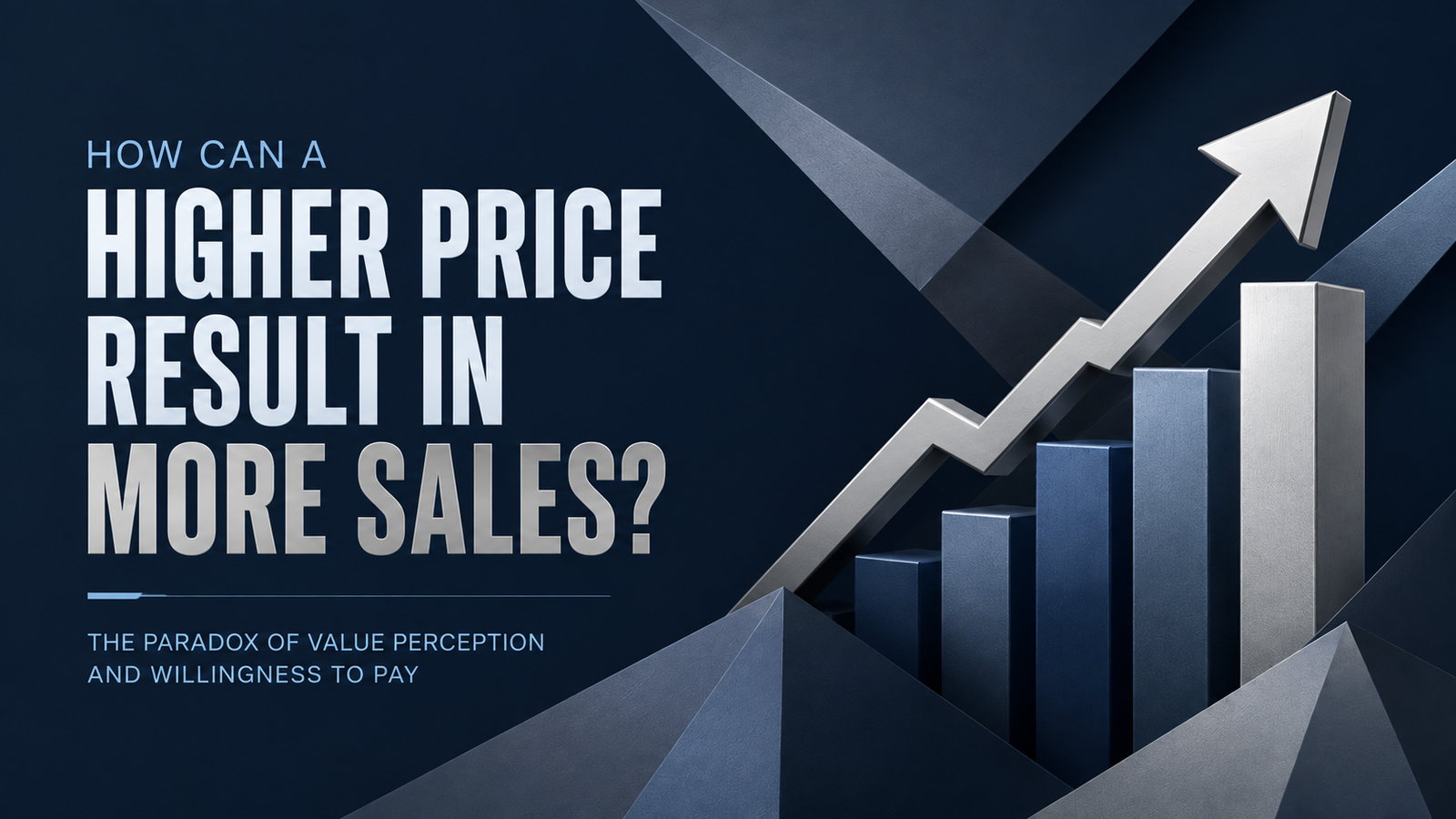
The concept of sales going up with a higher price is counter intuitive. It goes against the basic concept of price and demand taught in school. It defies the ‘law’ of demand. But it is real. Here are a few examples:
- I wrote about British Airways doubling the price of the Concorde transatlantic tickets with no decrease in sales and a dramatic increase in profits in A Pricing Lesson from the Concorde it’s one of my most popular posts.
- One developer doubled the price of his software from $9.99 to $19.99, hoping to at least hold onto revenue — instead, daily sales jumped tenfold with no change in traffic or marketing. Here is the story.
- A founder selling vertical-market software was originally selling it at $3K. On a consultant´s advice he doubled the price with no impact to sales volume, effectively doubling revenue overnight.
- Jacques Mattheij, an entrepreneur quadrupled subscription prices with no impact on unit sales, effectively finding a 4x sales increase with the same demand.
But the question we need to ask us is Why? Increasing price is fantastic for any business because the additional revenue goes straight to the bottom line. If you have been reading this blog, you know I am a fan of leading with value rather than discounts. Not that I ever advocate abusive pricing, which is simply a form of bad profits.
Back to the question – Why is it that customers are willing to buy more products at a higher price? The answer is straightforward: price communicates value. Maybe we can be bolder: price establishes value in the mind of customers.
Imagine I told you I just found a wonderful whiskey that sells for $5 a bottle. It is not credible. Your first thought may be that I don’t even know what is good whiskey (and you’d be right, but that’s another story). Conversely, when you are at a restaurant and you see a bottle of wine priced at $150. you immediately assume it is of very high quality.
You can charge more money for a product and see higher sales when your price and the value you deliver to customers is not aligned. In other words, when you are leaving money on the table.
How do you know if you are in this situation? The first and most common clue is when the price for your products or services is determined using a cost plus model. You have a target profit margin that gets added to your total costs and that becomes the price. This happens often when finance is in charge of pricing. The alternative is value-based pricing.
Building a value-based pricing model requires understanding your customers, what aspects of your product or service they value, and how they quantify that value. Often times, the value customers put in a product or service is determined by pricing anchors. Pricing anchors are prices in the mind of the customer that provide a range of costs for a product, a service or to solve a problem.
Pricing anchors are the reference points customers use to judge the relative price of your products. One effective way to set these anchors deliberately is Goldilocks Pricing, which consists in offering three pricing tiers: low, medium, high or good, better, best. I am sure you have seen this. With this tactic, customers judge each option relative to the others rather than in isolation.
The lowest tier makes the middle one feel affordable, the highest tier makes the middle one feel like a smart value rather than a splurge, and most buyers gravitate to the middle, which is often the exact option you wanted to sell all along. It’s the same anchoring effect at work in the Olay example below, just engineered on purpose rather than discovered by accident.
For now, imagine you need to replace the furnace in your home. You may think a furnace is going to cost you somewhere between $700 and $1200 (these are made up numbers) Whether those figures reflect the range of prices in the market is irrelevant. When you call the repairmen, you will judge the price based on the range established by these anchors.
As in the post about the pricing lesson of the Concorde, when your price and the expected price are misaligned, you can make a correction without an impact to demand. You can also do this with products that don’t have a strong price elasticity.
Understanding your customer segments, their anchors, their values and their price expectations is fundamental for value-based pricing.
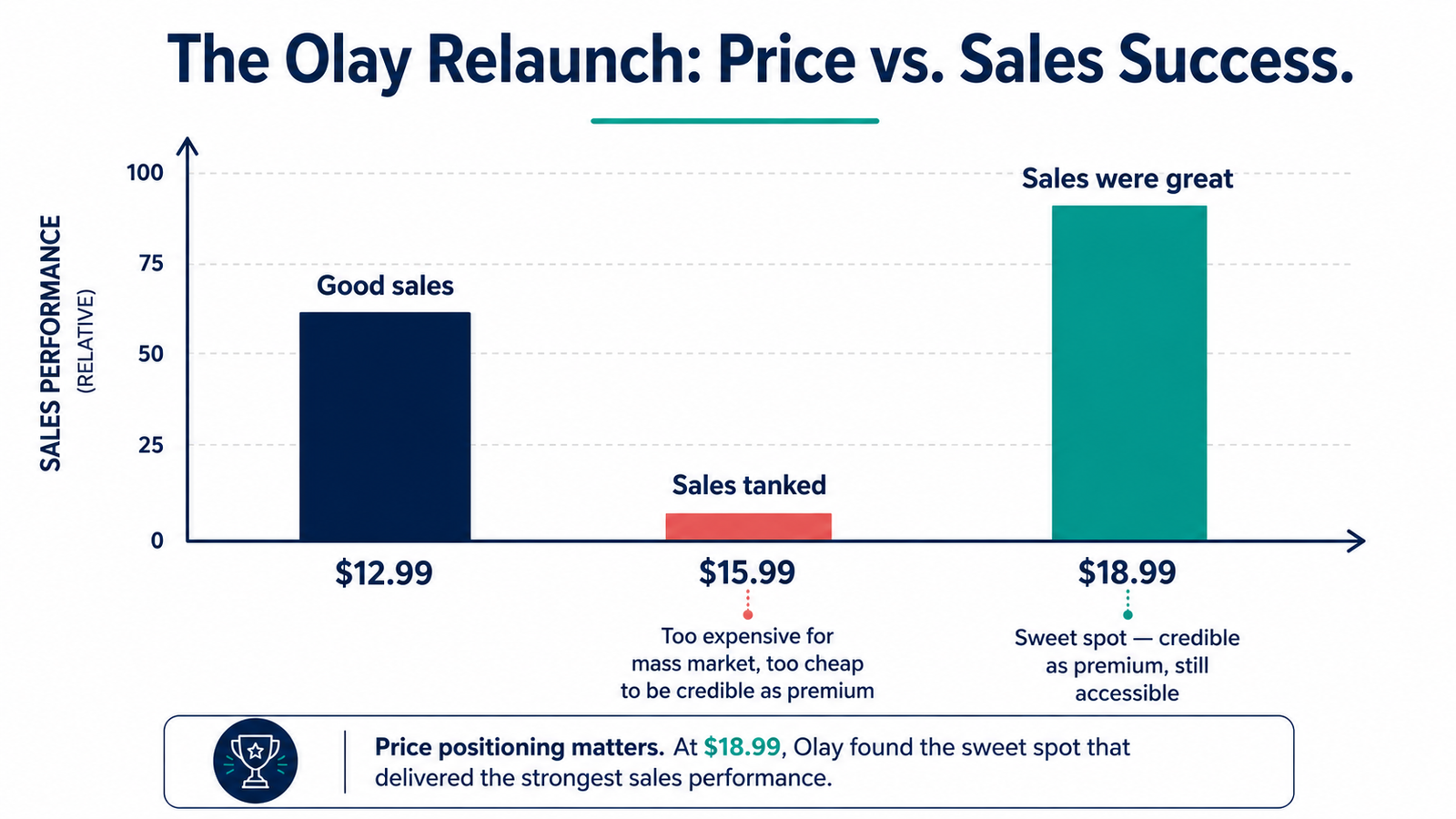
Let’s look at another example: As told in the book Playing to Win , when P&G was re-launching the Olay brand they did test on three prices:
- At $12.99 the sales were good. It was affordable to the mass market.
- At $15.99 sales tanked. Not expensive enough to be considered a premium cosmetic for the mass market, and to cheap to be a credible quality product for the prestige shopper
- At $18.99 sales were great. A good value but not too cheap for premium shoppers, yet credible as premium and still affordable for Mass market
Launching at $18.99, Olay became a $2.4 billion dollar business for P&G with double digit growth and fantastic margins.
Pricing can make or break a business. I want to suggest another resolution for the new year (the first one is at the end of this post): understand the value model for your products and services, and use it to review your pricing strategy.
A Quick Glossary
Cost-plus pricing — Setting price by starting with your total cost to produce or deliver a product, then adding a target profit margin % on top. It’s simple to calculate, but it ignores what the product is actually worth to the customer, often resulting in leaving money on the table or an overpriced product that does not sell.
Value-based pricing — Setting price based on what customers believe your product or service is worth to them (the outcome), rather than what it costs you to make. It requires understanding your customer buyer segments deeply: what they value, how they quantify that value, and what they’d be willing to pay to get it.
Pricing anchors — The reference points customers carry in their minds for what something should cost. Anchors come from past experience, competitor prices, or often guesses. They shape how expensive or reasonable your price feels, regardless of your actual costs.
Goldilocks pricing — A tactic for setting anchors deliberately: offering three tiers (low, medium, high) so customers judge each option against the others instead of in isolation. The role of the lower price is to make the middle one feel affordable and to avoid discounting, providing an option for value-based buyers. The high price makes the middle one feel like smart value.
Great article, explains the power of using value-based pricing very well.