
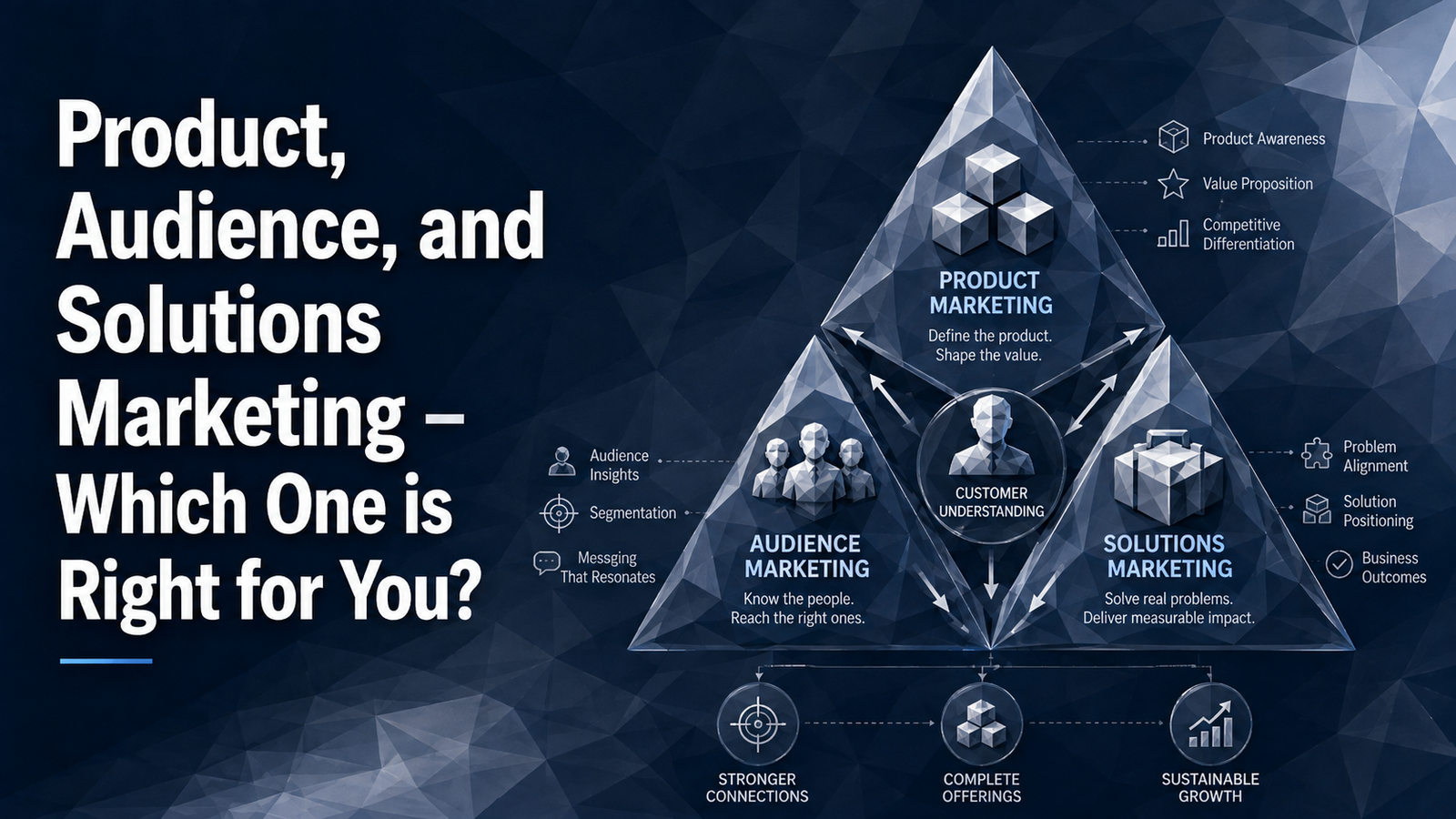
Three terms that describe different teams, disciplines, and functions inside leading organizations. Three terms that are misunderstood, misused, and somewhat mysterious. Let´s eliminate the mystery.
Not for academic purposes, but because these roles can be some of the most critical, most powerful in any organization. Let´s look at each one in sequence:
What Is Solutions Marketing?
Solutions Marketing is a buzzword used by marketers quite often. A buzzword not because it is not an important or a valuable concept, but because it has been both misunderstood and overused, like Big Data and building a Social Business.
A VP of Marketing at a large company once explained solution marketing to his team as “bundling two or more products.” This is one of the worst, but also one of the most common, definitions — and when the concept isn’t understood, it results in very ineffective communications.
I’ve seen a large technology company spend a significant amount of money to have a significant presence at a tradeshow where it introduced itself as offering “Enterprise Systems and Solutions.” Imagine an auto dealer introducing itself as a “personal transportation solutions company” instead of the much simpler and easier to understand “car dealer.”
What Is Solutions Marketing?
Here is my definition: A solution is a complete offering that will solve a customer problem.
- “A complete offering” means it must include all the products, services, parts, training and any other element a customer needs to solve a problem. In many cases it will require including partner offerings.
- “Will solve” implies the company is standing behind the complete solution. It has tested it, and provides customer service and a guarantee for the solution as a whole, not only for its individual components.
- “Customer” in “customer problem” implies solutions need to be defined by customers — independently of how the company is organized, how the products are defined, or what the company’s priorities are.
- “Customer problem” requires us to understand why customers buy our products: what is the intent, what are the complete requirements, and what are the alternatives being considered.
Defining a customer problem is often more complex than it sounds. It’s the thinking behind Jobs to Be Done, a concept popularized by Clayton Christensen, which suggests we understand products as being “hired” by customers to perform certain jobs for them.
HBS professor Theodore Levitt said it best, long ago: customers don’t want to buy a drill, they want to buy a hole. You can take this further — a bundle of a drill and bits can be purchased by a young person who just bought his first home and needs to hang a couple of pictures on the wall, or by a contractor who is planning to build a house with it. Same product, different jobs.
The value of solutions marketing is in putting yourself in the shoes of the customer, understanding their point of view, the problems they are trying to solve, and the value they can derive from the products or services you offer.
What Is Product Marketing?
To many, it could seem solutions marketing is the future. Does that mean product marketing is dead? Not at all. Product marketing is an essential discipline for companies offering complex products.
Product marketing is probably the least understood. I wrote a full post about What is Product Marketing to clarify the confusion but let´s cover it quickly here. My fuller definition of product marketing, along with its responsibilities and required skills. In many organizations, the product marketing team should be the primary driver of solutions marketing activities.
For the purpose of this article, product marketing refers to the activities and customer communications that are product-centric, versus customer-problem-centric in the case of solutions marketing. Product marketing focuses on the characteristics, features, and benefits of products and services.
¨Product Marketing is the function accountable for the success and growth of a product by connecting customer needs to product capabilities. The value of Product Marketing comes from its deep understanding of markets, customers and their needs.¨
There are many product categories where customers don’t want to buy solutions — because they want more control over what the solution looks like, because the solution is better assembled from multiple vendors, or simply because they just need a single product. As when I’m craving chocolate and just need to get a chocolate bar. In this last case, the product is the solution.
In these cases, product marketing may be more valuable than solution marketing. Even when a company pivots to solution marketing, some of its customers may still want to buy individual products. In most cases, product marketing is still required, because the features, benefits, and value of the individual products that make up the solution still matter. The key point: product marketing and solutions marketing are complementary, not competing.
What is Audience Marketing
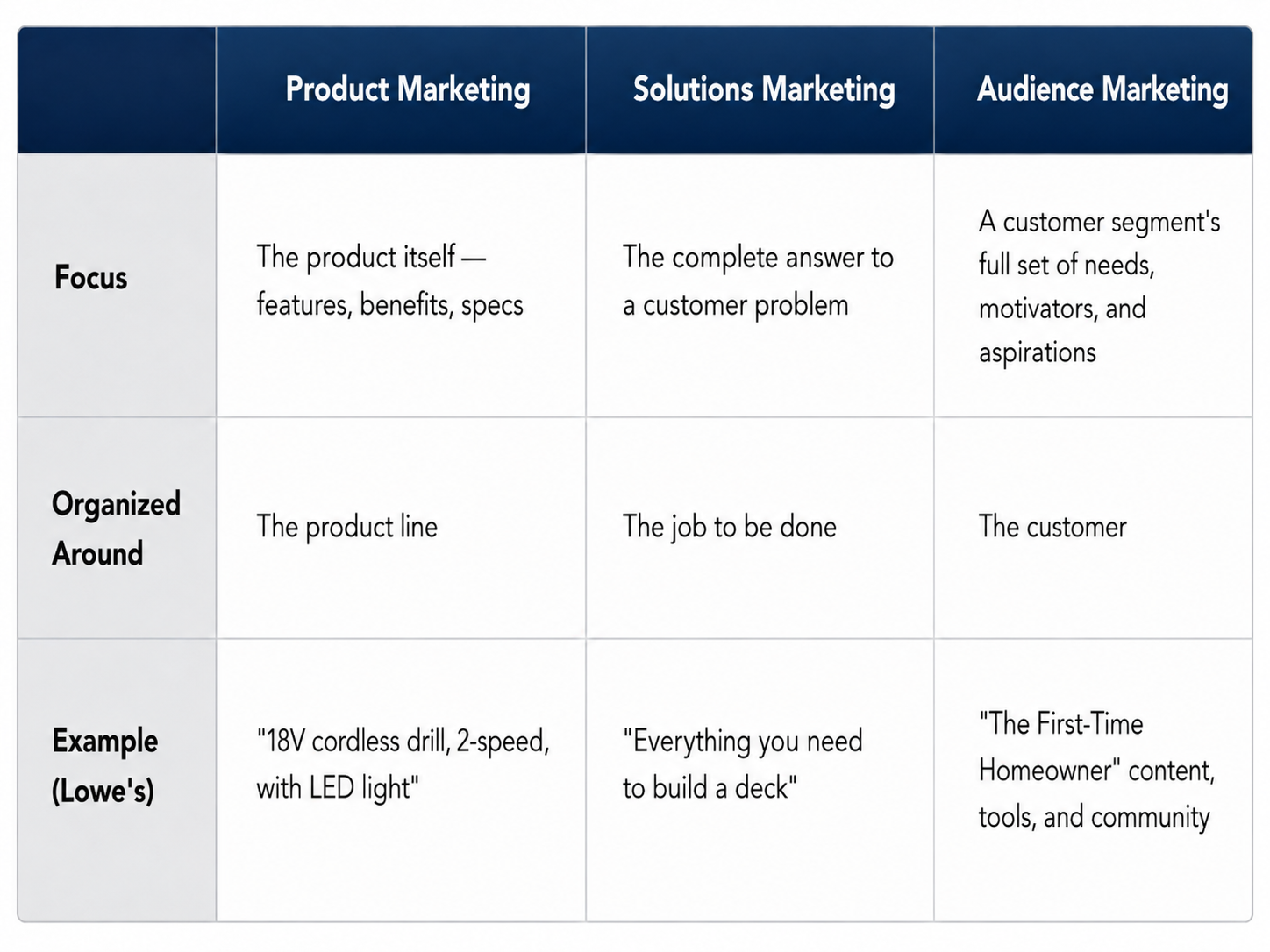
We established product marketing as product-centric, and solutions marketing as customer-problem-centric. Audience marketing is customer-segment-centric.
The role of an audience marketer is to understand a specific customer segment — the collection of problems they’re trying to solve, their personal motivators, their aspirations, their challenges, even their emotions. It’s a truly customer-centric approach to marketing, closer to industry or vertical marketing but with a deeper focus on the person and what they’re trying to achieve.
When I worked as director of audience marketing at Microsoft, I was the customer advocate for two audiences: students and developers. My job was to build a better understanding of both audiences — segmentation, personas, research — and then align company resources and create new programs to serve them better. That included customer experience (online and event strategy), community and social media, relationship marketing, coordinating how we interacted with students and developers across the company, training programs, and defining connected experiences.
My performance wasn’t measured by revenue, as product and solution marketing roles most often are, but by a measure of customer preference: how many developers in the world were using Microsoft technology as their primary tool to do their job. Microsoft took a bold approach to audience marketing — as a complement to solutions and product marketing, not a replacement for either.
Building the Team
An existing marketing team can start a solution- or audience-centric initiative, and it may be the right move for a particular market. But to really increase marketing effectiveness where solutions or audience marketing matter, it’s usually a good idea to establish a dedicated team.
The value of a dedicated team is focus and specialization. It lets the team develop a laser focus on understanding a customer problem or a customer audience, and to build the specific skills the job requires. More importantly, it gives the organization a team whose job is to bring an outside-in view — the true customer perspective — into the business.
Solution and audience marketing tend to carry a higher level of complexity, because they’re new to most organizations and operate in a different context than the core business: each problem or audience may have different objectives, buyers, influencers, partners, competitors, and success metrics, which can require a different go-to-market approach altogether. It may call for a focused thought-leadership effort, participation in different trade events, and engagement with slightly different markets than the core business. Existing marketing teams and programs are often not built for this.
Choosing the Right Orientation
Some companies benefit from having product, solution, and audience marketing teams — all part of the broader product marketing discipline. Others will find they have one main audience and well-understood problems and solutions, and that product marketing is really all they need. Some have too many products and solutions but three or four distinct target customers, which makes audience marketing the highest-value investment. And for those solving a handful of genuinely complex problems, solution marketing may be the better priority.
Here’s the test: look at where your organization’s complexity actually lives: in the product line, in the customer’s problem, or in the customer segment itself — and orient your marketing structure around that, not around habit or org-chart convenience.
Whichever is right for your organization, the goal is the same: align your marketing thinking, strategy, and activities with the market for maximum contextual relevance.
Do that, and you increase the level of customer empathy in the organization — which, especially over the long term, is what drives revenue and customer satisfaction.