
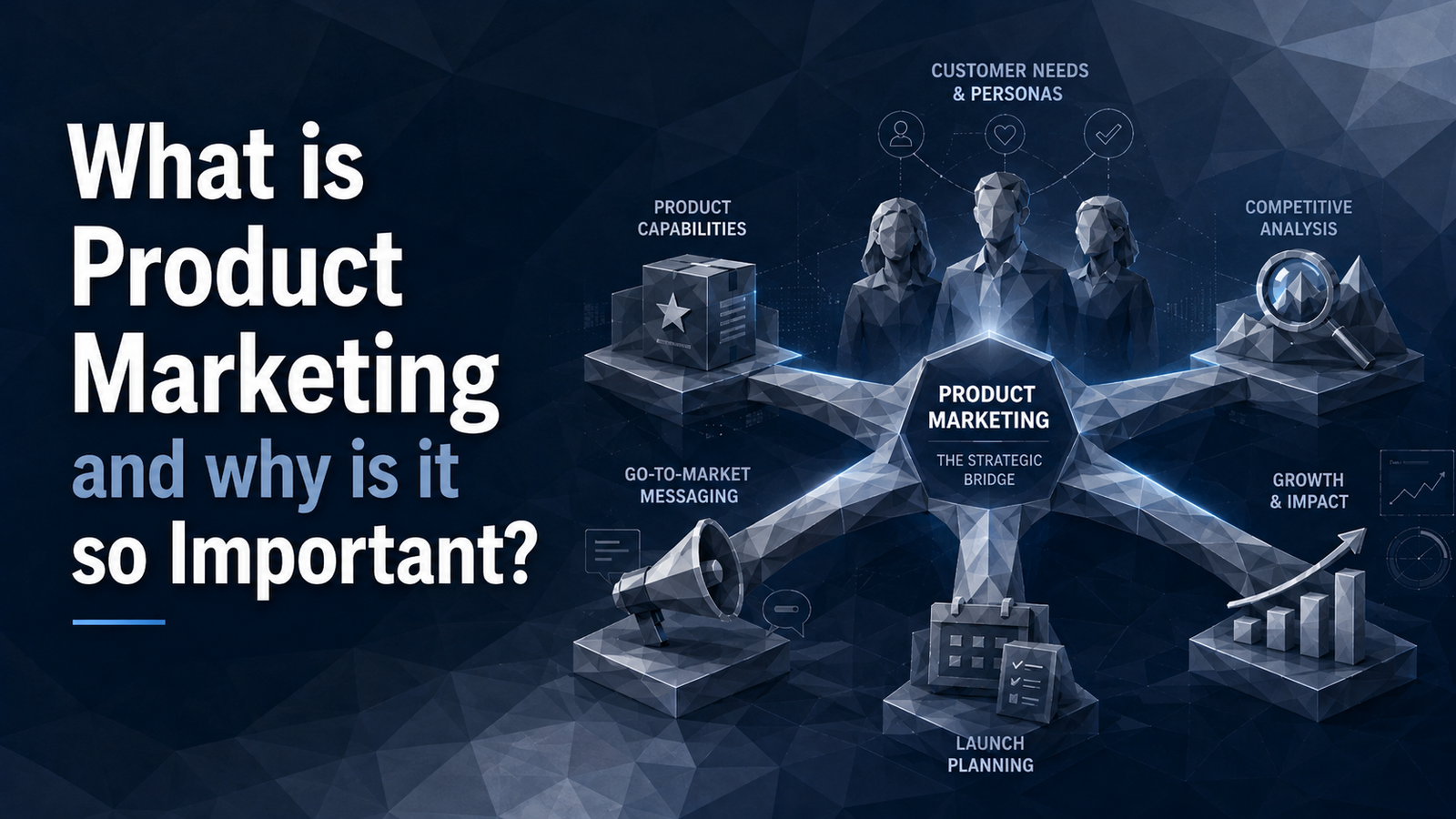
Most technology companies struggle with a fundamental problem: they build great products, but fail to bridge the gap between what they build and how the market buys, adopts, and finds value in it. This gap is where Product Marketing lives.
Yet, if you ask five different tech executives to define Product Marketing, you will get five different answers. Some view it as sales collateral creation; others see it as press release management or product launch coordination. When reduced to these tactical execution tasks, Product Marketing becomes trapped in a perpetual “launch treadmill”—shipping announcement after announcement while customer adoption, sales enablement, and market differentiation lag behind. Most people are unclear how Product Marketing is different from Audience Marketing and from Solution Marketing.
To build a high-growth, durable business, we must answer two fundamental questions: What actually is Product Marketing? and Why is it essential to business strategy?
What is Product Marketing?
One of the biggest challenges for marketers today is that we are too often focused on the most tactical aspects of the job: advertising and promotions, customer contact management, creating content with AI, social media marketing, etc.
We forget that the most important part of marketing, the source of value, is our understanding of customers: what customers want, and how to align your products to their needs and how they buy. Most marketing teams don’t have anyone dedicated to this function.
This is especially important in B2B because buying processes are more complex, there are usually more buyers involved, and products tend to be more technically complex. To solve this problem, aa function that has grown from a supporting role into a strategic one.
At its core, Product Marketing is the strategic glue between Product, Sales, Marketing, and the Customer.
While Product Management is responsible for bringing the product to the market (building the right solution), Product Marketing is responsible for bringing the market to the product (driving positioning, commercialization, and adoption). They should work together as a tight-knitted team, complementing each other, and acting as co-CEOs of the product, with full accountability for revenue and growth.
Product Marketing is the function accountable for the success and growth of a product by connecting customer needs to product capabilities. The value of Product Marketing comes from its deep understanding of markets, customers and their needs.
For more information of the Product Marketing function and the specifics in terms of day-to-day activities, I suggest reading this presentation on defining product marketing .
When Inc. Magazine asked the then CMO of Mozilla’s what is the most critical hire in marketing? Jascha Kaykas-Wolff answered “Without question, product marketing…. If I were a marketer re-starting my career, I would start in product marketing.”
“The aim of marketing is to know and understand the customer so well that the product or service fits him and sells itself.” – Peter Drucker
Product Marketing sits at the intersection of three critical pillars:
- Market & Customer Intelligence: Understanding buyer personas, urgent customer pain points, competitive dynamics, and market trends. PMM is the primary voice of the customer inside the company.
- Positioning & Go-To-Market (GTM) Strategy: Defining the narrative, value proposition, packaging, pricing, and category strategy that differentiates the product in a noisy market.
- Commercialization & Sales Enablement: Equipping revenue teams (Sales, CS, Partners) with the context, collateral, and training needed to win deals and drive long-term customer value.
The Trap: Escaping the Launch Treadmill
In too many organizations, Product Marketing gets trapped in a cycle of tactical execution focused entirely on Launch Day.
Engineering finishes a feature or a module, Marketing coordinates a press release and an email blast, Sales gets a slide deck and some training, and everyone moves on to the next release.
Here is the problem: A launch is an event, but adoption is a process. When you focus exclusively on launch day tactics, your latest launch actually increases the gap between you and your customers.
Think about it this way: Imagine you are building a space station in orbit, module by module. Each new capability or feature you release is like launching a new module into space.
If you simply launch Module C into orbit without connecting it to Module A and Module B—and without creating the airlocks, hallways, and environmental controls for your astronauts (your customers) to move between them—you haven’t built a bigger space station. You’ve just created floating orbital debris.
Your customers are living in the existing modules. If each new release requires a leap of faith across open space to use, most customers will simply stay where they are.
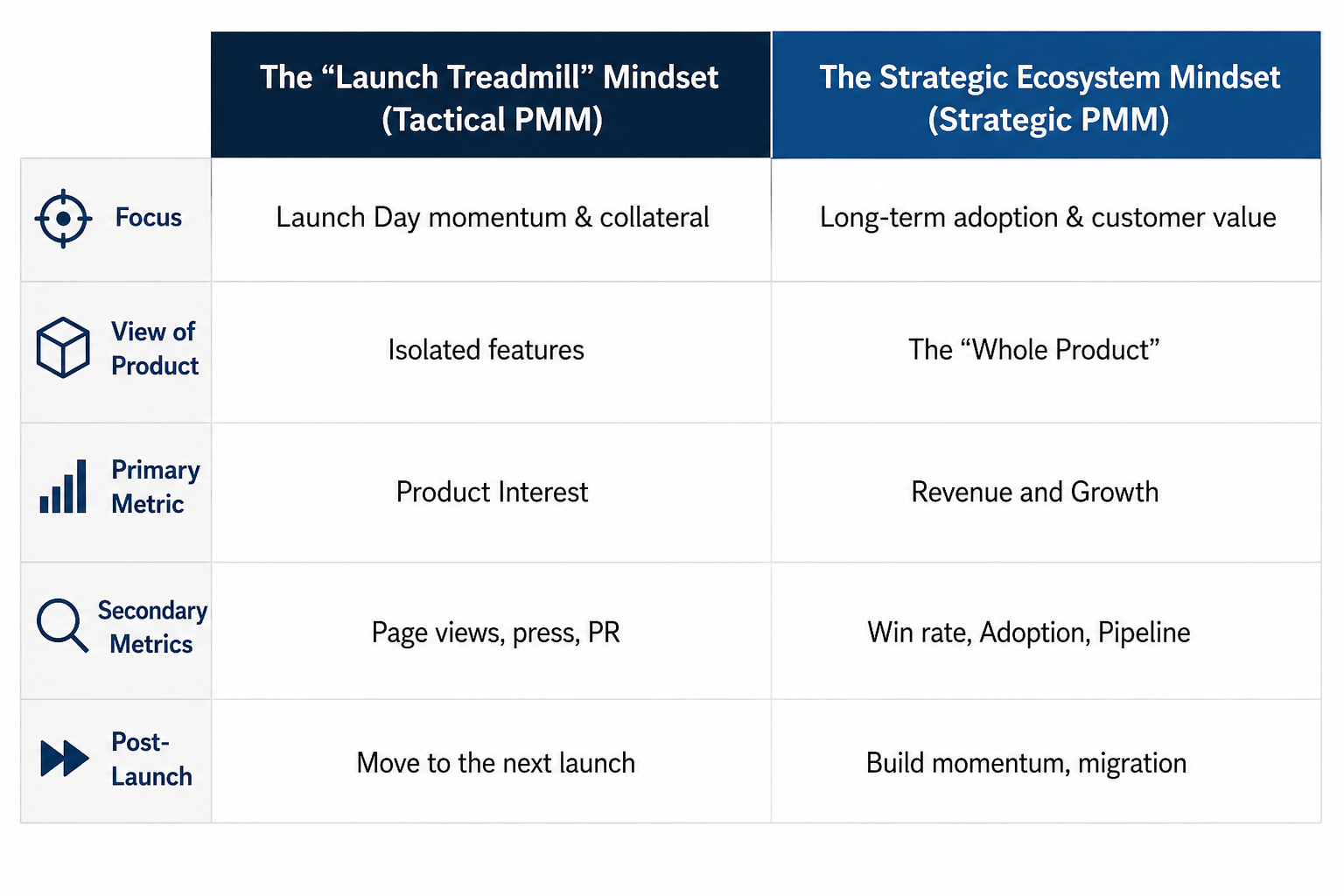
When Product Marketing focuses solely on feature announcements rather than ecosystem connection, it builds fragmented customer experiences, confuses the sales team, and slows down growth.
Why Product Marketing is So Important
Why does this role matter so deeply at an executive level? Because Product Marketing directly impacts the three most critical growth engines of modern technology companies:
1. Higher Win Rates and Shorter Sales Cycles
Unclear positioning forces sales teams to sell on feature checklists and price. Strategic Product Marketing equips reps with the narrative context, competitive landmines, and value frameworks that help buyers understand why you are uniquely qualified to solve their problem. They give them the market context to be helpful to customers and add value.
2. Reduced Customer Acquisition Cost (CAC)
When product positioning is sharp, marketing programs hit with precision. You stop wasting demand-generation budget on broad, unqualified audiences and start landing high-intent prospects who immediately grasp your value proposition.
3. Increased Net Revenue Retention (NRR) and Product Adoption
Acquiring a customer is only the down payment on lifetime value. By focusing on post-launch adoption, migration paths, and expanding the “Whole Product” experience, Product Marketing ensures customers don’t just buy the software—they activate it, embed it into their workflows, and upgrade over time.
The “Whole Product” Imperative
Product Marketing exists to ensure you are selling a Whole Product—not just software or a service.
The core software module is only a fraction of what a customer actually buys. The rest of the product experience consists of:
- Clear Migration Paths: How easy is it for existing customers on older versions or legacy workflows to move to the new capability?
- Ecosystem Integration: How does this release connect with the rest of your portfolio and the customer’s existing tech stack?
- Organizational Readiness: Is Customer Success trained to drive activation? Is Support ready to troubleshoot? Are partners enabled to implement?
- Customer Education: Do users have the documentation, best-practice guides, and workflows needed to derive real business value?
A 5-Minute Diagnostic for Marketing & Executive Leaders
I have observed technology companies start by creating a product management role, which is also responsible for the product marketing function. It used to be they did not want to be called marketers, so they called themselves Growth Hackers. That had fas passed now.
Only when these companies achieve critical mass, they realize there is a gap in their understanding of the market and their ability to connect the product with customer needs. There are clear signs that indicate the way your organization could use help in the product marketing function. Here are a few:
1. Lack of Real Product Strategy . Roadmap discussions and product decisions are made without someone whose main job is to understand the market, customers, competitors, and how to influence them. There is no centralized market research, no advocate for the voice of the customer, no roadmap validation.
2. Underinvested product launch. Decisions to invest in a product do not include a product launch plan and budget. Product launches are not tiered. There is no real customer engagement during product development. At launch, there are no customer success stories and quotes. Analyst, press, and influencers are not aware of the product or how it fits in the overall product vision.
3. PMM focused on Content. Product Marketing is seen almost exclusively as a content shop that owns collateral, website updates and sales training. The product marketing team does not have the focus, skills, investment in time, and resources to develop a deep understanding of products, competitors, markets and customers.
4. Sales Ineffectiveness. Sales reps cannot clearly articulate why you win against your primary competitor in two sentences, and they default to listing technical capabilities or features. They don´t know who their product marketing partners are and don´t invite them to customer meetings and presentations.
5. Tactical Demand generation. Campaign teams, demand generation, marketing and customer growth plans are not being guided by product marketing, as the team who most deeply understands customers. Sales, demand generation, product marketing, and finance are not aligned behind a single dashboard that shows adoption rate, win rate, and revenue which tracked as primary KPIs for everyone.
How successful Product Marketers think about their role
Becoming a successful product marketer and establishing the function as the value and growth engine for the company starts with you. Here is how the successful ones think about their role:
- There are no boundaries. This job is what you make of it.
- Take ownership of the long term success of your products. You are accountable for everything that impacts growth. Think like a business person.
- Balance long-term goals with short-term objectives.
- Lead by influence. Sales and Marketing do not report to them. Their influence should not be small. Product Marketing teams are small. Influence is earned, by adding value, based on their deep understanding of customers and the market.
- Product Marketing is the most cross-functional function in most companies. You are the interface between customers, your marketing team and the product team. Own this responsibility and be the architect of clarity and the enabler of alignment.
- Customer knowledge and insights is job #1. Knowledge is your power. Understand who is your customer, and who is not. What problems customers need to solve and what drives value for them. How they make decisions and who influences them. How they perceive your company and alternatives. And how to influence their choices and preferences.
The value of Product Marketing in the early stages of a company
Earlier this year, a startup founder asked me if an early stage company should prioritize hiring a demand generation leader or a Product Marketing leader. My response was that hiring a good product marketer would help the company in many ways, for example:
- Ensure product-market fit, with better understanding of customer problems
- Sharpen your perfect customer via segmentation, targeting and personas
- Help the company understand competitors, alternatives, and validate competitive advantages. This is where product marketing meets positioning, the subject of my book, OutPosition.
- Ensure all communications, from PR to the website to sales conversations, are consistent in message and aligned with the value you bring to the market
- Help decide between a product-led, sales-led, or hybrid go-to-market motion.
- Determine the best way to capture the value the company creates, in turn adjusting the pricing model
- Build the programs to generate demand, based on how the customer buys, the CPCA, AOV and other key business factors
- Determine the role content marketing, PR, analysts, influencers, partner marketing, community marketing or demand generation should play for the company, its priority and overall strategy
“Marketing starts before there is a product. Marketing is the homework the company does to figure out what people need and what the company should make” Philip Kotler
How AI is changing Product Marketing
AI is changing every function in marketing, and product marketing is no exception. But the change is not what most people think. AI does not make product marketing less important, it makes it more important, as long as product marketers focus on the right things.
1. AI does the production work. Product marketers must do the thinking.
AI can now produce a competitive battlecard, a product brief, a launch email, or a first draft of a datasheet in seconds. Work that used to take a product marketer a week now takes an afternoon.
This is good news. Too many product marketing teams have been treated as content shops that produce collateral on demand. If AI takes over that work, product marketers can spend their time where the real value has always been: understanding customers, markets, and competitors, and turning that understanding into strategy.
There is a trap, though. AI can generate content that sounds right without any real insight behind it. A battlecard written by AI reflects what the AI knows about your competitor, not what your customers told you last week. Insight comes from talking to customers, listening to sales calls, and studying why deals are won and lost. AI can help you process that information faster. It cannot replace it. (I wrote about a similar risk in The Mirage of Data.)
2. Buyers now ask AI. Someone needs to own the answer.
Buyers used to research by searching, reading analyst reports, and asking peers. Today, many of them start by asking an AI assistant. “What are the best tools for X?” “How does company A compare to company B?”
The answer they get shapes their shortlist before they ever visit your website or talk to sales. And if your positioning is unclear, the AI will fill the gap with whatever it finds, often your competitors’ framing of the category.
Product marketing should own this. Which category does the AI place you in? How does it describe your differentiation? Which competitors does it compare you to? Is it accurate? What content do we nee3d to publish and where to ensure LLMs understand our products and our advantages? Few companies have assigned anyone to these questions. Product marketing is the natural owner, because it is ultimately a positioning problem.
3. AI products are harder to position.
If you market an AI product, or a product with AI features, differentiation is harder than ever. Competitors can match a new feature in a matter of months. “AI-powered” has become table stakes. When everyone claims the same capabilities, features stop being a reason to buy.
Differentiation has to come from something harder to copy: deep understanding of a specific customer problem, proprietary data, workflow integration, trust, or a clear point of view about the category. That is a positioning challenge, not a features challenge.
AI is also changing how products are priced. Many companies are moving from per-seat pricing to usage-based or outcome-based models. Capturing the value your product creates, one of the core responsibilities of product marketing, is becoming more complex and more strategic.
The bottom line: AI raises the bar for product marketers. The ones who see their job as producing content will be replaced by tools. The ones who see their job as understanding customers and shaping how the market perceives their products will become more valuable than ever.
Conclusion
Product Marketing is not an auxiliary support function for the sales team, nor is it a glorified content or launch machine for product engineering.
It is the strategic discipline that aligns what you build with how the market buys.
When you move away from the launch treadmill and empower Product Marketing to drive positioning, ecosystem connectivity, and long-term adoption, you stop shipping isolated features into open space—and start building a connected, high-value solution that dominates your category.
For a deeper look at the day-to-day work, I created a free four-lesson Product Marketing Course on YouTube covering how to understand markets and customers, define positioning, and build messaging.
7 Replies to “What is Product Marketing and why is it so Important?”
Comments are closed.