
Peter Drucker, the father of modern management, wrote that a business has two, and only two, basic functions: marketing and innovation. “Marketing and innovation produce results; all the rest are costs.” He also called marketing the distinguishing, unique function of the business.
Quite an endorsement. And a great responsibility.
Yet in many companies, marketing is seen as the opposite: a cost center, a service department for sales, the team that makes the slides and runs the events. When budgets get cut, marketing is often first in line. Outside the company, marketers rank somewhere near used car salesmen in trust.
Where value comes from
A hundred years ago, companies won because of the products they built. Then they won by building distribution, getting their products into as many markets as possible. Then products became ubiquitous, and advertising emerged to create preference for one product over another.
Today, very few products are truly unique. Manufacturing is global, features get copied in months, and AI is making it faster and cheaper than ever to build software. When products look alike, customers don’t pay for the product itself. They pay for the value they perceive.
That perceived value is created by marketing. Financially, brand value is what customers are willing to pay for a brand above a generic product with the same characteristics. Coca-Cola’s brand alone is worth tens of billions of dollars. Microsoft and IBM, which sell mostly to businesses, have brands worth billions too.
The clearest way to see how marketing creates value is to look at commodities.
The most expensive commodities in the world
There is no bigger commodity than water. It covers most of the planet and literally falls from the sky. Yet I recently paid $7 for a small bottle at a hotel, more per gallon than gasoline. We pay for the perception of purity and health, and for convenience: the same bottle costs a fraction of that at the store a block away.
Coffee is a true commodity, traded on financial markets. Even after the record prices of recent years, the grower receives a few dollars per pound. Sold as a branded bag, the same pound costs several times more. Brewed at a diner, more still. And at Starbucks, where we happily pay $5 or more for a cup (and still wait in line), that same pound of coffee is worth well over $100.
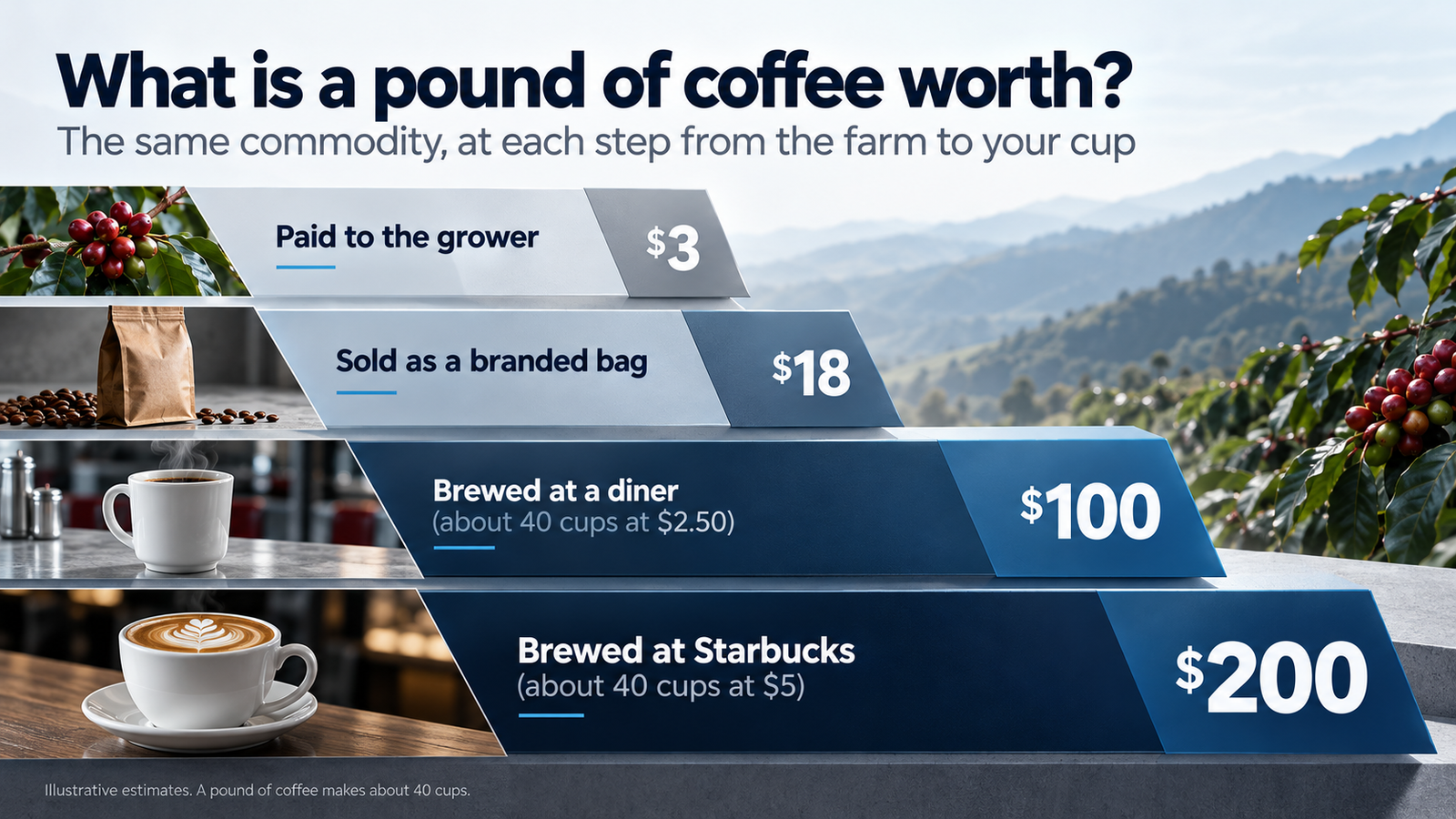
We are not paying for the beans. We are paying for the experience: the barista, the vocabulary (a Venti, not a large), the music, the décor, the small daily reward we feel we deserve. It is the emotions we pay for, not the coffee. The reason why people buy Starbucks coffee is explained by buyer psychology and how they create customer value. Not in the beans.
Luxury proves the same point from the other end. A Richard Mille watch can cost hundreds of thousands of dollars, and it doesn’t tell time any better than a $20 digital watch. The value is not in the function. It is in the meaning: craftsmanship, rarity, and membership in a very exclusive club. Richard Mille created value by building an icon that communicates social position.
It works the same way in B2B
Some people argue this only applies to consumer brands. I disagree. There is no B2B or B2C. It is all B2P: business to person. Business buyers are people, and like everyone else, they decide emotionally and justify their decisions rationally.
In B2B tech, most products in a category look alike to buyers. Every vendor claims to be fast, secure, scalable, and AI-powered. When everyone says the same thing, buyers default to price, and the market becomes a commodity.
Marketing is how you escape that trap. At Catchpoint, we repositioned the company around a category it could lead, and Gartner went on to name Catchpoint a Leader in its Magic Quadrant for Internet Performance Monitoring. Marketing changed how the market understood the company, and that changed the company’s competitive position. I tell the full story in Creating a Category: How Catchpoint Repositioned Itself for Leadership.
How marketing creates value
Marketing creates value in four ways. They build on each other: skip one, and the rest becomes noise.
- Strategy: choose where to play. Understand customers and markets deeply enough to decide which customers to serve, and which not to.
- Differentiation: shape what you build. Bring customer insight into product decisions, so the company builds something customers value and competitors can’t easily copy.
- Positioning: own a place in the customer’s mind. Define how the market perceives you, the category you compete in, and why you are the best choice for a specific customer. (See The Fundamentals of Effective Positioning.)
- Demand: make the value visible. Communicate and educate, make your products easy to find and buy, create preference, and generate demand.
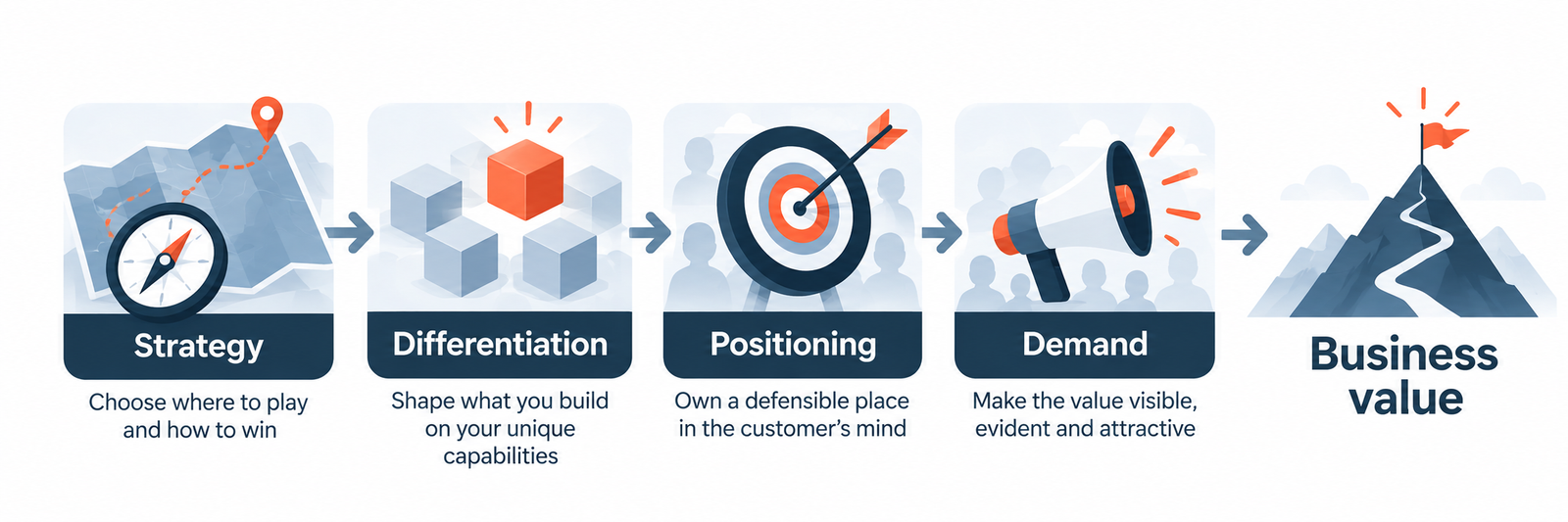
The first three are the subject of the book, OutPosition: strategy, differentiation, and positioning working as one system. Most marketing teams spend nearly all their time on the fourth. That is why so many are seen as a cost center. They are amplifying value that was never clearly defined.
Is your marketing a cost center or a value engine?
A few questions to ask about your own team:
- Can your CEO explain how marketing created value last year, beyond leads and pipeline?
- Does marketing have a voice in which markets the company enters and what the product roadmap prioritizes?
- Can everyone in the company explain who your customer is and why they choose you? (Personas help; see 8 Cardinal Principles to Use Personas Effectively in Marketing.)
- Would customers pay more for your product than for a competitor’s, and do you know why?
- If your marketing budget were cut in half, what would the company lose besides activity?
If most of your answers are no, your marketing team is operating as a service department, not a value engine.
From cost center to value engine: where to start
If your marketing team is seen as a cost center, a better dashboard or a bigger budget won’t change that. It changes when marketing starts doing work that creates value, and the rest of the company can see it. Here is where I would start:
- Become the voice of the customer. Bring insight nobody else has: why customers choose you, why they leave, what your win/loss patterns say, where the market is going. Executives make room in strategy conversations for whoever understands the customer best.
- Fix positioning before spending more on demand. More budget behind unclear positioning only amplifies the confusion. If your sales team describes the company five different ways, start there.
- Change how you report value. Leads and pipeline matter, but on their own they make marketing look like a service to sales. Also show the CEO how marketing affects win rates, pricing power, deal size, and the company’s competitive position.
- Use AI to buy back time. Let AI handle more of the production work, and invest the hours you save in customer research, strategy, and positioning, the work that creates value.
None of this requires permission. In my experience, marketing earns a seat at the strategy table by showing up with insight, not by asking for the seat.
AI raises the stakes
AI makes this distinction more important than ever. AI can now produce campaigns, content, and collateral faster and cheaper than any team. The activity side of marketing is becoming a commodity itself.
Marketing teams whose value is producing activity will be replaced by tools. Teams whose value is understanding customers, shaping strategy, and defining positioning will become more valuable, because that is the part AI cannot do for you. I explore what this means for product marketers in What is Product Marketing and Why Is It So Important?
Drucker was right. Marketing is the value engine of the company, but only when marketers do the work that actually creates value.
So the question remains: how are you creating value for your company?