What can we Learn from Nature this Season

Copyright (C) 2013 Gerardo A DadaI grew up in a place known as the ‘City of Eternal Spring’ where homes don’t have A/C or heating and where trees are green year round.

Maybe that’s why I have a special appreciation for the beauty of the fall foliage. It also made me think why trees get rid of their leaves this time of the year.

The leaves are beautiful, and perfectly fine. It’s not like the tree does not want them or that it feels it would be better off without them. The tree probably invested resources, energy and maybe effort in creating the leaves. So why drop them?

It’s getting ready for the hard times. Mother nature has made trees smart enough to know tough times are coming and while the tree wants to keep the leaves, it must get rid of them to focus maximum energy and protection on its core. The tree is smart enough to know it cannot support its core and the leaves, and that if it tries to do that it would probably die. So the leaves go. Could we consider this wise and courageous?

How many things in life, or in marketing are very nice, we want them – but like leaves in winter, create a distraction of resources and energy that we cannot afford?

When people talk about focus, often we hear the things they plan to do. Those with a more pragmatic approach know focus is about the things you will stop doing.

  • If you don’t have a list of things you will stop doing, you are not really focused.
  • If you don’t have a list of customers and markets you will not serve, you can’t say you are focused.
  • If you don’t have a list of marketing tactics you won’t pursue in 2014, you are not focused.
  • If you don’t have a list of the projects or tasks that would be nice to do but you won’t, you are not focused.

It’s hard to let go.  A few months ago I realized I would not be able to keep my responsibilities of my job, my family, this blog and my new photography blog. Like the tree that lets go of a beautiful leave, I had to make a decision to stop working on posts for my photography blog. Sometimes I catch myself with ideas for a good post, but then I remember I can’t do all, and I have to move on and focus on the important things in my life.

It takes discipline. It’s hard. A few years ago I heard ‘The most important thing is that the most important thing remains the most important thing. It is not only a tongue-twister, it is a very wise saying – an important one.

As we start making plans for the next year – for your business, your marketing plan or your personal life – what leaves will you drop this year?

Does Your Marketing Formula Pass the Correlation Test?

Math FormulaFinding the return on investment for marketing activities is like the holy grail for CMOs. There are countless articles wit ideas on how to determine social media ROI, content marketing ROI, video marketing ROU, and so on. We all have heard ‘I know 50% of my marketing spend is wasted, but I don’t know which 50%‘.
Every marketer has a hypothesis of what works. Otherwise, how could you do your job, You have one, right?

We should keep in mind, marketing leaders are not always looking for a mathematical formula, we are often looking for something more basic, more essential. We need to answer the questions: is this working? Should we do more? Could we have the same results with less effort? How do we know?

This is not a post about how to determine ROI (for my POV on social media ROI you can check my slideshare from 2009). This post is about how to make sure you have found a formula that works. Success without repetition is luck. Good marketers know what works, and can have predictable success.

There are many challenges that make it very hard to understand what marketing activities work. Here are three:

  • The Delusion of a Single Explanation: We would like things to be simple. Marketers would try to find correlation between two factors: satisfaction score and revenue growth, attending a webinar and purchasing, etc. In reality, most  outcomes depend on a multitude of factors.
  • Confusing Correlation and Causation. Maybe we have observed people who visit a webinar buy more from us. But do they buy more because of listening to the webinar, or did they decide to listen to the webinar because they wanted to buy more anyway? Phil Rosenzweig, author of The Halo Effect (great book, by the way), observed the consulting company Bain & Co claims on their website “Bain clients have outperformed the stock market 4 to 1” implying working with Bain leads to better performance. It is very possible that high performing companies are the only ones that can afford to hire Bain.
  • Customers buy on emotion. Emotions are hard to understand and to map to a formula (anyone who is      married knows that), how people buy cannot be put in a spreadsheet. But marketer will try anyway. It is almost impossible to understand what are the customers intentions. A UT professor shared with our class ‘I saw someone at Costco in the checkout line with a dolly on which he had two milk jugs and a 50″ plasma TV. Did he go to Costco for the milk and when at the store  decided to buy the TV or the other way around?’

How do we solve this problem of correlation versus causality? How do we know what we think is working actually works? How do we avoid falling in the traps of market research?

I found one interesting point of view from another industry: the Bradford Hill criteria is used to determine cause and effect in medical tests. If this is the method to determine causation in an industry where being wrong can be the difference between life and death for many people, I figured it is probably good for us to learn from. These are the Bradford Hill checks to make sure your assumptions of cause and effect are correct:

    1. Consistency. “One apparent success does not prove a general cause and effect in wider contexts. To prove a treatment is useful, it must give consistent results in a wide range of circumstances.” In your marketing test, are the results consistent when you try the same technique in different situations?
    2. Plausibility. “The apparent cause and effect must make sense in the light of current theories and results. If a causal relationship appears to be outside of current science then significant additional hypothesizing and testing will be required before a true cause and effect can be found.” Which to me sounds like thinking – does this result make sense? Is this assumption aligned with what we know about customers and about marketing?
    3. Specificity. “A specific relationship is found if there is no other plausible explanation. This is not always the case in medicine where any given symptoms may have a range of possible causing conditions.”. This is a big one, especially because of the delusion of a single explanation we talked about before. What other variables are in play? Can you rule our any other possible explanations? Is your test specific enough?
    4. Evidence. “A very strong proof of cause and effect comes from the results of experiments, where many significant variables are held stable to prevent them interfering with the results. Other evidence is also useful but can be more difficult to isolate cause and effect.”. Right, test one thing at a time. A/B testing and MVT testing tools are helpful, but you need to be careful to isolate one variable at a time. Things like seasonality and external events are not factored automatically in these tools..
    5. Analogy. “When something is suspected      of causing and effect, then other factors similar or analogous to the supposed cause should also be considered and identified as a possible cause or otherwise eliminated from the investigation.” What other explanations can you find for a customer behavior? What similar activities could influence decisions?
    6. Coherence.” If laboratory experiments in which variables are controlled and external everyday evidence are in alignment, then it is said that there is coherence.”. This point encourages us to experiment with the conclusions outside of our testing environment. Examples to check for coherence in marketing: If customers seem to react to certain messages online, test the same assumption offline. Testing theories in different geographical markets, for example, or validate what you ‘learn’ in a focus groups in a real world.

Four more things to keep in mind

  • Marketing optimization,  especially online, can easily trick you into optimizing your marketing for      those buyers that will buy quickly, not for the buyers that will take      longer to buy which could produce a higher customer lifetime value
  • Don’t rule out something just because it did not work before. I have heard many times ‘We tried that last year and it does not work’ . Goes back to specificity. This is a false negative. Until you understand why it did not work, you may keep testing. Maybe you can find a way to make things work
  • Measuring direct influence behavior is easier than building a model that measures leading indicators      to understand customer behavior over time that is difficult to observe and measure.
  • As Albert Einstein said: Everything that  can be counted does not necessarily count and everything that counts  cannot necessarily be counted.

The Modern Marketing Leader – A Manifesto

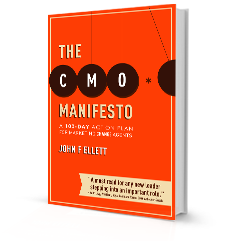
cmoBookA couple of months back, my friend John Ellett gave me a copy of his book, ‘The CMO Manifesto‘ which I thoroughly enjoyed. The book is the outcome of 50 interviews with CMOs to identify the best practices for the first 100 days of a CMO joining a new company. It turns out, The CMO Manifesto ends up being a very complete and modern description of the role of a modern marketing leader.

Establishing the role of marketing, a manifesto for a modern marketing leader, and best practices for marketing leaders in new roles is  important because of four reasons:

  1. The average tenure of a CMO is around 24 months.
  2. Marketing is becoming more complex.
  3. Most of the organization, including the leadership team, have a distorted, inaccurate or unclear understanding of the marketing role.
  4. Leaders are realizing how fundamental and strategic Marketing is for the success of any business. As Peter Drucker said “Marketing is the distinguishing, unique function of the business.”

Some of the more interesting points in the book I especially agree with:

  • Marketing leaders are change agents for the company
  • As leaders they impact strategy, revenue and the overall success of an organization
  • Focus and clarity (clear priorities) are especially important for a marketing team
  • Customer insights should guide all decisions
  • Vision, optimism and resiliency are essential traits of a good marketer

John organizes the book in 12 best practices for a marketing leader:

  1. Lead positive change
  2. Bring clarity and inspiration
  3. Build Relationships and trust
  4. Channel the voice of the customer and Insights
  5. Focus leads to greatness
  6. Drive agility and accountability
  7. Build capable, committed, collaborative teams
  8. Find the balance between chaos and process
  9. Do plan but focus on action
  10. Continuously measure and optimize
  11. Leverage new tools and technologies
  12. Remain resilient in front of challenges

Another thought leader, Ashley Friedlein, from eConsultancy recently published an update to his Modern Marketing Manifesto, which also happens to have 12 points. This manifesto has a slight digital marketing bias but is quite compatible with John Ellett’s point of view: There are many similarities and a few points that can be complementary :

  1. Strategy. Marketers should sit at the board table and set strategy. Strategy is shaped by knowledge of markets, products, customers and positioning. Digital needs to be part of every strategy.
  2. Revenue. Marketers must be accountable for revenue, have a common point of accountability with sales, and must understand P&L.
  3. Customer experience. Improving CX for the most valuable customers must be the relentless focus of modern marketing.
  4. Integration. Customers do not understand the distinction between mobile and desktop, online and offline, above and below the line. Marketing must focus on providing an integrated customer experience.
  5. Brand. Consumers control the message, forcing brands to be authentic and transparent.
  6. Data. Marketers must turn data into insight and action – hence the importance of research, marketing automation, predictive analytics, etc.
  7. Personalization. Relevance and optimization to each customer and his context.
  8. Technology. Marketers will have increasing ownership if the technology tools.
  9. Creative. We need creativity just as mush as we need technology.
  10. Content. Content marketing and the focus on owned and earned media.
  11. Social. Social is not a choice.
  12. Character. The modern marketer must be accountable, ethical, customer focused, agile, collaborative, innovative, brave and passionate.

What is obvious by reading both manifestos is that the marketing function is getting more complex, is evolving to play a more strategic role and becoming more and more interesting.

It’s a good time to be a marketer.

Content Marketing as an Antidote to Discounting

Flying back from San Francisco, I open the in-flight magazine and a half-page ad by Riedel catches my eye. Riedel a German company and one of the best known manufacturers of high quality wine glasses.

riedelad-275x300

It is a premium brand: a pair of wine glasses especially designed for Cabernet and Merlot retails for about $50. Their customers are either wine enthusiasts or people with a lot of money who don’t mind spending $25 for a wine glass.

It is a nice looking ad, but I was surprised to see the ad’s main message is an offer of  20% discount for a purchase of $100 or more. It does not seem to fit the brand. At the same time, it was not that surprising to see a discount oriented message: it is the easy answer.   ‘What should be the message? I know, let’s offer a 20% discount’

When a marketer’s creativity runs out he defaults back to price discounts.

Continue reading “Content Marketing as an Antidote to Discounting”

The Best Career Advice is to Follow Your Passion

Do what you loveMentoring others gives me deep satisfaction. One of the most common mentoring topics is the question of how to be successful: how to orient one’s career, what is the right job to take, what to do with your professional life.

The Secrets to Success According to Richard St. John’s

One of the top Ted talks (4.6 million views as of today), Richard St Johns talks about the 8 secrets of success, which he developed after 500 interviews of highly successful people. I have to completely agree with these 8 “secrets”.

The second, third and fourth are hard work, focus and practicing until you get good. Simple words, sure – yet working hard, being focused and practicing are difficult to do on a daily basis. Focus is tricky, because there are always distractions and other interests that pull you aside from the road. This is why focus is best defined in terms of what you will not do anymore.

Focusing tirelessly, practicing every day and working hard should drive your life. Many consume more than one self-help books and try to build the discipline to get them done. But they come naturally, almost effortlessly, if you have the first one of Richard St. John’s secrets: Passion. You will need to watch the Ted talk for the other four. (it’s worth it, it is only three minutes).

Developing Passion

You can’t just decide to get passionate about something. Passion is not commanded intellectually. Passion comes from the heart.

Or maybe passion comes from DNA: Marcus Buckingham leads a philosophy that suggests every one of us is ‘strong’ in certain areas or activities that we enjoy: activities that give us satisfaction and make us feel better when we perform tem. His philosophy is that the people that pursue their strengths are happier and that companies that focus on aligning their people with the activities that leverage their strengths are most successful.

What are you Passionate about?

Because you can’t decide to become passionate about something , you must find what you are passionate about and then focus your work on that.

One of the things I am most grateful to my dad is that he exposed me to many things allowing me to discover my passions. He made it possible for me to try many things that I did not like – or that I liked but was not good at, like musical instruments. One day, when I was in middle school, my dad showed up with a  book ‘Positioning. The Battle for your Mind’ . I devoured the book. Right then I knew I wanted to be a marketer. That’s my calling. What’s yours?

My point is that you can’t find your passion unless you spend some time exploring. A few months ago I blogged about my story of passion for Coffee and how knowledge is a requirement for love . You can’t love what you don'[t know. I probably would not be a marketer today if my dad had not exposed me to that book.

Be The Best You Can

You should aspire to be the best you can in whatever area you are passionate about. Note that being the best you can is about your performance relative to your potential. It is different to being the best in the world, which measures your ability relative to others (more ego driven).  but even while you should measure your success in terms of your own capabilities, it is important to understand your level of ability or competency relative to the rest of the world.

In his book Quitter, Jon Acuff tells a story of when he really wanted to be a copy writer at a large agency. One day, an exec at a prominent agency receives him and gifts him the experience to read all the portfolios that had been submitted for consideration by copy writing candidates. The experience allowed Jon to understand where the bar for good and great was, and in his case, to realize that he was not made to be a copy writer.

Passion Makes You Work Hard and Become Great

When you are truly passionate about something you focus, you aspire to learn and get better every day. You work hard and practice until you become good. You try to be the best.

When Mark Cuban got his first job as a software sales person, he read all the software manuals he could get a hold on. He read a manual every single day after getting home no matter how late, and he enjoyed it. “I could not put them down“. Mark quickly became an expert, and a valuable resource for is clients. He pulled away from the rest of the salespeople in software Dallas and found success. The rest is history.

Just Do it

A few months ago, a friend asked me for career advice. He told me he really wanted to be a writer and he was looking for a break. I asked him to show me examples of his work. He did not have any. If you are passionate about writing, you surely have a blog, or a manuscript for a book in a drawer, or poems in napkins, right? I asked. He did not.

How come? He really wanted to be a writer. But he did not spend time on his passion. Maybe he was afraid of not being good. Maybe he was busy. Maybe he never took the time to think about a path to become a great writer and where to get started. Unfortunately, this is a common scenario.

You have to follow your passion. You have to spend the time to explore the world and find what you are passionate about and then you must make time to practice and get better. ‘I don’t have time’ is not an excuse if you spend an hour every day watching TV. Get up 30 minutes earlier. Eliminate distractions. Unsubscribe from 10 email newsletters and a few RSS feeds. Cut back on Facebook. Otherwise, you will be in the same place 10 years from now.

Applying the Hedgehog Strategy to Your Career

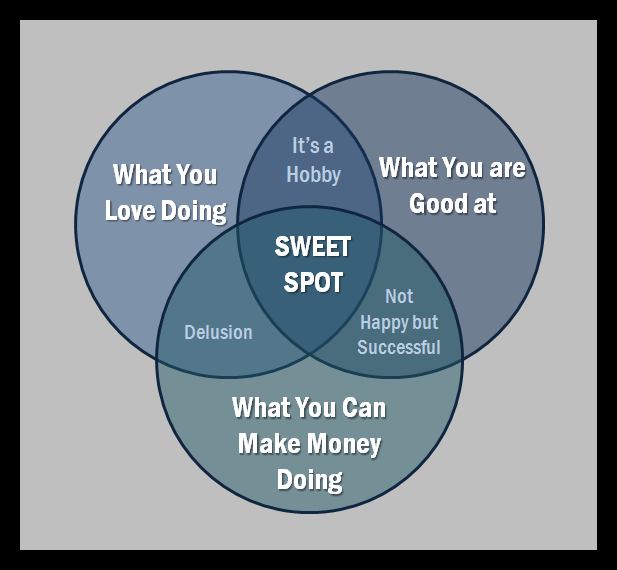
In his book, Good to Great, Jim Collins describes a “hedgehog strategy” for organizations that can be very slightly modified to become a very simple but powerful tool for career planning. The concept is based on a VIN diagram with three intersecting circles:

  • One circle defines what you can be really good at. Your strengths and natural skills.
  • One circle defines the activities that you enjoy doing, your passions.
  • One circle defines the activities that fulfill your financial needs. Where you can make enough money.

The area where the circles intersect are the most interesting:

  • I enjoy and am good at things like photography that won’t make me enough money to provide for my family, so they are hobbies.
  • I am also good at things that I don’t necessarily like, I could perform these activities and even make enough money but I will not be happy and probably won’t be very successful. I am a very good salesman, and I know I could make a ton of money in this career – but I would be miserable because I don’t like working on a quota and probably could not deal with the pressure.
  • There are also things that I like,  such as playing the piano, but I am not good at and I won’t get good at. I am delusional is I think I will be a professional piano player, I simply don’t have the coordination not I would be able to develop it.

The place where these circles overlap is the ideal spot for your career: an area you are passionate about, you are good at it, and you can make money. Again, it may sound like a simplistic concept, but I have seen it used as a tool by people in all stages of their career to make smart decisions.

Skills and Passion VIN diagram

 “Love. Fall in love and stay in love. Write only what you love, and love what you write. The key word is love. You have to get up in the morning and write something you love, something to live for.” — Ray Bradbury

 “You never achieve success unless you like what you are doing.” — Dale Carnegie

Make Someone’s Day

Image courtesy JoseMa Orsini - Creative Commons
Image courtesy JoseMa Orsini – Creative Commons

I was boarding my flight from Atlanta to Austin when I saw a little kid walking down the aisle with his mom. He looked a little bit scared or tired, I could not tell. They sat in the row behind me. The I overhead the lady on the seat next to them tell him “I am so happy I got to sit with you. I usually get sit next to very boring people.” as I turned my head I saw the kid smile. He chatted the entire flight. When we were leaving the plane, the smile was still on his face. All this for one sentence from the lady, who made the kid’s day.

Just a few days later I was chatting with one of my colleagues and simply told him the work he has been doing was impactful. I said something like “You have done a great job. We planned this a year ago, now we have solid results. Your work is having a positive impact for the company that can be seen in our revenue, thank you.”. Two days later my friend was still pumped. He thanked two more people who helped on the project and seemed happier than usual. All for a few sentences.

His reaction was not a surprise, but it made me think we should do more of this, I should do more. It is well accepted that feeling appreciated, recognition and encouragement are more powerful employee motivators than money. Bu you should not only do this because it is the right business decision, it needs to come from the heart. It is so easy to ignore the little things in life like this one that make a difference. They are important, that’s why I decided to blog about it even if it is off-topic for my blog.

How can you make someone’s day?

  • Tell someone in your team they are doing a good job and how they are helping the company
  • Smile to people that walk past you or say ‘Good morning” to people on the elevator
  • Find the person at work that has the most underappreciated job (helpdesk? IT? Receptionist? and thank them for what they do. Every time I am at an airport I thank the TSA personal for keeping us safe
  • Pay for coffee for the person next in line or bring chocolate to the a meeting for no reason
  • Write a sincere thank you note for someone

It’s so simple, it’s contagious, and it’s free. Most of our efforts in life are aimed at making us happy. And yet, happiness is right here, available to you and the people around you if we just make a small effort to create a spark.

Have a great day

Strategy or Tactics? It’s a Trick question!

Strategy and Tactics

You may have heard the question many times:

What is more important, Strategy or Tactics?

It’s a trick question. It assumes you can have without the other when in fact, the answer is that what is more important is the alignment between strategy and tactics:

Strategy should be based in  your tactical ability to execute (which includes your core competency, as the thing you can execute on better than anyone else) and tactics should support the  strategy

What is really important about this point of view is that it is not uncommon to find a disconnect between strategy an tactics in many companies:

  • The strategy is unclear for the teams executing, or
  • While the strategy is clear, how it should impact and guide tactical work for each member executing is unclear
  • Strategies are developed in a vacuum by executives that are not connected to the front lines, or worse, by top-dollar consulting companies that bring junior MBAs to craft a strategy with no real context of the business

Part of the problem is that there are very few people who can span both: who can think strategically but can also guide (and roll up their sleeves) to execute. Employees who can bridge strategy and tactics can add incredible value to an organization, when employed properly.

How do you do that? The first step is to take a dose of reality, we need to be self-aware of how strategic we really are. Most marketers consider themselves strategic, but do we even know what that means? Here are some questions to help you assess your strategic ability:

  • Do you understand the fundamental metrics of your company? Have you read the latest quarterly report and do you understand the fundamentals, and how marketing can influence the key metrics that influence shareholder value?
  • Do you understand how your company generates profits, cash and customers?
  • Do you understand the medium-term strategy for your competition? Have you reviewed their IR presentations?
  • Do you understand your core competency as a company? What are the things your company is really good at and which ones you should avoid?
  • Do you understand your customers, how they are evolving and how their needs and purchase behaviors are evolving over time? What is the gap between you and your customer expectations and what you deliver today?
  • Have you modeled the market and competitive landscape, using tools like Porter’s five forces or a simple SWOT model?  and, if you have done this consistently, have you been able to predict market evolution?
  • Do you know exactly how your marketing tactics and the work you are doing today contribute to the long-term success of your company?

These questions are not perfect or comprehensive, they are a start.

Customer Experience – Where the Rubber Meets the Road

I just spent 40 minutes on hold trying to talk to a TV/internet company. Chances are you have been in a similar situation where you have been waiting while you hear a recording (over and over) like the one I was hearing “Due to higher than expected call volume you have waited longer than we would have liked to. Your call is important to us”Phone - Customer experience

It seems the call volume is always higher than expected. Saying this sounds like a lie. It starts eroding trust before I have spoken a word with a “customer service: representative. Dear company: If my call is important to you , why don’t you hire more people to talk to customers?

With all the talk about customer experience and loyalty, you would expect companies would know better. Especially in a space that is fairly commoditized and in decline: cable TV is probably going the way of the landline phone and movie rentals,  it’s a matter of time until we get all our TV on demand.

I have four or five companies I can choose from for internet and TV service. Their service is pretty much the same. All of them offer VoIP phone, HBO, 200+ channels, HD, DVR, etc. Looking at their advertisements and promotions it looks like they are all competing on price. I asked around the office, and most of my co-workers shared stories of poor service with their current provider. It was pretty uniform. This seems to be a market where a company that focuses on service could stand out.

A great customer experience would be a good strategy to differentiate in a commodity market and to keep more paying customers. Over the last 5 years I have spent more then $7,000 with this company. Add wireless service and the average lifetime customer value is probably much higher than that. Right now I am about to cancel my service and take may business elsewhere.

If the waiting message was completely truthful it would probably say something like: “Due to our executives being unable to understand and quantify how wait times and customer experience correlate with customer loyalty and revenue, we have not hired enough staff to respond to customers in a timely manner. Your call is a cost to us, one that we try to avoid, not an opportunity to engage and satisfy customers. Thank you for waiting and keeping our costs low.”

That’s where the rubber meets the road. Over the last 10 years there has been a surge of companies who have Chief Customer Officers, customer advocates and other organizations who are tasked with transforming the organization. I was one of them – for a few years I was the SME in charge for Broad Customer Connection at a Fortune 50 company, even if it was not my full time job.

The problem is that while companies who create these teams have the best of intentions, often times the customer experience teams are not really empowered to make the transformational changes in the organization and end up doing surveys that no one reads. Even when there is a level of empowerment, when it comes down to dollars and cents it takes a real commitment to customer experience to make the hard decisions. This only happens when the people in charge fundamentally understand and believe in the financial mid and long-term benefits of customer experience.

For customer experience to be successful, it needs to drive the company strategy. From defining the culture (look at Zappos) to making financial commitments to go beyond the customer expectations. At Rackspace, for example, there are no call centers, no ‘hold’ music, and no customer service representatives. Customers wait an average of 6 seconds to talk to a technical person who will take ownership of solving their problem.

You don’t want to have a customer experience team that ends up doing stupid surveys as David Meerman points out in his latest post. Providing an acceptable customer experience is no longer optional. Building a company to deliver great customer experiences can be a source of sustainable competitive differentiation and a successful business strategy.

You are Increasing the Gap Between You and your Customers

This post originally appeared as a guest publication on Kevin Goldberg’s blog as Your Latest Launch Increased the Gap Between You and Your Customers

Mind the Gap H

It is so easy for Product Marketers to be caught in the product launch cycle. It is not uncommon for product marketers to be known as “the team that launches stuff”.  Even more dangerous is the mentality to forget a product one it has launched to focus on the next launch.

One of my mentors used to say that this behavior is akin to the Apollo XI taking off and having everyone in the Houston Command Center go back to the lab, as the rocket is pushing upwards and has not even left orbit. Can you imagine the astronauts? “Houston? Hello? ….Houston? ….anybody there?”. Well, that’s exactly how your product feels.

This launch-as-the-finish-line mentality is very dangerous and very prevalent in many technology companies. I saw his behavior at Microsoft, with one of the most public signs being Steven Sinofsky leaving the company on November 12th , just a few days after launching Windows 8 on Oct 25. Launch a product, claim success move to the next big thing.

Instead, we should think about launches more like modules that are being added to the space station. A product launch joins the other products in your portfolio and ultimately in the ecosystem, hopefully to help the life of your astronauts, the customers.

Astronauts cannot survive only with the latest module; they need the entire space station to survive. Similarly, your customers need the whole product – a complete solution made by multiple products, services, partner offerings, etc. Don’t lose that focus.

But here is a nugget for you to think about: every product launch increases the gap between you and your customers. What gap am I talking about? Remember how you felt when the iPhone 5 was announced? Your iPhone 4 was no longer current, you felt left behind.

I remember clearly how after we launched Visual Studio 2005, the focus moved almost immediately to Visual Studio 2008. This while most customers were on Visual Studio 2003 and millions of developers were happy with VB6. And while the team was thinking about Exchange 2013, most companies around the world were sending and receiving emails using Exchange 2003 – a 10 year gap.

It’s not the fault of product marketing that a gap exists, we want to push innovation forward which inevitably creates a gap. Just as marketers are sometimes too far ahead of customers, they tend to fall behind. A couple years ago when we moved back to Austin we were at our doctor’s office when the lady at the front asked if we could call our doctor in Redmond to get our files faxed. My daughter asked “Dad, what is a fax?”. That’s a generational gap.

As you are thinking about your next product launch, consider working beyond the launch to understand what the market will look like 12 months later. What will your customers be using? What will be their technology adoption reality? What up-sell or upgrade opportunities can you see? What about customers using older versions of competing products – are those good candidates for a targeted campaign? How will you increase customers’ satisfaction and profitability for your entire customer base?

My six recommendations to ease the gap between you and your latest product launch:

  • Avoid thinking of product launches as the culmination of your work, they are only a milestone
  • Think about product portfolios and ecosystems (whole product), that’s what customers care about
  • Take care of your astronauts and provide them with a safe landing with guidance, migration tools, education and support
  • Understand the technology adoption behavior of your customers: from early adopters to laggards
  • Be mindful of the gap and the reality of your customers adoption page and their urgency (or lack thereof) to upgrade
  • Provide bridges that make it easier for customers to upgrade to the latest version

Content Marketing Strategies You Can Use

Content Strategy and Content Marketing are some of the hottest topics in marketing today. With good reason – they are critical part of any solid marketing strategy, especially for considered purchases.

A few weeks ago I wrote a guest post on 10 steps to build a content marketing strategy, which was published in B2B Marketing Insider  , Michael Brenner‘s site. The post was very popular and was posted again  on the Business 2 Community and in SAP’s Business Innovation site.

Content Strategy

I want to summarize some of the key takeaways of the article and add a few additional thoughts.

  • Content Marketing is a response to changes in buying behavior: customers are doing much more reasearch before they buy and often making a decision before engaging with a company.
  • In this age, marketing is more about being helpful and education than broadcasting and clever headlines.
  • Content Marketing has been around for some time, especially in B2B – for example, white papers in technology marketing.
  • The most important aspect of a content marketing strategy is to be have an interesting and useful point of view. This means content must be written by subject matter experts and that content needs to be valuable and unique.
    • This is such a key point. As Ryo Chiba says “Great content marketing is neither spammy nor salezy. Solve a problem for your customers. Write posts that serve your audience”
  • A good content writer needs to be an expert. If you are not one, before you start writing start learning. Have a point of view.
  • Don’t lose sight of the fact that content’s main objective should be to influence buying decisions through customer education.
  • A content marketing pyramid is very effective at making the most of your valuable content: start with a solid white paper, turn it into a webinar or slidecast, extract interesting sections into a few blog posts, then extract nuggets into tweets.
  •  You can track leading indicators to determine which parts of your content strategy are working. ROI measures for content generally fall under three categories:
    • Consumption metrics: views and downloads (especially after someone downloads a white paper after reading a blog post, for example)
    • Engagement metrics:  shares, comments, votes, ratings and retweets
    • Funnel metrics: clicks from your content to the buying process on your site
    • Deal Influence: asking customers if they consumed any of their content and how much influence it had in earning their business

I encourage you to take a look at the original article and to share your thoughts below.