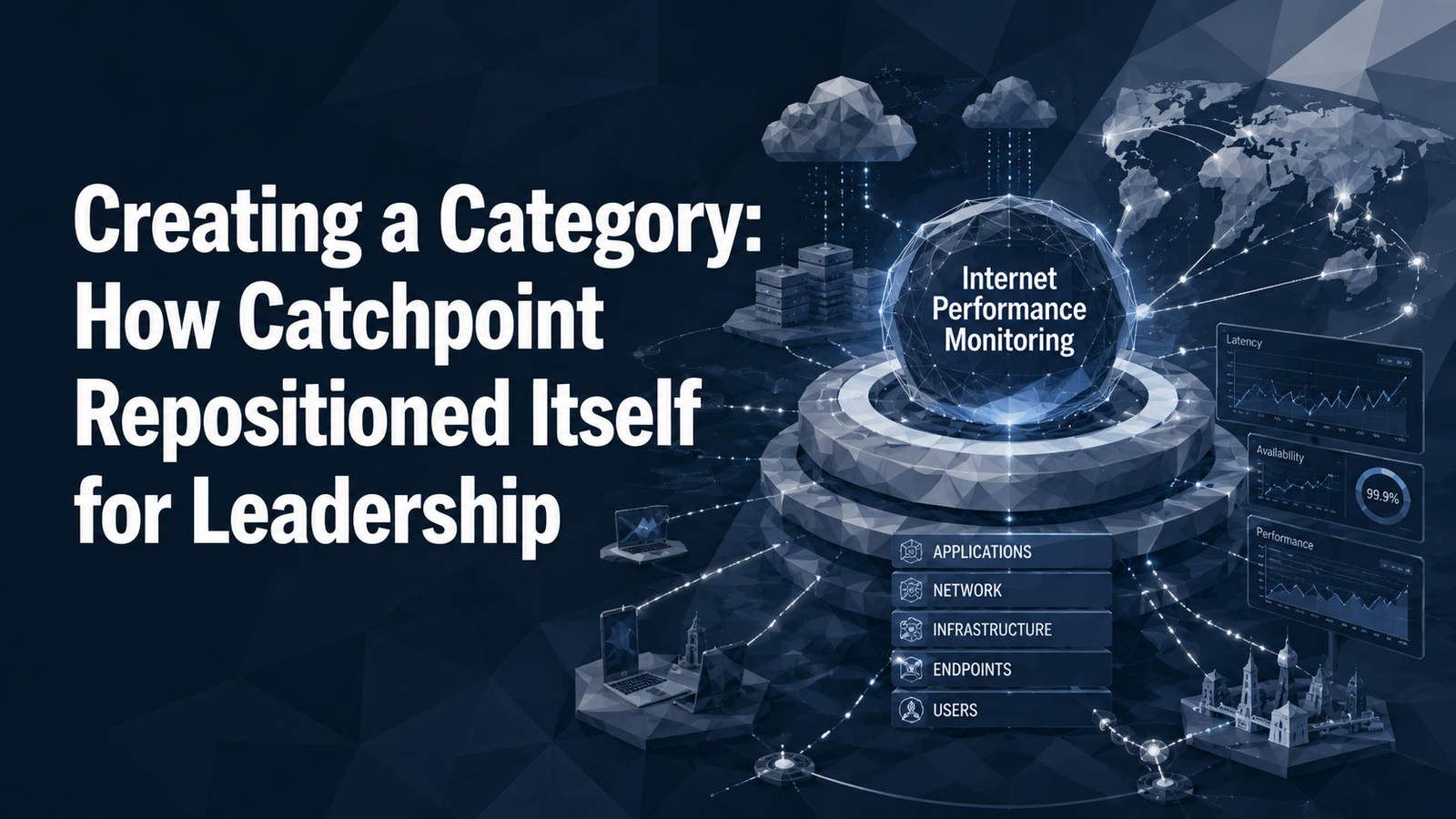
Creating a Category: How Catchpoint Repositioned Itself for Leadership

A little over 3 years ago I joined Catchpoint, a software company who met my criteria for my ideal job: I wanted a medium-sized company (I am not good with big company politics), that had a great product and bad marketing.

My last requirement, which was not negotiable, was that the company had to have a great leader and a good culture. I found Catchpoint to be a company with heart: a passion for customers, for what they do, and for the team that worked together to build a great company.

My Most Important Priority as a CMO

The first job was not to upscale the team, optimize demand programs, or rebuild the website, no. My most important task was to build a strategy that would help the company stand out, build awareness, and earn the business of the biggest companies in the World.

This is how, Catchpoint embarked on one of the most remarkable repositioning journeys in enterprise technology.

Continue reading “Creating a Category: How Catchpoint Repositioned Itself for Leadership”

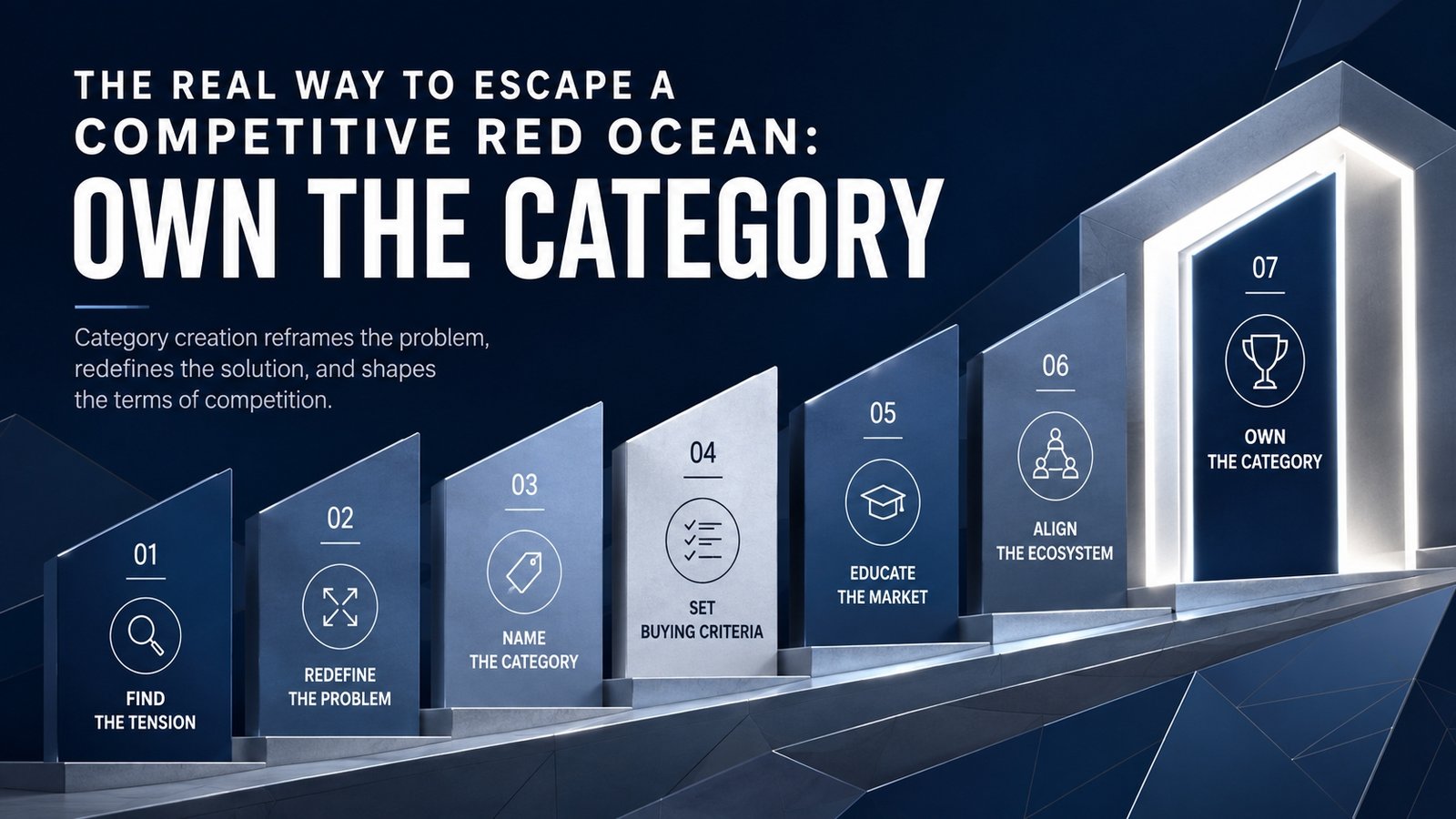
The Fundamentals of Effective Positioning

Fundamentals of Effective Positioning

Positioning is one of the most powerful — and most misused — tools in marketing. It’s not a tagline, a clever campaign, or the latest buzzword tossed around in a boardroom. Positioning is the strategic lens through which customers understand who you are, what you stand for, and why you matter.

When done well, it becomes the foundation of every message, product decision, and go-to-market motion. When done poorly, it creates confusion, weak differentiation, and a brand that feels interchangeable. Despite its importance, positioning is often treated as a quick creative exercise rather than a rigorous strategic discipline — which is why so many companies get it wrong.

In this post, I break down the eight rules that define effective positioning — the principles that separate brands that own a place in the customer’s mind from those that simply blend into the noise. Whether you’re refining an established brand or shaping a new one, these rules will give you a practical framework to sharpen your strategy and communicate with clarity and conviction.

Continue reading “The Fundamentals of Effective Positioning”

Stop the Content Machine – The Seven Deadly Sins of Content Marketing

Stop the Content Machines

Every minute, 4.5 million blog posts are published. Yet most go unread.

Content marketing started as a revolutionary idea: educate, don’t just sell. But somewhere along the way, the mission changed — from teaching to churning. The content machine took over.

When done right, inbound marketing builds trust and a steady flow of qualified opportunities especially when you are trying to educate potential customers about a new technology, a new approach, or to establish expertise. But somewhere along the way, the mission changed. What began as a way to build expertise has turned into a production race

“Content Marketing is the only marketing left.

– Seth Godin
Continue reading “Stop the Content Machine – The Seven Deadly Sins of Content Marketing”

The Risks of Following a Blue Ocean Strategy

Blue Ocean Strategy

Adopting a Blue Ocean Strategy, pivoting to a brand-new markets without competitors, is, for many, the holy grail of corporate strategy. Who does not want to make competitors irrelevant and to in grow a vast, blue, new market uncontested? It it smooth sailing or is it too good to be true?

Pursuing a Blue Ocean strategy can be a great choice for many companies, but it is not without risks or challenges. It’s also not easy. Otherwise, every company would pursue a blue ocean. Let’s start with the definition of blue ocean and then let’s explore the challenges and risks in pursuing such a strategy. Continue reading “The Risks of Following a Blue Ocean Strategy”

Writing well is an essential business skill

Knowledge is useless unless you know how to communicate it – in writing.

We live in a world where most communication happens in 140 character messages, 7 second videos and short text messages. It’s easy to forget how important is good writing as an essential and personal skill.

I have been inspired by David Ogilvy, the father of advertising. His story is really interesting. His teachings fundamental. His books are some of the first every marketer should read. In the Unpublished David Ogilvy, I found great advice by the master.

The better you write, the higher you will go in Ogilvy and Mather. People who think well, write well.Continue reading “Writing well is an essential business skill”

What is Product Marketing and why is it so Important?

What is Product Marketing?

What is Product Marketing? Why is such an important function so misunderstood?

One of the biggest challenges for marketers today is that we are too often focused on the most tactical aspects of the job: promotion, contacts, reach, social marketing, etc.

We forget that the most important part of marketing, the source of value, is our understanding of customers, what customers want, and how to align your products to their needs and how they buy. Most marketing teams don’t have anyone dedicated to this function.

This is especially important in B2B because buying processes are more complex, there are usually more buyers involved, and products tend to be more technically complex.  To solve this problem, a relatively new function has been created, which is often referred to as product, audience or solutions marketing.
Continue reading “What is Product Marketing and why is it so Important?”

RadioShack Strategy: A Lesson for Business Leaders

Strategy example: Radio Shack

RadioShack lost its focus and pursued a path where they had no significant advantage in a highly competitive field. In other words, RadioShack’s strategy was the wrong one.

The company fell into the “Large Market” trap. The same trap many entrepreneurs fall into. We see it on Shark Tank, I see it in strategy discussions in large companies. What is this trap and how to escape it? read on…

Continue reading “RadioShack Strategy: A Lesson for Business Leaders”

Are We Doing Content Marketing Right?

Are we failing at content marketing?

Without question, Content Marketing is one of the hottest topics today. But we are in the early days. Are we doing content marketing right?

A few weeks ago, I had the opportunity to participate in a Content Marketing panel at the Texas Marketing Summit in Houston. The other panelists provided with great insight. I also came to the conclusion that our understanding of Content Marketing is in its infancy, much like social media was 8 years ago.

It seems we still have much to learn and to improve as marketers. Sometimes it feels we are failing. Are you failing too?

Let’s Start With the Basics.

To understand the right way to do content marketing, let’s be clear about what it is not:

  • Content marketing is not new – it’s been around for a long time
  • Content marketing is not a strategy – it should support your existing strategy
  • Content marketing is not a program – but it should influence your marketing programs
  • Content marketing should not be a department in marketing – all of marketing should embrace it
  • Content marketing is not a tool or a set of tools – tools support it and enable it
  • Content marketing is not publishing blog posts, slideshare decks, and Instagram posts

If your view of content marketing falls under one of the bullets above, you are limiting your success. Content marketing is far more powerful than that. Continue reading “Are We Doing Content Marketing Right?”

10 Business Lessons from Carlos Slim

What are the secrets to Carlos Slim Success

As I write this, Carlos Slim Helú is the second richest man in the World, according to Forbes, following Bill Gates by a ‘mere’ $2 billion dollars. Carlos was number one in 2010 and 2011. Everyone knows how Bill made his fortune, as the founder of Microsoft, and much has been written about him. But what drives Carlos Slim’s success, and what are the strategies that make his companies so successful seem to be more of a mystery.

When companies struggle, they usually blame increased competition and unfavorable economic conditions. Carlos Slim seems to thrive on downturns and recessions.

Slim’s business portfolio, under the holding company Grupo Carso, is much more diversified: it includes real estate, retail, telecom, mining, financial services, tobacco, aluminum, tires, copper, insurance, restaurants, oil and gas, paper, hotels, and more.

People in Mexico say you can’t live a day of your life without somehow giving money to Slim’s empire. He has also made significant investments in the US. In 1997, Carlos purchased 3% of Apple for $17 a share. He has made significant investments in Saks and the New York Times and in business that have gone south like Prodigy and CompUSA.

Carlos is 75 but he has been very aware of technology advances and has positioned his companies to take most advantage of them: “Technology is going to transform people’s lives and society everywhere in the world. My main task is to understand what’s going on and try to see where we can fit in.Continue reading “10 Business Lessons from Carlos Slim”

The Top 5 Challenges Marketers Face Today

Marketing challenges

There are 5 key marketing challenges every marketer is facing today and must be ready to solve to be effective.

Marketing seems like an easy profession for most people. But marketers know there are many challenges marketers face. Marketing is getting broader but also harder every day. Every function within marketing has its own challenges, but these impact every marketer:


Marketing Challenge 1: How to break through the noise.

Ads are everywhere. Attention spans are shorter. Everyone is ignoring banner ads. There is too much noise on social media. Everyone is selling ‘solutions’ promising lower costs, more time. Everything is on sale.

All this makes it harder and harder for marketers to deliver their message to prospective buyers. How do I get my message across?
Continue reading “The Top 5 Challenges Marketers Face Today”